
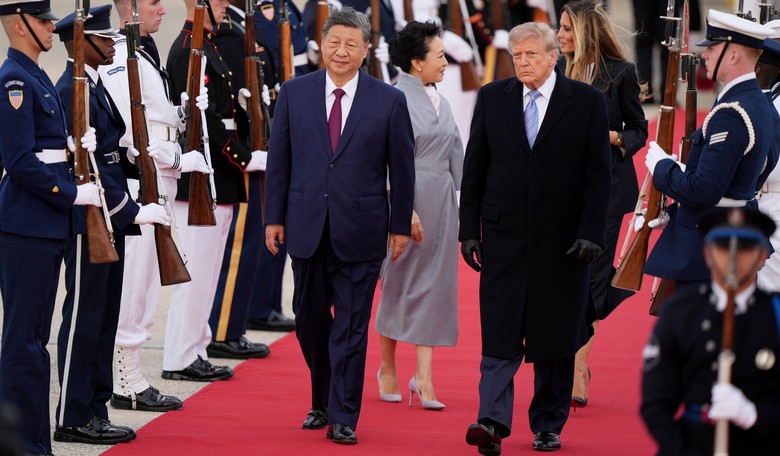
President Donald Trump recently wrapped up another summit with Chinese Premier Xi Jinping in Washington, and the details are still being discussed from the U.S. to Europe to Taiwan.
The summit was always going to be consequential, a major policy meeting between the leaders of the world's two most powerful countries. Yet the legacy media has been trying ever since to dismiss the meeting and Trump's efforts with China more broadly.
The New York Times criticized the summit for producing “few tangible policy announcements on some of the most pressing issues of modern times.” The Times continued, “At least in public President Trump seemed more focused on playing host than challenging his geopolitical rival.”
Once upon a time, not even in the distant past, leftists attacked Trump for being too tough on China; now they’re apparently mortified that he wasn’t aggressive enough.
It’s true that the state visit was largely ceremonial, but any lack of substance stems from the fact that the relationship between the United States and China has fundamentally changed. Blame Beijing’s long pattern of egregious behavior and Trump’s determination to finally hold them accountable.
Yes, there were few substantive accomplishments when Mr. Xi came to Washington. But that’s how it works with a communist geopolitical adversary.
The laundry list of Chinese offenses against this country runs long. For decades, China engaged in widespread intellectual property theft and corporate espionage against American companies to jump-start its economic growth. China massively subsidized its own multinationals and engaged in trade dumping in violation of WTO rules.
China has hacked hundreds of American companies and government departments, including a recent cyberattack that targeted the U.S. power grid. The FBI believes Chinese hackers could even threaten America’s nuclear weapons arsenal. More recently, China has supplied Iran with drone and missile parts to prolong its war against the United States.
At every turn, China has tried to hobble American economic development and national security, breaking international law and sometimes even endangering Americans. This, not Trump being polite about it, was why policy breakthroughs last week were such an uphill battle.
The last time Xi attended a U.S. state dinner was in 2015 when Barack Obama was president. At the dinner, Obama proposed a toast: “To the people of China and the people of the United States. May they work together, like fingers on the same hand, in friendship and in peace.”
Around that time, six of those same Chinese people were caught stealing trade secrets from U.S. companies. Obama did next to nothing about China’s ramped-up efforts to exploit its supposed “friend,” and America paid the price.
In fact, Trump did exactly what he should have done while Xi was in town. If the United States wants China to change its conduct, one way to achieve that is to build personal relationships while aggressively countering Chinese policies altogether.
This was Ronald Reagan’s approach to the Soviet Union, as he negotiated and schmoozed with Mikhail Gorbachev. It’s been Trump’s approach to North Korea, trying to talk down Kim Jong-un from his apocalyptic threats.
And it’s how Trump is handling Xi. When Trump fetes the Chinese premier, even referring to the U.S. and China as a G2, he’s trying to build a lasting relationship that will enable the U.S. to exercise both soft and hard power.
Yet the media treats him like a dimwit.
There’s one more thing worth noting about the Trump-Xi summit: the lack of Chinese CEOs in tow. When Xi visited Barack Obama’s White House in 2015, it was with an entourage of Chinese businessmen looking to tap markets in the United States. In 2026, those executives either skipped the visit or were relegated to the sidelines.
This is no coincidence. The Trump administration recognized long ago that Chinese companies are willing tools of Communist Party interests that damage America.
Trump has slapped export controls on many U.S. components to China while banning some Chinese corporations outright. He’s invested in American industry to counter Chinese economic power.
He’s approved mergers between American tech companies with the explicit goal of outcompeting globally scaled Chinese giants like Huawei. His Justice Department has even put Huawei executives on trial in New York City.
If Chinese companies weren’t in Washington last week, it’s because they recognize U.S. authorities have wised up to their game. That’s a sign of policy success, not failure.
It’s time to admit that America’s relationship with China has changed. The official summits may be less productive, but America is more competitive and secure as a result.
Haley Kennington is a conservative commentator who served as the Research Director and Story Editor for “2020:The Plot Against the President” and Research/Archive Editor for “What Is a Woman?" Follow her on X @LadyKennington.