
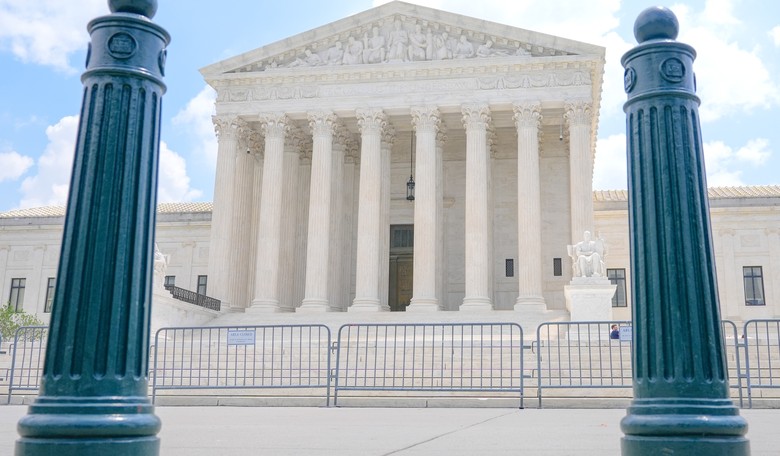
It finally comes down to this: An immigration case that could make or break President Donald Trump’s deportation policy.
If there were one achievement that the Trump presidency has accomplished so far that might satisfy the most jaded MAGA supporter, then it might be deportations.
While the hardcore base may have wanted millions of illegal aliens rounded up and shipped on trains out of the country posthaste, that was never going to happen.
Not in the United States, not with this activist media, and not with this judicial system.
So, it is with some trepidation in MAGA world that a case is heading to the Supreme Court that has a chance to turn whatever progress the Trump presidency has made upside down.
I know how the women will vote.
— Centinel_1787 (@1787Centinel) October 1, 2026
I am including Roberts as one of the five women on the Court.
so the judicial branch is now running this country?
— Nancy Moore (@NancyMoore1966) October 1, 2026
The Supreme Court is taking up a major immigration case that could determine whether the Trump administration can continue holding large numbers of illegal aliens without bond hearings while their deportation cases move through the courts.
President Donald Trump's administration had urged the high court to take up a different but related case that involves the broader constitutional implications of the new policy.
Attorneys from the Republican administration argue the circuits' split is "disrupting the orderly administration of immigration law." They say the nation's courts have been inundated with thousands of petitions filed by immigrants challenging the government's legal interpretation.
"The result is an unworkable patchwork of inconsistent immigration enforcement, where aliens present without admission are subject to mandatory detention in some circuits but are entitled to bond hearings and often released in others," lawyers for the administration wrote.
The justices agreed Thursday to hear the administration's appeal in the case involving Ricardo Aparecido Barbosa da Cunha, a Brazilian citizen who entered the United States illegally more than two decades ago. The Supreme Court's docket confirms that the petition was granted on Oct. 1.
Easily the most important SCOTUS case being taken up during the 2nd Trump Admin.
— America First Insight (@AF_Insight) October 1, 2026
This easily could double deportations, or halve them, depending on the outcome. https://t.co/YmabiyX8av
At stake is the administration's interpretation of a 1996 immigration law and, specifically, which illegal aliens are subject to mandatory detention.
The Trump administration adopted a policy in 2025 requiring illegal aliens to remain detained during removal proceedings without receiving the individualized bond hearings that had previously been available to many people arrested after living for years in the interior of the country.
That qualification could have enormous consequences for President Donald Trump's deportation agenda.
If the administration prevails, federal authorities could continue detaining a much broader group of illegal aliens while their removal cases proceed, rather than releasing some of them on bond and potentially having to locate and arrest them again if they ultimately receive removal orders.
If the Supreme Court rejects the administration's interpretation, many detainees could instead become eligible to ask immigration judges for release on bond while their cases remain pending.
Barbosa da Cunha's case illustrates exactly how the dispute developed. He entered the United States illegally around 2004 or 2005 and later applied for asylum in 2016. Immigration authorities arrested him in Massachusetts in September 2025 while he was driving to work. An immigration judge initially concluded that the government's new interpretation of federal law made his detention mandatory and therefore denied him a bond hearing.
A federal district court disagreed and ordered the government to provide Barbosa da Cunha with a bond hearing or release him. An immigration judge subsequently found that he wasn't a flight risk or danger to the community and released him on bond. The Second Circuit later upheld the lower court's interpretation of the statute.
The Trump administration then went to the Supreme Court.
Mandatory detention gives ICE one major practical advantage during lengthy removal proceedings: The government knows where the person is when the case closes.
Bond hearings create another possibility. An immigration judge can examine the individual case and potentially release the detainee after considering issues such as danger to the community and flight risk. If the immigrant later receives a final removal order, federal authorities may need to locate that person again to carry it out.
The central question is which detention provision applies to people such as Barbosa da Cunha, who entered illegally but then remained in the United States for years before being arrested.
The administration says the 1996 law requires their detention without bond. Barbosa da Cunha and his attorneys argue that Congress didn't impose that requirement on this category of long-term residents.
It could be argued that this case is only a matter of whether the United States is a sovereign nation of laws whose people decide who has the right to be in the country or not.
Now the Supreme Court will settle the dispute.
Editor's Note: This article was edited for clarity post-publication.