
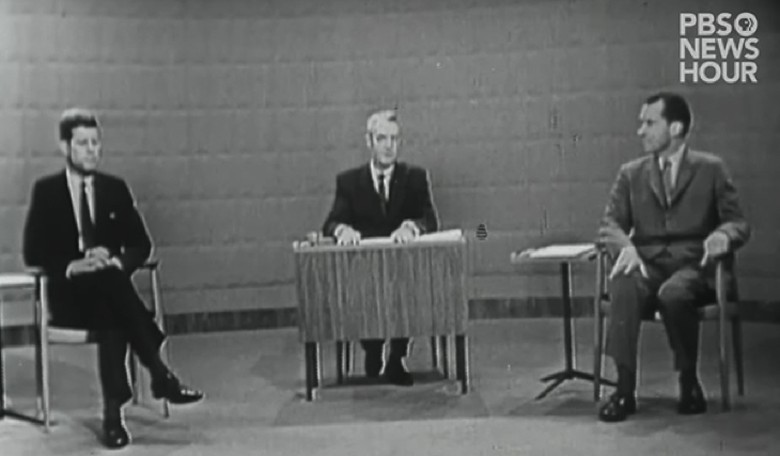
September 26, 1960, is an interesting date in American history. Sixty-six years ago, as of the date I write this, was the first televised presidential debate in the United States, wherein the Republican candidate, Vice President Richard Milhous Nixon, squared off against the Democrat, an upstart Senator from Massachusetts named John Fitzgerald Kennedy. Opinions about the debate, then and now, are varied, as are opinions about every presidential debate before and since, but since this was the first one where the candidates appeared on screen in American homes, things were a little different. Two years ago, the Conversation's W. Joseph Campbell examined this debate and compared it to the 2024 Trump/Biden debate, and their report is still worth reading.
The run-up to the Joe Biden-Donald Trump debate at the end of June 2024 has brought reminders about the first-ever televised presidential debate – and how Vice President Richard Nixon’s sweaty, haggard appearance that autumn night in 1960 opened a pathway to the White House for the tanned and telegenic Sen. John F. Kennedy.
That, at least, is conventional wisdom about the Kennedy-Nixon debate of Sept. 26, 1960: Image prevailed, rewarding Kennedy and punishing Nixon.
“Kennedy went on to narrowly win the election that most say he never would have had a shot at without that first debate,” Time magazine declared in 2016, in recounting the greatest missteps in political debates. “It seems Nixon’s fatal flub was in failing to recognize the power of the visual image.”
Or as Max Frankel, then the executive editor of The New York Times, wrote sardonically several months after Nixon’s death in 1994, “Nixon lost a TV debate, and the Presidency, to John F. Kennedy in 1960 because of a sweaty upper lip.”
That was generally accepted. I remember my parents, who watched the debate on a 14-inch black-and-white TV on a table in their farmhouse living room, describing it to me years later when I first started becoming interested in politics. The Old Man pointed out that Nixon was sweating, which made him appear nervous, and had a visible five o'clock shadow. My Mom noticed that he wasn't as polished a speaker or as handsome as the polished, urbane Kennedy. But my grandfather, who listened to the debate on the radio and thus didn't see either candidate, was convinced Nixon won handily.
Kennedy, of course, won the 1960 election handily, with 303 electoral votes to Nixon's 219. Campbell writes of the aftermath:
I examined scores of newspaper articles, editorials and commentaries written in the debate’s immediate aftermath in researching a chapter for “Getting It Wrong,” my 2017 book about media-driven myths. There was, I found, no unanimity among newspaper columnists and editorial writers about Nixon’s appearance. Not all of them thought Nixon’s performance was dreadful or that Kennedy was necessarily all that appealing.
The Washington Post, for example, declared in an editorial two days after the debate: “Of the two performances Mr. Nixon’s was probably the smoother. He is an accomplished debater with a professional polish, and he managed to convey a slightly patronizing air of a master instructing a pupil.”
The debate moderator, Howard K. Smith of ABC News, later was quoted as saying he thought “Nixon was marginally better” than Kennedy.
But you can't argue with success — or failure. The 1960 debate may not have been the utter disaster for the Democrat candidate that the 2024 Biden/Trump debate was, but Nixon lost, and that in itself says something.
Of course, the American public hadn't seen the last of Dick Nixon. He roared back in 1968, trouncing Democrat Hubert Humphry and American Independent George Wallace, 301 to 191 to 46, the last time a third party candidate won even one electoral vote in a presidential election. Then, in the 1972 election Nixon destroyed Democrat George McGovern in a 49-state landslide, 520 electoral votes to McGovern's 17, a feat only accomplished one other time, by President Reagan in 1984.
Then, of course, Watergate.
These days we take television and streaming for granted in any debate, presidential or otherwise. And, yes, it's certain that a candidate's appearance counts for a lot; in the 2024 Biden/Trump debate, Trump was energetic, focused, wielding his usual acerbic wit with abandon. Joe Biden, by contrast, looked decades older, and was clearly befuddled and disoriented. Not every presidential election can seriously tip the scales. It's not now, even after all these years, the 1960 election did that, but the fact that the appearance issue is still discussed says a lot. And the 2024 debate? That resulted in the Democrats wielding a big, Chuck Jones/Warner Bros. style shepherd's crook coming in from stage left (hah) and yanking Joe Biden off the stage, replacing him with the worst presidential candidate in American history: Kamala Harris.Who knows what the 2028 presidential contest will bring? But it's certain to bring yet another set of televised debates; but the first was 66 years ago, on September 26, 1960, and we're still talking about it. That in itself says a lot.