
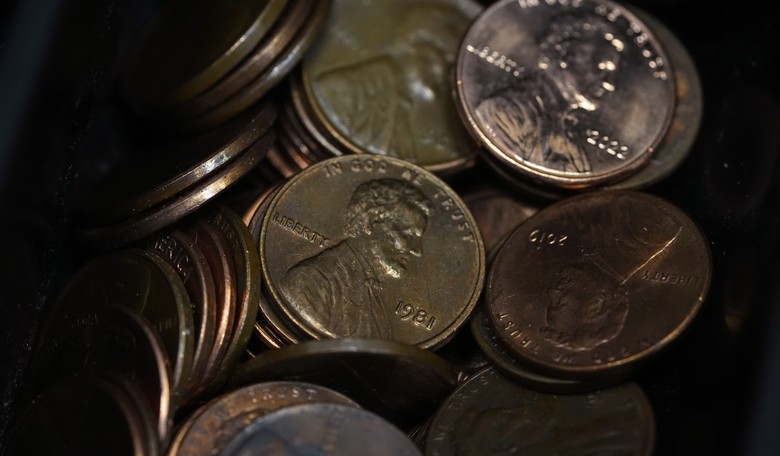
In May 2025, the United States Department of the Treasury announced that the U.S. Mint would discontinue the production of the penny, removing it as a part of U.S. currency. In December 2025, a mock funeral was held at the Lincoln Memorial for the 232-year-old coin. Men and women dressed up as Abraham Lincoln carried caskets, while mourners tossed pennies into it.
On Monday, Congress made the penny's demise a part of the legislative record, passing the Common Cents Act by unanimous vote. The Act codified the end of penny production and established a framework for how cash transactions would be handled going forward. The passage of the Act also prevents future presidencies from reversing this decision.
The House of Representatives voted to send the smallest piece of U.S. currency the way of the dodo on Monday, passing the bipartisan Common Cents Act in a unanimous vote.
In addition to blocking the Treasury from minting any more pennies save for collector coins, the bill would also set up a framework for cash transactions to be rounded to the nearest 5 cents, in order to eliminate the need for pennies altogether.
An exception would be provided for cash wages, which must be rounded upwards if the total is not divisible by 5 cents.
Existing pennies will still remain legal tender.
Saying, "A nickel for your thoughts," just doesn't have the same ring to it. Ultimately, the decision to nix the currency came down to fiscal and practical considerations. It cost 3.69-cents for each penny produced; definitely not penny-pinching by any means.
According to the U.S. Mint’s 2024 annual report, it cost 3.69 cents to make a single one-cent coin. This was largely due to the rising prices of the metals used in its production, primarily zinc and copper. When you consider that the Mint produced billions of pennies each year, the financial loss became significant. In fiscal year 2023 alone, taxpayers spent over $179 million on penny production.
Beyond the cost, our spending habits have changed. The rise of debit cards, credit cards, and digital payment apps means that fewer people are using cash for their daily purchases.
With the penny’s purchasing power diminished by inflation over the decades, it has become more of a nuisance than a useful coin for many. This combination of high production costs and low utility made its continuation impractical.
Not only have we lost a currency marker, but a cultural one. From the expressions mentioned above to several others, the use of the penny to express a larger concept will eventually disappear from common understanding and into obscurity. After all, you can't say someone turns up like a bad penny if one doesn't know what a penny, good or bad, looks like.
But that won't happen for quite some time, maybe for at least a generation, maybe two. According to the Treasury, there are roughly 114 billion pennies still in circulation. As pennies slowly move out of common usage, they will always be around as items for coin collections or historical nostalgia. They will also stand as a reminder of an era when a tiny copper coin embodied a wealth of meaning.