
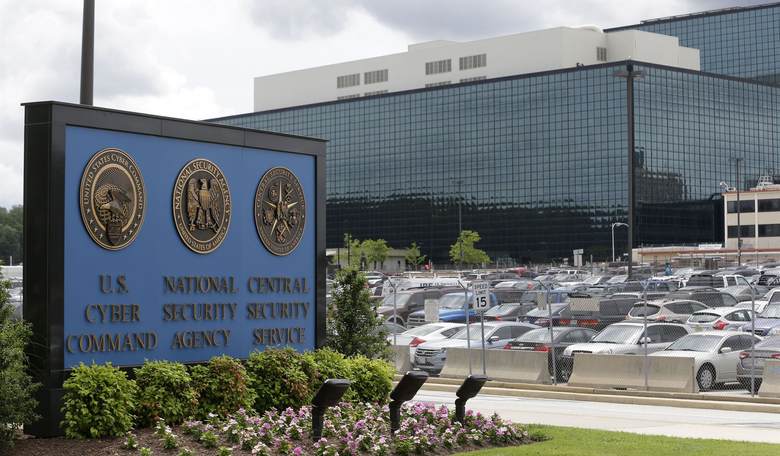
The National Security Agency was created in 1952 under President Harry Truman to replace the Armed Forces Security Agency in a bid to centralize U.S. communications intelligence.
In the decades following, it's undergone several reorganizations to deal with emerging challenges and new threats.
A new report Sunday said that the NSA, under the direction of Army Gen. Joshua M. Rudd, is about to get the biggest overhaul in at least a decade, and will put China and AI, among other issues, at the top of its priority list:
Rudd’s initiative calls for the creation at NSA’s Fort Meade, Maryland, headquarters of five new organizations inside the agency, in artificial intelligence, China, cybersecurity, combat support or warfighting, and global intelligence. Each will be led by a newly elevated “mission director,” according to former officials.
This new organizational configuration will better reflect NSA’s current and future priorities, Rudd believes, according to current and former officials. NSA, the U.S. intelligence community’s premier global eavesdropping arm, specializes in digital espionage.
China is increasingly seen as our main global threat as they’ve ramped up their espionage efforts to 11 and are regularly accused of aiding and abetting our enemies — like Iran. AI, meanwhile, is at the top of the headlines and President Trump’s to-do list because there’s been a growing backlash against data centers and the potential threats the technology poses to humanity.
Trump has argued that we can't afford to snooze and then lose on the AI revolution or China will dominate, and that poses a high risk for our security.
— Rapid Response 47 (@RapidResponse47) September 14, 2026
The NSA is by its very nature shrouded in secrecy, and most of its operations remain invisible to the public:
The NSA, generally believed to be the biggest and most-well-funded arm of the U.S. intelligence apparatus, focuses on the large-scale collection of signals intelligence, including communications and other electronic information. It also manages and secures U.S. encryption systems to prevent foreign actors from penetrating sensitive coded U.S. government communications and networks.
The new changes are described as “aggressive” and are expected to reach “full operating capacity” by mid-January 2027, according to the report. The mission directors may come from the outside, but final decisions have not been made yet.
Rudd is keenly focused on AI, and this restructuring is meant to highlight that:
Since becoming NSA director in March, Rudd has been focused on AI-related advancements, according to former officials. The NSA has rolled out a new desktop AI tool called “Ask Mary,” purportedly named for the head of the division leading the agency’s AI-related integration efforts. The agency has been keenly interested in working with commercial AI labs, even circumventing a Pentagon ban against Anthropic to employ the firm’s advanced Mythos model.
It’s the largest restructuring since 2016, when then-director Mike Rogers launched “NSA21,” which merged offensive and defensive operations. That effort was never fully implemented and caused frustration within the ranks.
We won’t know most of what goes on with this move, because the NSA is, by its nature, tight-lipped, but the restructuring highlights the mind-blowing speed with which AI has taken over the world and presented both opportunities and threats. The Chinese Communist Party, meanwhile, has effectively replaced Russia as our main geopolitical foe.
Fail to adapt, prepare to fall. That seems to be the message the higher-ups at the NSA are taking to heart.