
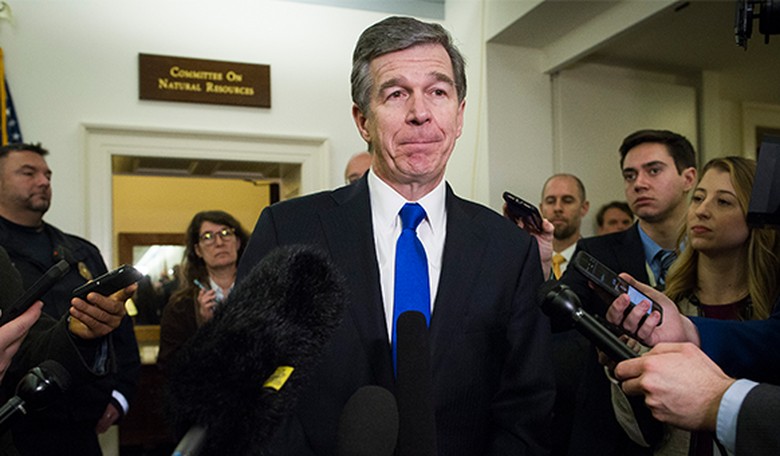
Roy Cooper spent three years telling North Carolinians that opposing ESG was dangerous politics. His own Senate financial disclosure reveals he spent millions participating in it anyway.
The former North Carolina governor reports that millions of dollars have been invested through Vanguard and Charles Schwab. The Crimson Hub calculated the total to be between $2.6 million and $5.9 million. Neither company is new to the ESG fight, and both have drawn years of pressure from conservatives over how environmental and social factors are used in investing.
Cooper filed the disclosure with the Senate on Aug. 13, 2026. No explicitly branded ESG fund appears on it. That's the narrowest possible defense. His Vanguard positions are still substantial. He reports between $500,001 and $1 million in the Vanguard Total Stock Market Index Fund, $250,001 to $500,000 in the Vanguard Total International Stock Index Fund, and another $250,001 to $500,000 jointly held in the Vanguard High Dividend Yield ETF.
Schwab shows up throughout the filing, too. Cooper lists $100,001 to $250,000 in the Schwab U.S. Dividend Equity ETF and another $100,001 to $250,000 in the Schwab U.S. Aggregate Bond ETF. His rollover IRA includes Schwab large-cap, small-cap, international equity, Treasury, corporate bond and mortgage-backed securities funds. The man who argued ESG restrictions threatened retirees' best interests was, at the same time, building a seven-figure portfolio with the two firms most associated with that movement.
Back in June 2023, Cooper vetoed a bill barring North Carolina agencies from using ESG standards to screen investments, contracts, or employment decisions. For pension investments, the measure directed the state treasurer to consider factors expected to materially affect financial risk or return.
Cooper objected:
“For political reasons only, it unnecessarily limits the Treasurer’s ability to make decisions based on the best interest of state retirees and the fiscal health of the retirement fund.”
Republicans overrode him. Then-State Treasurer Dale Folwell backed House Bill 750 and had a different description for the ESG push.
"The best interests of North Carolina taxpayers and retirees will be served through legislative passage of House Bill 750, which requires investment decisions to be made on the basis of the highest financial returns, not social and political 'wacktivism,'" Folwell said. "We are grateful to those lawmakers who understand the need to shield the state pension plan against the movement to weaponize public retirement systems to achieve extreme agendas."
Three years later, Cooper is running for North Carolina's open U.S. Senate seat.
The Crimson Hub also put three of Cooper’s Vanguard holdings, VYM, VTIAX and VTSAX, up against Invesco’s QQQ. QQQ came out ahead in each comparison shown in the report.
Cooper has plenty of campaign money for the race ahead. Federal Election Commission records show Cooper for North Carolina reported nearly $35 million in receipts and about $20.7 million cash on hand through June 30.
The 2023 veto never disappeared. Cooper’s disclosure just gave his opponents the receipt.