
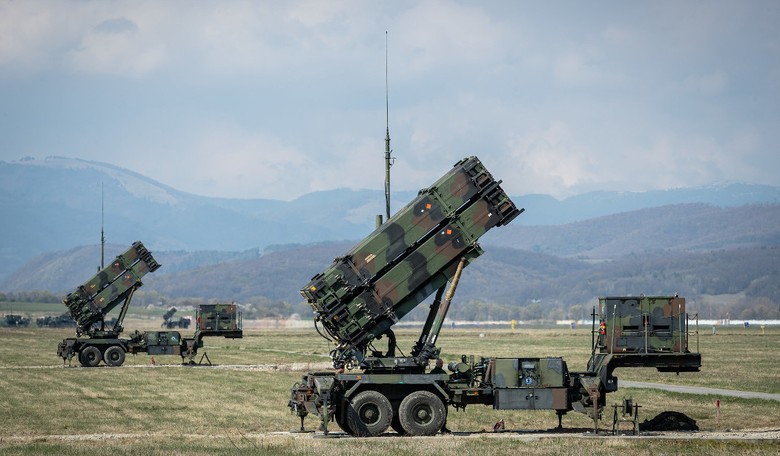
The Department of War (DoW) is now penning deals to rebuild our weapons stocks. In one such move, the Department of War has announced it has struck deals with Lockheed-Martin and General Dynamics to ramp up production of two key air-defense weapons: The THAAD missile interceptor and the PAC-3 Missile Segment Enhancement (MSE).
The DoW announced the deals in a press release issued Monday.
The Department of War (DoW) announced the signing of two pivotal framework agreements with General Dynamics Ordnance and Tactical Systems (GD-OTS) and Lockheed Martin. These agreements initiate seven-year multiyear procurement (MYP) contracts designed to increase production quantities and accelerate delivery schedules for critical missile subcomponents supporting the Terminal High Altitude Area Defense (THAAD) and Patriot Advanced Capability-3 Missile Segment Enhancement (PAC-3 MSE) interceptor programs.
The ramp-up is, according to DoW, being fast-tracked.
"Today's announcement represents an example of the evolution of how we partner with industry to expand the Arsenal of Freedom, outpace emerging threats, and ensure the Warfighter never faces a fair fight," said Under Secretary of War for Acquisition and Sustainment Michael P. Duffey. "General Dynamics and Lockheed Martin have answered the call. We are cutting red tape, shortening timelines, and rapidly scaling our domestic manufacturing capacity to deliver the advanced air and missile defense capabilities."
There are reports that the Army's inventory of these critical air-defense weapons has been drawn down in the ongoing conflict with Iran; estimates (unconfirmed) are as high as 80 percent of the stockpile of these systems has been expended, mostly intercepting Iranian ballistic missiles. This fast-tracking of replenishment would seem to provide some verification that the Department of War is at least somewhat concerned about inventories.
Iran, also, is nothing like a near-peer conflict. It was more of a walkover, and now the United States' strategy is shifting from military to economic pressure on the Islamic Republic. But were we to be involved in a near-peer conflict with a major power (China), we would probably be burning through these missile interceptors at a prodigious rate. Best to have those assembly lines up and running. Drones may be the next big thing in military technology, but ballistic missiles are still an ever-present threat, as this dust-up with Iran as well as the seemingly never-ending Russo-Ukrainian War have shown us.
There's a catch in this latest deal:
The funding for these transformative agreements is subject to annual appropriations. These agreements provide industry with a stable, long-term demand signal by guaranteeing minimum annual procurement quantities which empowers General Dynamics and its lower-tier suppliers to make generational investments in workforce expansion, bulk material purchases, and facility upgrades.
Subject to annual appropriations means Congress has to sign the checks. And the current Congress is only in place for the next few months; much depends on the November elections to see what sort of Congress we will have in January of 2027, and how friendly they will be towards weapons acquisition expenditures. And, if you need another good reason to get out and vote in November, well, we are probably into scientific notation by now on the number of reasons we have motivating us.
You can see specifics on the PAC-3 MSE and the THAAD system at the links.