
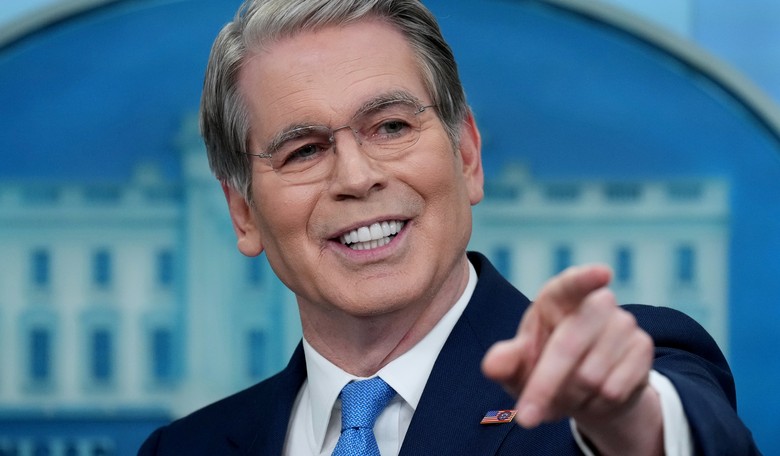
The economic pincers around Iran are growing tighter and tighter by the day. Treasury Secretary Scott Bessent, who is probably the best SECTREAS since Alexander Hamilton, and Secretary of State Marco Rubio, probably the best SECSTATE since Cordell Hull, are spearheading what is being called Operation Economic Outcast, and it may very well be doing more damage to the Iranian regime than any amount of missiles and bombs.
On Friday, the State Department issued a press release detailing some new actions against bankers and brokers behind Iran's "Shadow Fleet" of oil-smuggling ships.
Operation Economic Outcast continues in full force. Today, the United States is imposing sanctions on the manager of the Dubai branch of Iran’s Bank Melli, Reza Mohammad Taeedi. Bank Melli has served as a critical financial hub for Iran’s armed forces, including the Islamic Revolutionary Guard Corps-Qods Force and the Ministry of Defense and Armed Forces Logistics, both U.S.-sanctioned entities. We are also sanctioning a Hong Kong-based company that has helped designated Iranian individuals and entities to access the international financial system. In addition, the U.S. Department of the Treasury’s Financial Crimes Enforcement Network (FinCEN) proposed a rule that would revoke Banque Misr UAE’s correspondent banking access to U.S. financial institutions. Treasury assesses that Banque Misr UAE is a critical node for the Iranian regime’s access to U.S. dollars.
Action has already been taken; the Department of the Treasury, Financial Crimes Enforcement Network (FinCEN), has already issued a proposed rule designating Banque Misr UAE as a "primary money laundering concern."
FinCEN is issuing a notice of proposed rulemaking, pursuant to section 311 of the USA PATRIOT Act, that finds the five United Arab Emirates-based branches of Banque Misr (collectively, Banque Misr UAE) to be of primary money laundering concern and proposes imposing a special measure to: (1) prohibit U.S. financial institutions from opening or maintaining a correspondent account for, or on behalf of, Banque Misr UAE; (2) require U.S. financial institutions to take reasonable steps not to process a transaction for the correspondent account in the United States of a foreign banking institution if such a transaction involves Banque Misr UAE; and (3) require U.S. financial institutions to apply special due diligence to their foreign correspondent accounts that are reasonably designed to guard against their use to process transactions involving Banque Misr UAE.
These are front companies, working with the Iranian regime, specifically with the Iranian Ministry of Defense and the Islamic Revolutionary Guard Corps, to pass as much as $1.8 billion to over a hundred companies that comprise Iran's shadow-banking network. No more midnight deliveries of pallets of cash to Iran. Now, the cash is being pulled away, the carpet yanked out from under their feet, and Banque Misr is being booted from the international financial networks.
The message, should the proposed rule be adopted, is simple: No American financial institutions may do any business with Banque Misr UAE, and they have to take steps to prevent any overseas affiliate from doing so. Treasury warned of this at the outset; now, it's happening.
Also sanctioned were one individual, Reza Mohammad Taeedi, the manager of Bank Melli's Debai branch, and a Hong Kong front company called Kameng Trading Limited.
Hong Kong-based Kameng Trading Limited has aided sanctioned Iranian persons in accessing the international financial system. Sanctioned Iranian exchange house Pedram Pirouzan Exchange House, also known as Opal Exchange, has used Kameng Trading Limited to launder money for Iran. Pedram Pirouzan Exchange House was designated pursuant to E.O. 13902 for operating in the financial sector of the Iranian economy.
Reza Mohammad Taeedi is being designated pursuant to E.O. 13224, as amended, a counterterrorism authority, for having acted or purported to act for or on behalf of, directly or indirectly, Bank Melli. OFAC is designating Kameng Trading Limited pursuant to E.O. 13902 for operating in the financial sector of the Iranian economy.
On Friday, Secretary Bessent made a pithy statement on all this:
Treasury promised to sever every economic lifeline Tehran has left and finally end the threat of the Iranian regime. We also warned that Iran’s enablers cannot continue to enjoy access to the U.S. dollar and the global financial system. Banque Misr UAE decided to find out the hard way, and today, we are taking the first step in holding it accountable for its continued, egregious support of the Iranian regime.
Consider the implications of all this.
Aside from the financial market aspect, with the message being "no matter where you hide your money-laundering operations, we will find them," there's also the fact that these actions hit directly at the heart of what's left of Iran's economy. The United States is going after the ships that carry Iran's oil, but they are also now going after the banking and financial institutions that launder and transfer the illegitimate increment that Iran realized from the sale of their oil. We are going after their oil sales and financial structures from top to bottom, and Iran's currency, already in free fall, is taking an even bigger hit.
As someone once said, this is a big freaking deal.
I'll offer one prediction and one evaluation: This isn't the last such action we'll see against Iran's shadow finance systems. There will be more, and it is happening now in a manner that we can only describe as fast and furious. As for the evaluation: Secretary of the Treasury Scott Bessent, out of all of President Trump's Cabinet choices in his second term, is certainly in the top three.