
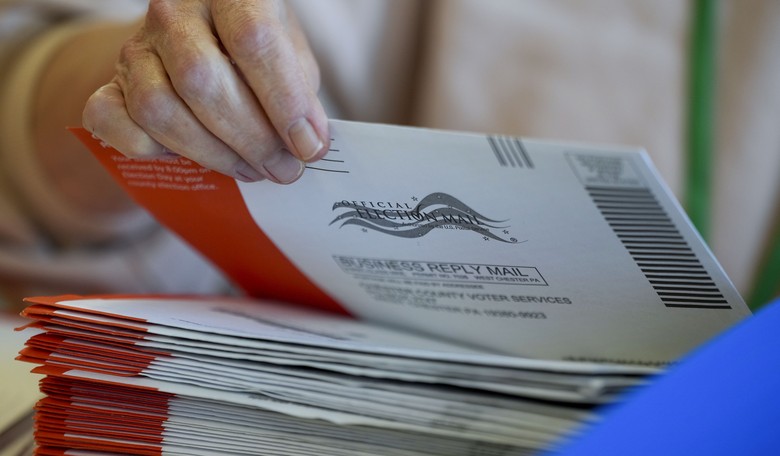
President Trump's election-integrity agenda scored another significant court victory Wednesday when U.S. District Judge Indira Talwani vacated her nationwide injunction blocking the U.S. Postal Service (USPS) from implementing new mail-ballot rules for the November midterms.
The move comes just two days after SCOTUS stayed a separate Talwani injunction involving the same executive order. And this time, Talwani makes clear she isn't voluntarily reconsidering her view of the underlying dispute — rather, she states she is “compelled by the Supreme Court's ruling” to lift the injunction.
Now, before I go further, I'll acknowledge up front that there are multiple twists and turns and legal nuances and whatnot with these related cases. But I'm not going to bog us down in the weeds with that — here's the bottom line:
The two Massachusetts injunctions (both issued by Talwani) that had prevented the USPS from moving forward with the new mail-ballot rule for the 2026 election are no longer operative. SCOTUS stayed the California v. Trump injunction Monday (the case involving plaintiff states); Talwani has now vacated the separate League of Women Voters v. Trump injunction.
The USPS finalized its rule Friday and published it in the Federal Register Wednesday. The rule itself said USPS wouldn't implement it for 2026 until the government obtained relief from those two injunctions.
Now it has.
Thus, barring some other legal machinations restraint, the USPS can move forward with implementation while litigation continues.
ALSO SEE: A Major New Mail-In Voting Rule Is Ready to Go — but There's One Big Problem
Just as a quick reminder of how we got to this point, Trump's executive order directed the USPS to develop new rules governing mail ballots in federal elections. Judge Talwani's Aug. 11 injunction went beyond prohibiting enforcement: it barred USPS from even completing the rulemaking process. Nevertheless, the USPS persisted, finalizing the rule Friday.
On Tuesday, Talwani ruled that doing so violated her injunction — but (importantly), she imposed no additional remedy. Meanwhile, the Supreme Court's Monday decision had fundamentally changed the legal landscape and essentially forced her hand.
In that decision (in Trump v. California), SCOTUS concluded that the states' challenge ran into standing/ripeness problems because, when they sued, too much depended upon speculative future events — including whether the USPS would ultimately issue a final rule.
Now, the League of Women Voters plaintiffs in this suit aren't identical to the states and allege a different injury: disruption and confusion for voters caused by election changes shortly before the midterms. And Talwani's ruling emphasizes that SCOTUS hasn't actually decided whether that injury is sufficient for standing. Even so, she concludes that SCOTUS would likely apply the same ripeness reasoning here “despite the different injury.”
In other words, the SCOTUS decision amounts to an intervening change in law requiring her to dissolve the injunction.
It's clear that Judge Talwani isn't enthralled with this turn of events. She says plaintiffs have “substantial arguments that might persuade the Supreme Court to reach a different result” if given the opportunity to present them. And she notes that SCOTUS apparently didn't account for the fact that USPS had already finalized its rule Friday. (Timing is everything.) She also pointedly observes that the administration pursued an emergency stay rather than expedited merits review in the 1st Circuit, “where they could avoid review of the merits.”
It's also important to note that the fat lady hasn't sung on this. There is now a final USPS rule, and the plaintiffs have already obtained permission to amend their complaint to account for it. With Wednesday's ruling, Talwani expressly vacates the injunction without prejudice to their seeking another preliminary injunction after filing that amended complaint.
So the administration has won the current round, and the USPS is presently freed from this injunction, but another request to block the finalized rule could be coming almost immediately.
What that means is that, for now, the legal roadblocks to implementing the new USPS mail-ballot rules for November have been removed. But with the rule now final, the plaintiffs are already repositioning their challenge — meaning the next round of this election fight may not be far behind. So do stay tuned.