
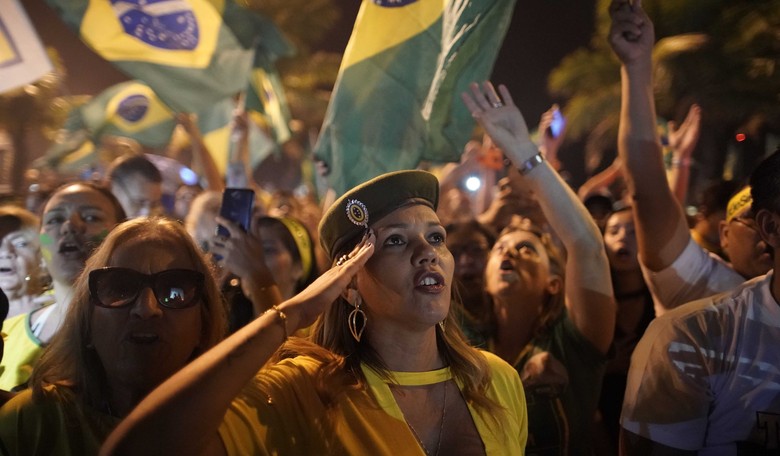
The Washington Post is jumping into a politically fraught election in Brazil with a bold announcement: “Right-wing” presidential challenger Flavio Bolsonaro has “effectively conceded.”
WaPo is hanging this remarkable announcement, at odds with nearly all other reporting, and the accounts of people in Brazil, on one vague line from Bolsonaro.
In a remarkable piece of political spin dressed up as straight news, the Post claimed Monday that Bolsonaro had "effectively conceded" defeat to leftist incumbent Luiz Inácio Lula da Silva.
There's just one rather problem. Bolsonaro did no such thing.
The Post's article, written by Michael Birnbaum and Marina Dias, opened with this assertion:
"Brazil's leading right-wing politician, Flávio Bolsonaro, effectively conceded defeat to the incumbent left-wing president Monday, minutes after President Donald Trump indicated he would not intervene on his behalf despite saying that Sunday's vote 'looked like another rigged election.'"
Notice what's going on. The Post is presenting Bolsonaro's supposed surrender as a political consequence of President Trump's refusal to intervene.
It's a neat little narrative. Trump abandons an ally, Bolsonaro folds, and Lula emerges victorious. Too bad the facts don't fit the narrative.
Near the bottom of the story, the left-wing activist Washington Post gives the game away:
Sunday’s election was a blow to White House efforts to install a string of right-wing leaders sympathetic to Trump across Latin America. They have been successful over the last year and a half, but Brazil is by far the most populous country in the region, and Lula has been a vocal opponent of Trump’s agenda.
Bolsonaro initially refused to recognize the results of Sunday's election, which officially gave Lula 51.8 percent of the vote to his 48.2 percent.
The conservative candidate questioned a last-minute decision by Supreme Court Justice Cristiano Zanin, Lula's former personal attorney, to extend voting hours at certain polling places.
"It is impossible to recognize the election results," Bolsonaro declared, according to Agência Brasil.
He initially threatened to seek annulment of the election over the extension.
But after consulting with attorneys and political allies Monday, Bolsonaro decided against pursuing that particular legal challenge.
And this is apparently where the Washington Post decided to declare victory for him. Except Bolsonaro wasn't done. Not remotely.
In a video statement released Monday, he declared: "I wasn't the one who lost; the system won."
That is the quotation the Post prominently featured in its coverage. But here's what Bolsonaro said in the same statement:
"So I will indeed request the disqualification of Lula's ticket for all the abuses he committed."
"The law must apply to everyone. The competition must be fair and equal, which did not happen," he added, according to UOL.
The candidate whom the Washington Post claims has "effectively conceded" is announcing plans to pursue a legal remedy that could disqualify the winner's presidential ticket.
In Brazil, that process is known as cassação da chapa. It is an electoral challenge alleging violations such as abuse of political or economic power.
If successful, it can invalidate the winning ticket.
In what universe does seeking to invalidate your opponent's victory amount to conceding defeat?
Brazilian journalists certainly didn't see it that way. Jornal Razão reported the same statement under a headline that translated roughly as:
"'It wasn't me who lost, it was the system that won,' says Flávio Bolsonaro and calls for Lula's disqualification."
Notice the difference. The Brazilian outlet reported what Bolsonaro actually announced. The Washington Post imposed its own interpretation on the announcement and promoted that interpretation as the news.
Now, there is a genuine distinction worth making here. Bolsonaro backed away from his initial demand to annul the vote over the extension of polling hours. He has also not established that the extension affected the outcome, which Lula won by roughly 4.4 million votes.
But changing the legal grounds for challenging an election is not the same thing as recognizing the winner's legitimacy.
And the Post knew about the new legal challenge. It mentioned the planned lawsuit in its own article.
That makes the misleading framing particularly difficult to excuse. The problem wasn't that the reporters lacked the relevant information. It was right there in their story.
Then there's the attempt to tie Bolsonaro's supposed concession to President Trump.
The Post emphasized that the development occurred minutes after Trump expressed skepticism about the election results without pledging intervention.
"It looked like another rigged election, frankly," Trump told reporters.
But the available Brazilian reporting points to Bolsonaro's consultations with attorneys and political allies as the explanation for his changed strategy.
The Post's timeline may be accurate. Its implied cause-and-effect relationship is another matter. And readers aren't obligated to mistake insinuation for evidence.
Even Brazilians were calling out the coverage. When the Washington Post promoted the article on X, one respondent wrote: "Fake news! Eu sou brasileiro e posso dizer que isso é mentira!"
@washingtonpost Fake news! Eu sou brasileiro e posso dizer que isso é mentira!
— Wesley 🥺🇧🇷🇮🇱🇺🇦 (@NinhoEngland_) October 26, 2026
Translation: "Fake news! I'm Brazilian and I can say this is a lie!"
That's not a scientific survey of Brazilian opinion. But the instant objection gets straight to the point.
Bolsonaro has not publicly conceded. He has not congratulated Lula. He has not withdrawn his objections to the election. And he is still pursuing a legal challenge that could overturn the winning ticket.
Whether Bolsonaro's legal challenge succeeds is another question. Lula may be the officially declared “winner” but that doesn’t mean the election is “over” yet.
This is starting to feel a lot like the international version of the 2020 election.
And in order for an election’s results to be legitimate, it has to be free, fair, and secure.
In the case of Brazil, it looks like we’re a long way from establishing that was the case.