






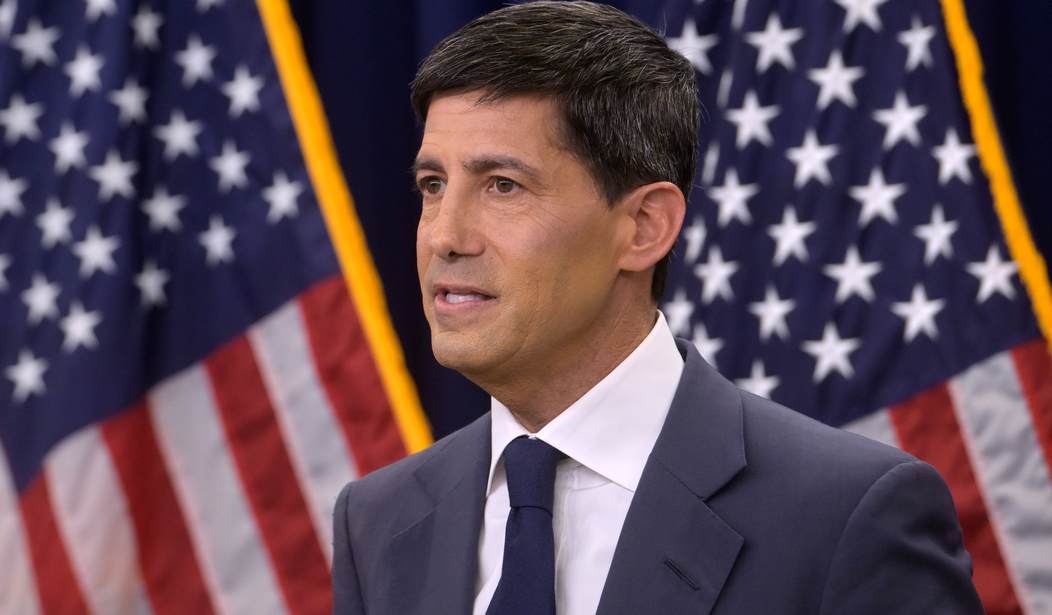
Kevin Warsh is now the Chairman of the Federal Reserve after he was sworn in by President Trump in late May. He replaces Jerome Powell, who Trump had grown frustrated with for massive cost overruns on a renovation project and for refusing to lower interest rates as quickly as the president would have liked.
On Wednesday, however, the Board issued its first major decision under Warsh, and they are leaving key interest rates unchanged as concerns over inflation and the uncertainty in the Middle East continue to make them cautious.
Fed policymakers voted 12-0 to leave the benchmark federal funds rate unchanged at its current range of 3.5% to 3.75%. The move follows the central bank's decision to hold rates steady in January, March and April following three successive 25-basis-point rate cuts in September, October and December to close out last year.
The Federal Open Market Committee (FOMC), the central bank's panel responsible for monetary policy moves, noted in its statement that inflation remains elevated above the central bank's 2% goal, which it said was "in part reflecting supply shocks that have driven price increases in certain sectors, including energy."
Warsh said inflation, though better than it was under Joe “9.1” Biden, is still a pesky enemy:
"We recognize that inflation has been running well ahead of the Fed's long-stated inflation goal of 2%. That's been going on for more than five years. Persistently high prices are a burden for the American people, but the recent past need not be prologue," Warsh said.
"I am pleased to report that members of the FOMC are unambiguous and unanimous – this committee will deliver price stability," he added.
Federal Reserve Chair Kevin Warsh: "The Committee decided to maintain the target range for the Fed Funds Rate at 3.5 to 3.75% in support of the Fed's dual mandate." pic.twitter.com/vNyAgxYUBT
— CSPAN (@cspan) June 17, 2026
MORE: Trump Welcomes New Fed Chair Warsh During White House Swearing-in Ceremony
It's Official: We Have a New Fed Chair As Jerome Powell's Long Farewell Finally Comes to an End
Based on Trump’s past statements, we can assume he would have preferred a rate cut, but he said while on the way to a post-G7 summit dinner in France that he still had faith in his pick:
.@POTUS on the Fed's decision to leave rates unchanged: "It's alright... We have a very good guy over there now, so I'm guided by what he wants to do." pic.twitter.com/CBVmGNeNUY
— Rapid Response 47 (@RapidResponse47) June 17, 2026
Despite his support for Warsh, the president also said a high rate "keeps the country down."
Some Board members even predicted a rate hike by year’s end:
Rates could even go up by year end, according to According to the latest “dot plot,” which tracks what policymakers think will happen to borrowing costs over the coming years, roughly half of the officials forecast one or more quarter-point increases from the Fed by year-end. Three people penciled in just one increase, while five thought the Fed would need to raise rates by half a percentage point. One person thought the Fed would need to raise rates by three-quarters of a percentage point.
Eight officials were of the view that rates could remain unchanged by year-end, and only one person penciled in a quarter-point cut.
Warsh also announced that he planned to create five independent task forces to review monetary policy operations, communications, data sources, productivity, and the labor market. Meanwhile, he also wants to further investigate the root causes of inflation and hopes to have updates by the end of the year.
Federal Reserve Chairman Kevin Warsh announces a new task force with five distinct focuses:
— Yahoo Finance (@YahooFinance) June 17, 2026
-Fed communications
-Fed balance sheet
-Use and reliance on existing data sources
-Productivity and jobs
-Fed inflation frameworks pic.twitter.com/Ry4f7FyCne
If the Iran deal pans out, oil prices could drop and inflation could cool, so we might be looking at an entirely different picture in the coming months. Those who are looking to finance a mortgage or a new car, or even use a credit card, would certainly like to see rates come down.
Editor’s Note: Thanks to President Trump’s leadership and bold policies, America’s economy is back on track.
Help us continue to report on the president’s economic successes and combat the lies of the Democrats. Join RedState VIP and use promo code FIGHT to receive 60% off your membership.
Join the Conversation
VIP members get the ability to comment on articles.