
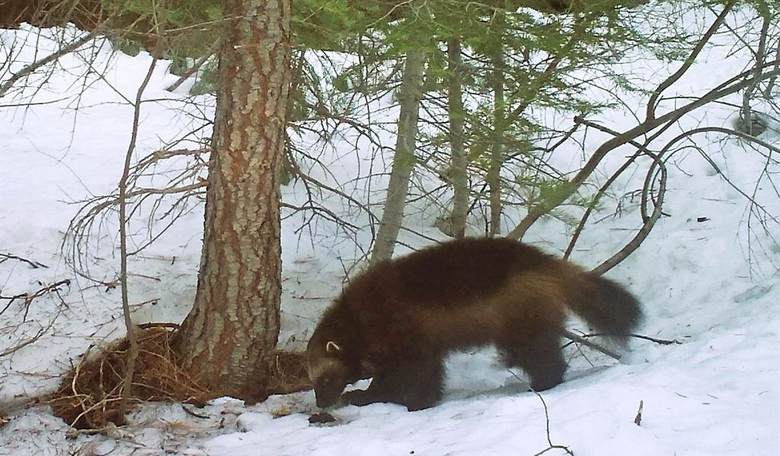
Wolverines (Gulo gulo) are formidable creatures. They are one of the largest of the mustelids, an order of mammals that also includes martens, weasels, skunks and otters. They are tenacious, fearless, and resourceful. They are also reclusive, avoiding people, and they are thin on the ground, maintaining large territories and low population densities. In all of Wyoming, there are an estimated 15 wolverines.
Now, in response to a bill passed by the Colorado legislature and signed by Gov. Jared Polis, the Centennial State wants some of those Wyoming wolverines, to bring them into Colorado. Note that this isn't an initiative coming from the various wildlife experts that Colorado has employed to manage things like this; it's a vote by the (liberal) state legislature.
That's not really how wildlife management should work. The reintroduction is, at least, dependent on a final ruling by the U.S. Fish and Wildlife Service, so there are at least some people who actually know what they are doing looking at this idea.
Colorado might finally be ready to start reintroducing wolverines, and Wyoming is near the top of the list of places that could supply the fierce predator-scavenger.
Pending a final ruling from the U.S. Fish and Wildlife Service, Colorado might start reintroducing wolverines next year. The program was initiated by a bill passed by the Colorado Legislature and signed by Gov. Jared Polis in May 2024.
If Colorado asks Wyoming for wolverines, there would be few to spare. Although it’s not entirely clear how many wolverines live in Wyoming, the most recent official estimates put the state’s population around 15.
FWS lists wolverines in the Lower 48 as threatened under the Endangered Species Act. Wyoming classifies them as protected animals, and intentional hunting or trapping is prohibited.
Colorado’s reintroduction program will rest on FWS classifying wolverines there as an experimental nonessential population under the Endangered Species Act's 10(j) rule. Colorado reintroduced wolves under the same classification.
The wolf reintroduction, mind you, was done after a ballot initiative, in which urbanites from the Denver-Boulder Axis voted to reintroduce big apex predators into parts of Colorado that are home to many of that state's largest cattle ranches. At least the wolverine initiative went through the state legislature, members of which, of course, are still dominated by the votes of the urban Denver-Boulder Axis.
We're forced to ask once again what Colorado hopes to gain from this? If there's a niche for wolverines in the remote high places in the Colorado Rockies, then in time those animals will move in; one has already been found in the Rocky Mountain National Park in Colorado's northern Rockies. There's no need for the taxpayers to receive a soaking to bring back a very few animals that the vast majority of the state will never see any sign of.
Granted, wolverines are less likely than wolves to prey on livestock. They will scavenge wolf kills, although cautiously; gray wolves are the only animal known to kill wolverines. It's unusual but it happens, and now Colorado proposes to raid Wyoming's few wolverines to drop them into areas they are not familiar with, areas that may well have populations of the only animals known to kill wolverines, animals which were already brought into Colorado at the behest of urban liberals who know nothing of the ecosystems they are messing with.
This whole thing is going to get out of hand. The U.S. Fish and Wildlife Service should veto this whole ill-advised scheme.
Unrelated, but no story of wolverines is complete without this.