
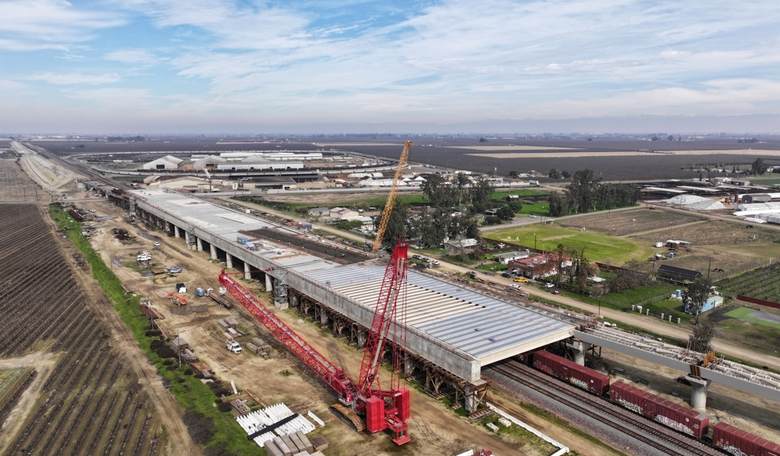
California's high speed rail project has been a litany of disasters. The groundbreaking for this boondoggle was in 2015, and in the 11 years since, not one passenger has been moved one inch. But the people in charge of the project have been living high on the hog, as we have documented, via various expense report shenanigans, among other things.
In the latest, the CEO of the California high speed rail authority has resigned in the face of the rising scandals.
The CEO of California’s high-speed rail authority resigned late Wednesday, saying he needs to focus on “important personal and family priorities,” according to a copy of the emailed resignation obtained by CalMatters.
“This has not been an easy decision, as leading the Authority has been one of the most meaningful and rewarding chapters of my professional life,” wrote Chief Executive Ian Choudri.
The abrupt announcement comes in the midst of a two-day meeting of the board that oversees the project, which continues Thursday. It follows Choudri’s tumultuous two-year tenure, which has been troubled by budget woes, project delays, transparency concerns and various scandals including the misuse of nearly $600,000 in taxpayer money for questionable trips by rail authority consultants.
We covered the misuse of taxpayer money scandal recently right here at RedState.
CBS News Investigative Correspondent Julie Watts, who has done sterling work documenting this scandal, appeared at the board meeting of the high speed rail authority on Wednesday, intending to ask some pointed questions, only to find the CEO absent.
BREAKING: High-Speed Rail CEO Ian Choudri will not be presenting his own CEO report at today’s board meeting (he’s not here). The board is set to finally approve the train contract delayed under Choudri… Details in 🧵👇 https://t.co/YoEIwN7Pap
— Julie Watts (@juliewattsTV) October 28, 2026
She addressed the board nevertheless:
High-Speed Rail has stopped responding to our requests for comment, so we brought our questions to the Board today. pic.twitter.com/zlgdO8qpau
— Julie Watts (@juliewattsTV) October 28, 2026
She asks:
High speed rail has not been responding to our repeated requests for responses, for answers to questions, and they've not required the public records that we've requested. So, we'd like to raise a couple of issues here, and hope that the board would address them publicly, since we've been trying to get answers for our viewers. On the last meeting, you talked about changes to contracts, and then in contracts moving forward, but can you address what you're doing about existing contracts signed over the last two years? Specifically, consulting contracts. Back in January, the IG flagged a lucrative contract for the CEO's former employer, that legal counsel did not approve of, and sources both currently and formerly from high speed rail have asked me to ask you, will you consider giving chief legal counsel the authority to review all existing contracts signed over the last two years? For fraud, waste, and abuse, and favoritism. And, allow counsel to independently request clawback or cancellations of those contracts.
Taxpayers, you know, are paying a quarter of a billon dollars over just two years to support consultants alone, who are not laying track or building trains, but who are under investigation for wasteful and unallowable spending. I would love if you could please ask the executives in the room today if they knew that these consultants billed taxpayers for late night rides home from the CEO's house, and nearby restaurants. And if they were billing their nearly $600 per hour rates, while at these steak dinners or cigar lounges. Were taxpayers footing that bill? Our recent investigation that that Chair (Steve) Kawa you commented on, found high speed rail paying those things, consultants, through a contract, that's billing taxpayers up to 10 times the rate allowed in a winning bid, and contract. We're talking $2 billion, potentially $2 billion over four months. KP&G has already billed nearly half of it's four-year budget in just one year.
And so, Chair Kawa, you did ask for an independent IG investigation. But, at the rate that this money is being spent, we're asking you to address, is there something you can do to stop potentially unallowable spending, and I would just ask, can you please ask high speed rail to provide the records we requested immediately? Or at the very least, upload all the contracts? Including the train contract you're all going to approve today, so the public can see what we are spending our money on? And, I would ask, does the board take any responsibility, in, or, is there anything you would do different, moving forward, in terms of oversight? Thank you so much.
Later in the X thread, Julie Watts noted that the board did not answer directly, but that she expected an answer after the meeting.
In most places, this disaster would have been shut down long ago. The federal government, which initially was on the hook to help fund this monstrosity, has, under the Trump administration, yanked funding, but California apparently seems to be all too willing to throw good money after bad.
Under Choudri, the authority also lost $4 billion in federal funding under President Donald Trump’s administration, after the agency repeatedly missed deadlines required by the funding agreement to buy trains. The state initially sued Trump for the funding but abruptly dropped the lawsuit in December 2025, blaming Trump as “not a reliable partner” and turning to private investors instead.
Choudri did not respond to an email or text from CalMatters requesting comment Wednesday night. It is unclear when his last day will be.
Private investors would be well advised to stay away from this. When a state is suffering this kind of utter failure and these dramatic displays of incompetence, to the point where even the setup and construction of a similar high speed train in Morocco, of all places, is making California look like chumps, perhaps it's time for the state to cut its losses.
But here's the thing: This train wasn't meant to be a practical solution. It was meant to be a political solution. Democrat politicians all too often look at the modern passenger rail services in places like Japan with envy, but Japan is a country the size of California with a heavily urbanized population of 122 million people, as opposed to California's 39.5 million. What works in Japan won't work in California, let alone many of the other states.
But the Left loves them some mass transit, even if it soaks the taxpayers for billions, even if they can't even be bothered to ensure the safety of passengers.
One bureaucrat, out of many, has at least woken up to reality — and may well find himself facing the music. That, in the sane world, is what we call "a good start."