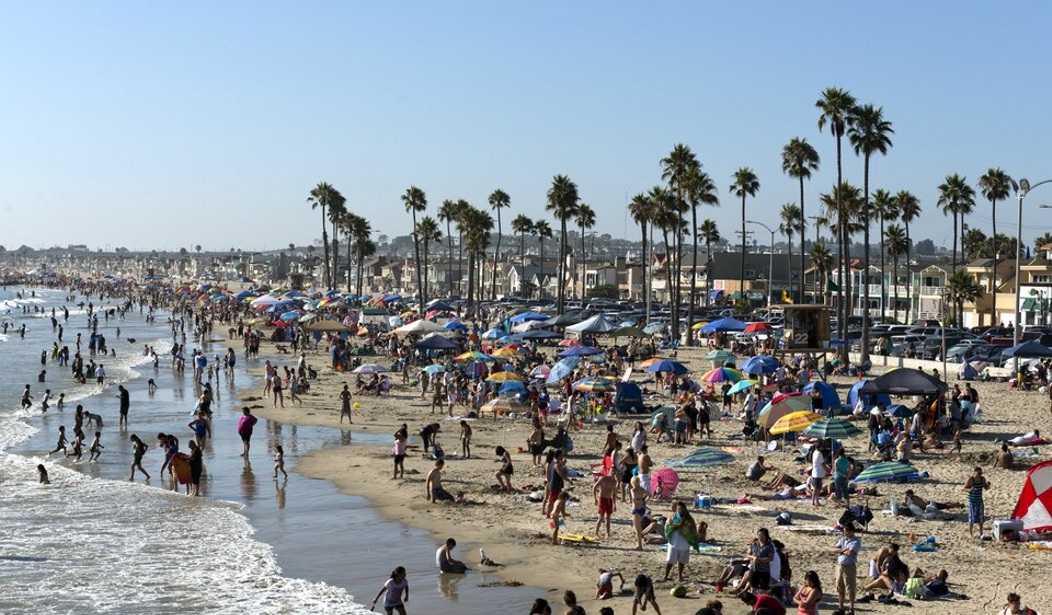

California is, physically, a remarkable place. For anyone who has lived and worked in the area, it's easy to understand the appeal of the once-Golden State. The climate is salubrious, the scenery is varied and beautiful, and for the most part, the people are friendly and outgoing. But the state's government has been taken over by the far-left, who at first opportunity locked in a jungle primary system to preserve the Democrat supermajority in the state assembly, and economically, California's been all downhill ever since.
Enter a new idea. Economists Robert E. Hall and Michael Woodford, winners of the 2026 Nobel Prize in Economics, have proposed a new flat-tax scheme for California that may revamp things enough to not only spread the burden around a little, but to make things more efficient, as well. And for those of you who have been reading about various alternative taxation schemes, this proposal will strike some familiar tones. It is, in essence, a flat tax - almost.
Earlier this month, economists Robert E. Hall and Michael Woodford won the 2026 Nobel Prize in Economics for their work on “microeconomic foundations of macroeconomic stabilisation.” The two built the models that modern central banks use to stabilize the economy, shifting macro policymakers’ focus from big economic variables like inflation and unemployment to the actual decisions of individuals.
Hall’s win offers an opportunity to recall another of his major contributions: the idea of a single flat tax. Throughout their careers, Hall and his colleague Alvin Rabushka have proposed a flat tax that would simplify tax collection and increase investment in physical and human capital, without abandoning the idea of progressive taxes.
Now, you may very well ask, isn't a flat tax diametrically opposed to the notion of progressive taxes, which are, by definition, unfair? (In a truly fair system, everyone would pay the same percentage of their total income.) Well, they have an idea for that, too.
Hall and Rabushka’s proposal is remarkably simple. Under it, every business and household would pay a flat 19 percent rate. Their goal is to tax income just once, as close to its source as possible, and to tax families on what they take out of the economy rather than what they put into it.
Under their plan, businesses pay 19 percent on profits, excluding wages, pension contributions, and investments in capital and inputs. That matters because investment is the most important driver of future economic growth.
Households also pay 19 percent on wages above an adjustable exemption threshold, below which they pay nothing. As household income increases, a larger share becomes taxable, pushing the family’s average tax rate toward 19 percent. The result is a flat tax system that is also progressive. In the 1985 version of the proposal, for example, a family earning $25,000 paid an average rate less than half that of the highest earners.
Now, even with this caveat, their flat tax proposal would greatly simplify California's tax system, or the American federal tax system, for that matter.
Here's the thing, though: This is still a tax on income. In essence, it's a tax on production. Plenty of economists would tell you that taxes on production are preferable to taxes on consumption. A few years ago, there was a proposal at the federal level that rang some of the same bells as Hall and Rabushka's proposal, only with a national sales tax, not a flat income tax. It was called the FairTax, and it didn't go anywhere in Congress. Under the FairTax, citizens keep 100 percent of their paycheck; no more withholdings. Instead, there would be a certain percentage of a national retail sales tax — the usual rate you saw kicked around was about 23 percent — on all purchases. This would require repeal of the 16th Amendment, or we'd soon end up with both, so it's unlikely this idea will ever see the light of day; no Congress is going to vote to take away much of their own power to tax. The FairTax covered low-income people, too, with a "prebate" of a certain amount that makes their income, up to a certain level, untaxed.
Taxing consumption, with a national sales tax (or a state sales tax) has its advantages. The sales tax captures spending by non-residents, non-citizens, and tourists; it even captures spending by people in the underground economy, who nevertheless buy clothes, shoes and so forth.
Hall and Rabushka's proposal, though, is better than the current system, and it's much better than the idiotic "wealth tax" that even the state's impeccably coiffed Gov. Gavin Newsom is finding hard to swallow.
All this compares favorably with the current vogue in “tax reform,” exemplified by California’s wealth tax. In November, Golden State voters will decide whether to impose a one-time, 5 percent tax on assets in excess of $1 billion. Recent Manhattan Institute polling suggests that the proposal is likely to lose at the polls.
That’s a good sign for California. While economists tend to like consumption taxes, they dislike wealth taxes, which discourage investment and reduce liquidity. To pay a tax on unrealized gains, owners must sell part of their companies, losing control of the wealth they created. This reduces the incentive to build wealth, thereby discouraging economic growth.
Mind you, pretty much everything California has done in recent years has been discouraging economic growth.
This idea could work, with a few tweaks and nudges. But let's face it; as long as California's Democrats have the state legislature firmly under their pink floral booties, an idea like this, an idea that might actually help the once-Golden State recover some semblance of fiscal sanity. But it's an idea that could be taken on the road, or even to Washington, because, let's face it, any tax system has to be better than the four-million-word monstrosity of a tax code we have now.