
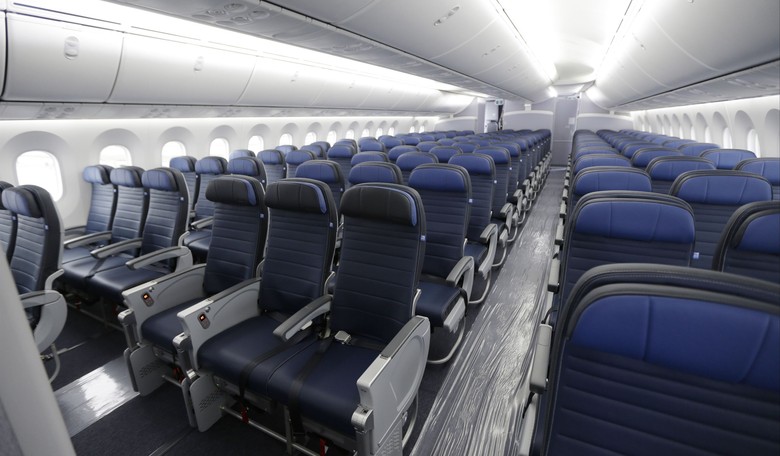
Everyone who has traveled by commercial airline in the post-911 world knows that it can be a daunting experience, and an expensive one. Some of us are obligated to do so regularly, to see family that we may not otherwise see, for business, for any number of reasons. And it can be frustrating when the airline charges extra for premium seating, or even for less-than-torturous seating. United Airlines, my airline of choice as my years of business travel have left me with lifetime status, does this. As far as I know most airlines do.
Recently, United's CEO, Scott Kirby, sat down with the New York Times to discuss a number of airline-related issues, and yes, that issue came up. Note: The bolded text represents the NYT's questioner, Jordyn Holman.
Some people just want to get from A to B at the cheapest price possible. There are some customers who want to sit in a window seat or a better seat, and that costs money to deliver. The way to give everyone what they want is to charge for the services and products that those customers want.
Then do you disagree with the premise that the frequent fliers are the haves and other travelers the have-nots?
I would never describe it that way. There are customers that pay more that get more.
That's fine. We pay extra for more comfort. You get what you pay for, as solid a rule of economics as you're likely to find. But that wasn't the alarming part of this interview. This was.
Do you have any concern that the general public seems to have less trust in C.E.O.s, and do you have any responsibility for dispelling that?
Wealth inequality has become a danger to our society, and we need to address that.
We should have a national wealth tax — it won’t work by state because people will just move. And I think we should have inheritance taxes that get close to 100 percent at some level. I would pay them.
Now that right there is alarming. This is a guy who has risen through his corporate career to sit at the controls of a major global airline, and here he is spouting cant that could have come directly from the mouth of a Democratic Socialist of America (DSA) nutcase?
I don't run a major airline, nor should I, but I am more than passingly familiar with the United States Constitution, having taken an oath to protect and defend it, and what Mr. Kirby describes simply can't be done; the Constitution forbids it. Article 1, Section 8 reads:
The Congress shall have Power To lay and collect Taxes, Duties, Imposts and Excises, to pay the Debts and provide for the common Defence and general Welfare of the United States; but all Duties, Imposts and Excises shall be uniform throughout the United States.
That means that one cannot levy any such tax unless it is uniform throughout the states, regardless of population. In other words, direct taxes, which is what a wealth tax would be, are required to be apportioned among the states based on their respective populations — that the amount of tax collected from each state must be proportional to its population as determined by the Census. This is why, in order to legalize the federal income tax, the 16th Amendment was required.
The Congress shall have power to lay and collect taxes on incomes, from whatever source derived, without apportionment among the several States, and without regard to any census or enumeration.
Without regard to any census or enumeration. That language was what was required, and it would be required for any national wealth tax, as well. Mr. Kirby- you simply can't do this without amending the Constitution.
The notion of a 100 percent inheritance tax may be even more heinous. Most of us who are in our senior years have spent a lifetime building wealth. We have property, we have savings, we have assets. And now, we learn that Mr. Kirby is in favor of government just seizing all that when we die? The government has no business seizing those assets — and what incentive, then, would anyone have to conduct all the economy-building activities that build wealth? This would be an economy destroyer, as is most socialist/communist nitwittery.
Mr. Kirby may be a good airline executive. He may even be a great airline executive. But when it comes to economics, taxation and the Constitution, it's pretty clear he's still struggling to learn the difference between fundament and face.