
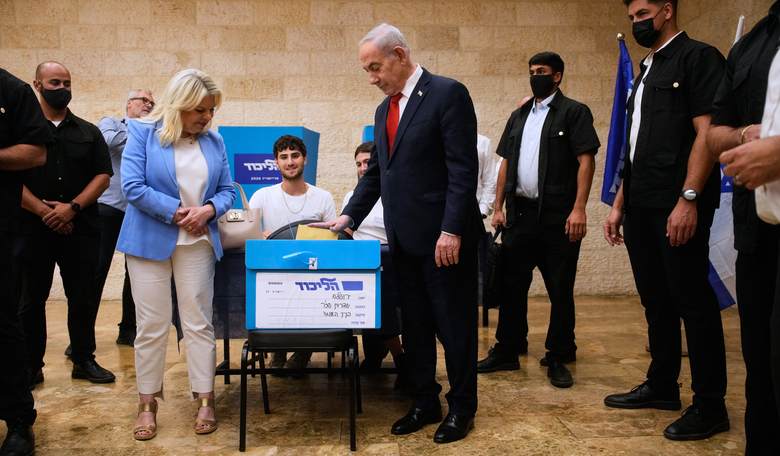
President Isaac Herzog has tasked Yashar party leader and Benjamin Netanyahu nemesis Gadi Eisenkot with forming Israel’s next government after the October 27, 2026 election left both the opposition and Netanyahu’s bloc short of a Knesset majority; see Israel Election Results: Netanyahu Bloc at 53 Seats, Arab Parties Surge to 19 – RedState. The former IDF chief of staff and leader of the Yashar party secured the first mandate after receiving recommendations from parties representing 67 lawmakers, compared with 46 for Netanyahu.
However, nothing is ever as easy as it seems.
Math is tough for most of us, even in the best of times. When the math involves the five-dimensional chess of creating a governing majority in a 120-seat Knesset from 11 parties, some of whom hate each other, it looks insurmountable.
With 100% of votes counted, the final results from Israel’s election show the Netanyahu-led coalition with 53 seats, the Jewish opposition parties with 48 seats, and 19 seats for the two Arab parties. A short thread summarizing some of the most notable results: 🧵 https://t.co/NdzvhW1xe8
— Gabriel Epstein (@GabrielEpsteinX) October 29, 2026
🇮🇱2026 FINAL Election Results Dashboard (Pending Verification) https://t.co/6ul2SCeiTA
— Israel Elects (@israel_elects) October 29, 2026
Eisenkot’s four-party Jewish opposition alliance — Yashar (21 seats), Together (12 seats), Yisrael Beiteinu (7 seats), and The Democrats (8 seats) — holds 48 seats. Netanyahu’s right-wing and religious bloc holds 53 seats. Arab parties (Ra’am and the Joint List) won a record 19 seats. Neither side has the 61 seats it needs on its own.
Making matters more difficult, Eisenkot has tried to thread the needle between mobilizing dissatisfaction with Netanyahu's governance and appearing to be somewhat traitorous as wars with Iran, Hamas, Hezbollah, and occasionally the Houthis rage. His solution was to publicly prioritize a “national emergency government” built on the Jewish opposition parties. This is where the math gets stickier: He has laid out four principles any partner must accept:
- recognition of Israel as a Jewish and democratic state;
- acceptance of the values of the Declaration of Independence;
- mandatory service for all citizens to strengthen the IDF;
- and recognition of Hamas as a terrorist organization that must be dismantled.
The immediate deal-breaker is that the Arab parties are Islamist, anti-Zionist, and don't recognize the right of Israel to exist. I haven't seen this stated, but I'd be willing to bet they wouldn't agree with calling Hamas a terrorist organization.
Eisenkot has repeatedly declined to bring the Arab parties into a governing coalition. In fact, he has stated he does not believe current Arab parties meet his conditions, particularly the Hamas one, and has emphasized forming a Zionist government. Netanyahu has warned that any arrangement relying on Arab parties would endanger Israel. Yisrael Beiteinu, a secular Russian Jewish party that voted to give Eisenkot first crack at forming a government, has long opposed dependence on Arab votes. A move to include those parties would not only violate Eisenkot's stated "red line," but it would also create internal tension within his coalition.
His other main problem is that he has essentially put collaborating with Shas and United Torah, the ultra-Orthodox parties, on the issue of draft exemptions for yeshiva students. Eisenkot has insisted on ending broad draft exemptions for Haredi yeshiva students as a non-negotiable principle. Either Eisenkot has to back down from this "red line" or the ultra-Orthodox have to vote to basically destroy their communities.
Writing off 13 ultra-Orthodox seats and 19 Islamist seats to stay true to his stated principles means Eisenkot has to find 61 votes from the remaining 88 when Netanyahu's Likud party owns 27 of them. Because Eisenkot has ruled out any deal with Netanyahu, the math becomes very difficult for the anti-Netanyahu parties.
Under Israel's constitution, Eisenkot has 28 days to assemble a ruling coalition. If he fails, which seems to be likely, another member of the Knesset must be offered the chance. That would be Netanyahu. If he fails, the president calls for a new election.
In the meantime, Bibi Netanyahu remains prime minister.