
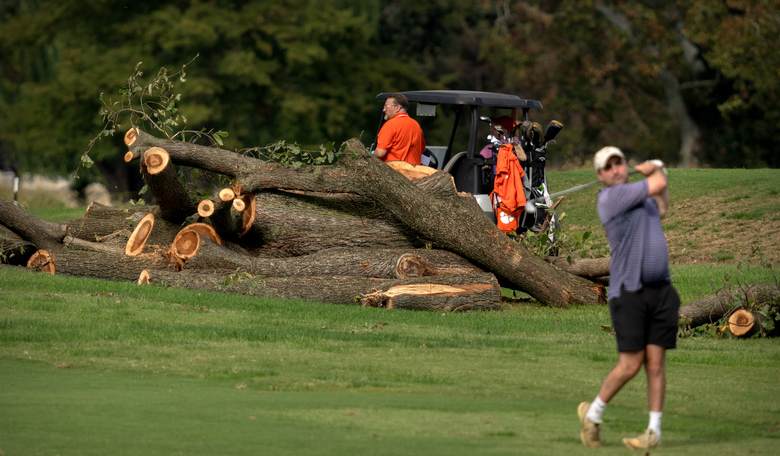
Well, that escalated quickly...
What began as a dispute over the Trump administration's removal of hundreds of trees from Washington, D.C.'s East Potomac Golf Course has now become a rather pointed confrontation between the executive and judicial branches.
And the Department of Justice (DOJ) just raised the stakes considerably.
As RedState reported Monday, U.S. District Judge Ana Reyes was decidedly unhappy with the National Park Service after it removed roughly 430 trees over the weekend, having notified the court late Friday afternoon. Reyes summoned senior administration officials to explain the operation, sharply criticized government attorneys, and temporarily halted further tree removal.
On Tuesday, she extended that prohibition through October 26, finding that the plaintiffs were likely to succeed on their claim that the government failed to comply with the National Environmental Policy Act (NEPA).
But the administration isn't taking this lying down. On Friday, the DOJ filed its opposition to the plaintiffs' request for a longer-lasting preliminary injunction, arguing that Reyes exceeded her authority by compelling testimony from senior executive officials and relying on evidence developed through what the government contends was an improper judicial inquiry.
Then came the real fireworks.
In a separate motion signed by Associate Attorney General Stanley Woodward, the DOJ formally requested Reyes's disqualification under 28 U.S.C. § 455(a), arguing that her conduct has created an appearance of partiality. The motion cites Reyes' treatment of government counsel, her demands for testimony from senior officials, and remarks made in other Trump administration litigation.
The DOJ also wants the audio from Monday's hearing released publicly, arguing that transcripts alone cannot adequately convey the judge's demeanor.
And this goes well beyond judicial temperament. Section 455(a) requires recusal when a judge's impartiality might reasonably be questioned. But under the Supreme Court's decision in Liteky v. United States, harsh criticism and adverse rulings ordinarily aren't enough. The question is whether the judge has demonstrated such deep-seated antagonism that fair judgment becomes impossible.
Separately, established precedent generally protects high-ranking executive officials from compelled testimony absent extraordinary circumstances — another issue DOJ has squarely raised.
So where does this leave things?
Ordinarily, Reyes would decide the recusal motion herself — at least initially. She could grant it and transfer the case to another judge, although that wouldn't automatically invalidate her previous orders. But she could also deny it, leaving the administration to consider appellate remedies, potentially including mandamus. The DOJ could also seek appellate intervention regarding compelled testimony or the existing injunction.
Meanwhile, an evidentiary hearing is scheduled for Monday, October 19, with senior Interior officials ordered to appear.
None of this establishes that Reyes' disqualification is inevitable. But it does mean the litigation has moved well beyond the question of whether NPS conducted adequate environmental review before removing trees.
The increasingly consequential question is whether the court itself has remained within the proper bounds of its authority.
And to think, on Monday, we were just talking about some trees on a golf course...