
On December 3, the U.S. Army will do something it hasn’t done in 81 years. It will execute a soldier by firing squad.
Long overdue justice has finally arrived for one of the most heinous criminals on death row anywhere in the United States. That would be former U.S. Army major Nidal M. Hasan. On November 9, 2009, Hasan, then a psychiatrist preparing to deploy to Afghanistan, entered the Soldier Readiness Processing Center at Fort Hood, Texas, to conduct some pre-deployment processing. Instead, he opened fire on fellow soldiers and civilians. Hasan executed thirteen people and 31 more were hospitalized. This was the most serious terrorist attack on U.S. soil since September 11, 2001, and would hold that grisly distinction until the San Bernardino shootings in 2015; see San Bernardino Shooter Planned A Previous Attack And Was Under Investigation – RedState.
Last Tuesday, the Department of War announced it was seeking approval from President Trump to execute Hasan; see War Department Seeks Approval for First Military Execution Since 1961 – RedState. The United States Court of Appeals for the Armed Forces heard Hassan's final appeal on March 28, 2023. On September 6, 2023, it affirmed his death sentence. Before the National Defense Authorization Act for Fiscal Year 2024 (Public Law 118-31, December 22, 2023) that would have ended the process, however, Section 533 of the FY2024 NDAA permitted appeals from the USCAAF to the Supreme Court.
On Monday, President Trump concurred with Secretary of War Pete Hegseth’s recommendation that Hasan be executed by firing squad; see Firing Squad, It Is: Trump Approves the Execution for An Enemy of the United States – RedState. Tuesday, we got more detail. Hasan’s execution is scheduled for December 3. The venue is not the U.S. Disciplinary Barracks at Fort Leavenworth, Kansas, where all military executions since the end of World War II have happened; We Now Know When and Where Nidal Hasan Will Be Executed — and There’s a Certain Poetic Justice to It – RedState. Hasan was being returned to the scene of the crime, Fort Hood, Texas, for final out-processing.
Most soldiers executed under military authority in the history of the Republic have been hanged. During World War II, 141 U.S. soldiers were executed; 12 were by firing squad. Oddly enough, neither the Navy nor the Marines have executed one of theirs in well over 100 years. Conventional wisdom has it that the firing squad was reserved for purely military offenses while run-of-the-mill felons were hanged. A cursory examination of the data shows that is not the case. The most common offense is the murder and/or rape of a civilian. Military offenses are limited to one instance of shooting an MP while he was acting in the line of duty and, of course, Eddie Slovik for unrepentant desertion. I suspect that courts-martial ordered hangings because of a reluctance to have troops carry out the executions.
Contrary to the popular social media misinformation, the last “death by musketry” carried out by the U.S. Army was not Eddie Slovik. At least nine executions of U.S. soldiers took place by firing squad after Slovik. The sad distinction of being the last execution by firing squad belongs to Private Dan J. Lee, in the Philippines on November 9, 1945. This is his story.
Little information is available about Lee. It is known that he was drafted from Okfuskee County, Oklahoma, on November 28, 1942, and inducted at Tulsa. He was 34, a married farmhand. He was black, and in the segregated Army of World War II, this meant that he was probably going to be assigned to a service unit. In Lee’s case, that was the 629th Ordnance Ammunition Company belonging to the Sixth Army. His unit came ashore on Luzon on D+2, had a close encounter of the worst kind with Japanese artillery, losing several men, and set up ammunition supply points for the troops moving inland. The fact that Lee had three years’ service at this time and was still a private hints that he might not have been a fast mover.
So, this is Dan Lee’s sad saga.
On the afternoon of June 11, 1945, in San Fernando, La Union, he entered the one-room house of Julian and Tomasa Esperanza armed with a knife. Julian, 58, was asleep. Tomasa confronted him. Lee spoke only English; Tomasa caught only the word “pom-pom.” It doesn’t take much imagination to think what “pom-pom” might mean. Another court-martial, that of Corporal James Norman, who was hanged on April 25, 1947, provides a succinct explanation: “He went to the Walled City, where he knew some men, and met Melitona Rarela and struck up a brief conversation. He asked her if he could pom-pom her (have sexual intercourse) and she said yes and she would take him to her house.”
From Lee’s court-martial proceedings:
He then shook her husband who was sleeping. The Filipino awoke, and as he sat up, the negro stabbed him (R 7). The woman ran to the home of Vicente Esneranza, her brother-in-law, a short distance away. ·He proceeded to her house, saw that his brother, Julian, was dead and went out to look for the negro (R 9). About five minutes later he saw a negro, whom he identified during the trial as the accused (R 9), dressed in underdrawers and an undershirt in a house about a third of a kilometer away throwing rice and clothes out the window· {R 11). He entered the house,· said, "Hello,” and accused struck him in the neck with a knife. Vicente then drew his bolo knife and struck accused repeatedly until the latter left the house and ran to the woods,, (R 9). Vicente testified that accused was drunk (R 10).
By the way, this is a recurring theme in the courts-martial for rape and murder in France, Italy, and the Philippines. One or more drunk GIs show up at a random house. They enter without invitation, and they ask the women for sex. When they are told "no," somebody gets killed. Frequently, the women are raped in front of their husbands and children before the murders.
The homicide was reported to the Military Police. They immediately investigated and observed accused running down a hill. He stopped and was apprehended “exhausted”(R 12).
Accused was taken to a hospital where that evening he was questioned by a special investigator. After being warned of his rights (R 15), he made a statement (Ex A) which was. reduced to writing and signed by him. In it ·accused said that he had been drinking on the afternoon of 11 June. He went to a small house where, "For no reason at all I began to stab this man ... who was laying down ... in the neck and chest with my pocket knife." He then left, and "tore" off his clothes because they were covered with blood and went to another house where he “lunged” at another Filipino with his knife. The native cut him with his bolo knife, so he ran away but was apprehended (Ex A).
Two days later accused was asked where he had left his clothes, and the investigator found them at the place he indicated. The clothing and knife were shown to accused and he identified them (R 16).
At his general court-martial on July 18, 1945, he backtracked on his statement and claimed the deceased Julian had assaulted him and that he stabbed him only to escape. The court rejected that account, convicted him, and sentenced him to be "shot to death with musketry." He was executed by firing squad at Luzon and buried in Clark Veterans Cemetery in Manila. Consider this. Thirty-seven days elapsed from Lee's crime to conviction — one hundred and fourteen days from his conviction to execution. Compare and contrast with the 1,392 days between the Fort Hood shooting (November 5, 2009) and Hasan’s death sentence (August 28, 2013) and the 4,845 days between the death sentence and projected execution date of December 3, 2026.
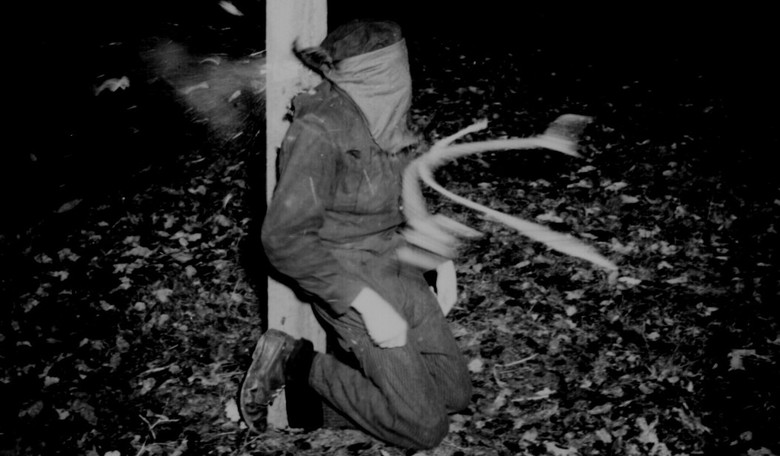
The regulation governing Lee’s execution was Department of the Army Pamphlet 27-4, Procedure for Military Executions. Lee was tied to a post, 6 feet 6 inches high. The firing squad consisted of “twelve men and one sergeant,” along with a chaplain and medical officer. The firing party would draw pre-loaded weapons from a rack; the officer in charge of the execution was to “[c]ause twelve rifles to be loaded in his presence. Not more than four nor less than one will be loaded with blank ammunition. He will place the rifles at random in the rack provided for that purpose.” The regulation also called for a band — "The escort will then proceed toward the scene of the execution, the band playing the 'Dead March'" and "The escort, with the band playing a lively air, will return to their parade ground and be dismissed" — but I've never found an instance of that happening.
If the first time didn’t take, there was a contingency:
d. The officer charged with the execution will join the medical officer who will examine the prisoner and, if necessary, direct that the "coup de grace" be administered. Should the medical officer so decide, the sergeant of the execution party will administer the "coup de grace," with a hand weapon, holding the muzzle just above the ear and one foot from the skull.
e. Under exceptional circumstances, the officer charged with the execution, with the permission of the commanding officer, may detail an extra file of six men to administer the "coup de grace." This file will form the rear rank of the execution party, and if it is necessary to administer the "coup de grace," will move in front of the execution party and fire, at the command of the officer charged with the execution.
Early in the war, there were some dramatically incompetent hangings; I don't consider them "botched" if the felon doesn't survive. I haven't read of any of the twelve firing squad executions by the U.S. Army requiring a "do over."
To the best of my knowledge, there is no video of the hanging or shooting of any American soldier. There are pre-execution stills of Louis Till (hanging, oddly enough, the father of civil rights icon Emmett Till) and Charlie Ervin (shooting) in French L. McLean’s book Fifth Field. Most probably looked like this compilation of German spies and saboteurs executed on June 14, 1945. An execution order in my possession from the Aversa (Italy) stockade shows that twelve-man firing squads were used there and that it was required that prisoners attend the executions. In this video, you'll see that none of the firing squads exceeded nine men; one seems to have only six, and, as far as can be seen, no sergeant is available for the coup de grâce.
As an aside, social media is full of idiots. There are people arguing that the shooting of Hasan is “illegal” because the “UCMJ” specifies lethal injection. That is nonsense. The Uniform Code of Military Justice has nothing to say about the death penalty beyond permitting it. The version of Army Regulation 190-55, U.S. Army Corrections System: Procedures for Military Executions, that existed from January 17, 2006, until October 23, 2023, specified lethal injection as the means of execution. A still earlier version had presented a menu of hanging, firing squad, or electrocution. When I visited the “death house” at Leavenworth while a student there, they had three skull caps for the electric chair that someone had written “small,” “medium,” and “large” on with white-out. The 2023 version of the regulation is pretty clear. “Military executions will be by a method designated by the SECARMY,” states the regulation, and he may select from “[a}ll lawful, feasible methods available.”
The Supreme Court denied Hasan’s final appeal in March 2025. He still has access to federal habeas procedures, but they must start in the District of Kansas, where all of the judges are Trump appointees. Given all the facts and that Hasan admitted to the killings at his trial, acted as his own counsel, and refused to call witnesses, it is hard to see how a habeas appeal gets much traction. So, unless Chief Justice Roberts decides to find some emanation or penumbra in the Constitution that offsets black-letter law, Hasan is well and truly cooked.