
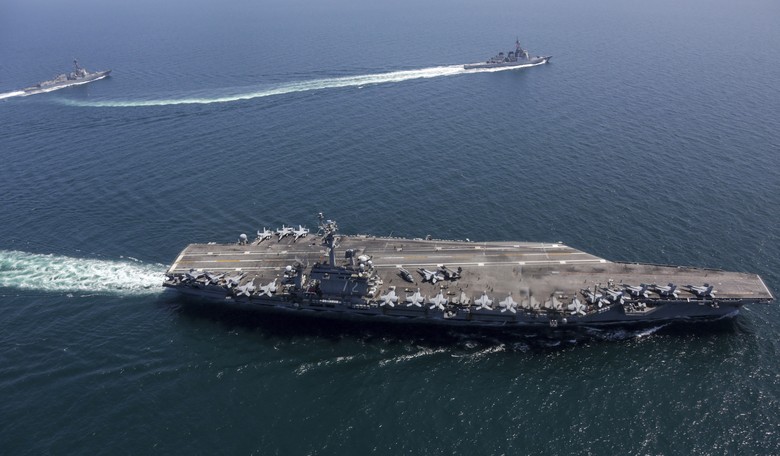
The men and women of the USS Abraham Lincoln received a hero's welcome as the aircraft carrier returned to its home port of San Diego on Thursday after a record-making 321 days at sea. Families eagerly gathered at the port, waiting to embrace their loved ones for the first time since the carrier group departed last November.
It's an emotional end to the historic deployment that saw the Lincoln sail into the center of U.S. military operations against Iran, with her crew eventually flying thousands of missions and spending a record-breaking 265 consecutive days at sea without a port call.
(And, as RedState reported, enjoying a much-deserved few days in Thailand after the Lincoln was relieved by the USS George Washington in August.)
What the Sailors and Marines likely didn't expect during their deployment was becoming the center of a media-created firestorm over the conditions on board the aircraft carrier, which houses 5,000 and operates as a floating city.
RedState readers will remember the steady stream of breathless reports saying conditions aboard the Lincoln were proof positive of poor leadership and collapsing morale. There were drama-filled stories about supposed food and supply shortages, the length of the deployment, the lack of port calls and, memorably, rust being visible on a warship that had spent months at sea.
Oh, the calamity!
What seemed to have slipped the minds of many in the media was the fact that the USS Lincoln was part of a war effort, and that ain't all unicorns and sunshine. In the words of General William Tecumseh Sherman: War is hell. And it's what the crew signed up for, despite some of them undoubtedly having complaints and missing home.
Here are some of the scenes of the Lincoln sailing back into the San Diego Bay.
JUST IN: THE USS ABRAHAM LINCOLN IS BACK HOME https://t.co/nxfcc1OOZz
— Stars and Stripes (@starsandstripes) October 8, 2026
Captain Dave on his fishing boat is trying to talk to Warship USS Abraham Lincoln. Sounds a bit tipsy. Clip from @SanDiegoWebCam https://t.co/YaPW6AlFE9
— 🦋KristaSkyAngel🦋 (@zodysid) October 8, 2026
It's a full house! News media and hundreds of families are awaiting the crew of the USS Abraham Lincoln at NAS North Island, California. 📹: @alisonbath_ https://t.co/EEDXlxX1t9
— Stars and Stripes (@starsandstripes) October 8, 2026
The USS Abraham Lincoln has arrived in San Deigo. Welcome home! 🇺🇸 https://t.co/RVFuO0xA2W
— Lori Rusher ☮ (@elvislver56) October 8, 2026
Hundreds of families are eagerly awaiting the return of the those aboard the USS Lincoln. The ship is scheduled to come to port very soon, but it will be another hour or so until the crew can disembark and be in the arms of their loved ones. 📽️: Alison Bath / Stars and Stripes https://t.co/mVlU3vsK0X
— Stars and Stripes (@starsandstripes) October 8, 2026
Secretary of War Pete Hegseth flew out to the Lincoln on Wednesday to greet the crew and present the entire strike group with the Presidential Unit Citation, the nation's highest unit-level military award. Hegseth had some remarkable numbers to share about what happened during the deployment: roughly 10,000 sorties, 23,000 combat flight hours, nearly 4,000 combat sorties and 1.5 million pounds of ordnance dropped.
He also had some choice words for those who had spent months trying to turn the Lincoln into a symbol of failure.
"There were a few folks in the media who tried to turn the USS Abraham Lincoln into some sort of a symbol — a symbol of dysfunction, or a symbol of low morale or a symbol of a failed mission," he said.
The reality, he added, was "the exact opposite."