
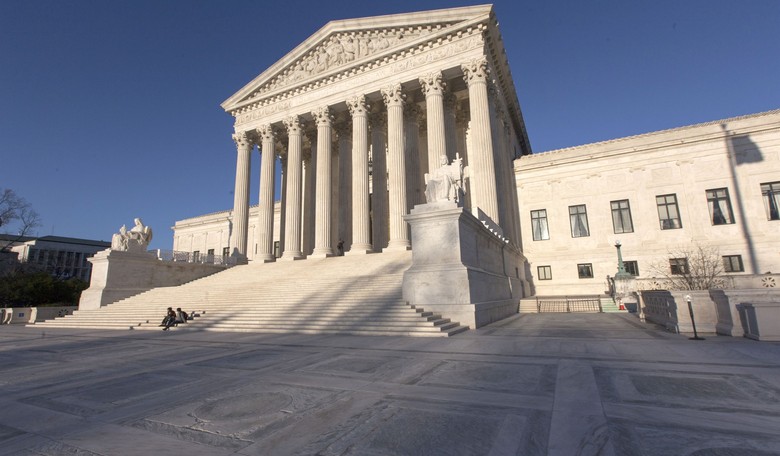
The Supreme Court handed the Trump administration a significant immigration win on Tuesday, blocking a lower court ruling against the Department of Homeland Security (DHS) and fast-tracking the underlying legal fight for argument in December.
The case, Department of Homeland Security v. D.V.D., involves “third-country removals” — deporting illegal aliens with final removal orders to countries other than those designated during their immigration proceedings.
Can President Trump use lawful authority granted by Congress to deport illegal aliens to third countries? The Supreme Court has stayed an order saying no twice, now stayed a permanent injunction for a third time. Oddly, 6-3 despite a similar posture to the Missouri First map pic.twitter.com/IWXAIeqCA0
— Eric W. (@EWess92) September 29, 2026
The administration maintains that such removals are sometimes necessary when an illegal alien’s home country refuses to accept him or when he has received protection against being returned there. DHS guidance provides that if another country has credibly assured the United States that deportees will not be persecuted or tortured, removal may proceed without additional individualized procedures. Absent those assurances, DHS provides notice of the intended destination and an opportunity to raise a fear of persecution or torture.
The plaintiffs contend that illegal aliens must receive meaningful advance notice and an opportunity to present country-specific claims before any third-country removal. In February, U.S. District Judge Brian Murphy agreed, declaring that members of the plaintiff class possess those rights and setting aside the DHS guidance under the Administrative Procedure Act. The 1st Circuit Court of Appeals upheld that judgment on September 18.
On Tuesday, however, the Supreme Court stayed the district court’s judgment, meaning it has no operative effect while the justices consider the case. DHS may continue using its existing third-country removal procedures in the meantime.
But the Court didn’t stop there. Rather than simply ruling on the administration’s emergency request, the justices treated that application as a petition for certiorari (the formal request asking the Supreme Court to take a case) and granted review. They also directed the clerk to establish an expedited briefing schedule so the case can be argued during the Court’s December session. While this likely comes as no surprise, Justices Sonia Sotomayor, Elena Kagan, and Ketanji Brown Jackson would have denied the stay.
If this case sounds familiar, it should: This is now the Supreme Court’s third intervention in the dispute. (Remember the back-and-forth over South Sudan, the stranded flight in Djibouti, etc.?)
In June 2025, the Court stayed a preliminary injunction requiring additional procedures before third-country removals. The following month, it clarified that the district court could not continue enforcing a related remedial order after the underlying injunction had been stayed.
The lower court subsequently entered a final judgment using different legal tools: classwide declarations and vacatur of the DHS policy rather than another injunction. That raises one of the major questions now before the Supreme Court: Federal immigration law restricts lower courts’ authority to issue classwide injunctions blocking the operation of certain immigration provisions. The administration argues that the lower court accomplished essentially the same result by labeling its remedies “declaratory relief” and “vacatur.”
The justices will also consider whether the district court had jurisdiction at all and whether DHS’s guidance violates federal immigration law, the Due Process Clause, or federal protections implementing the Convention Against Torture.
In an especially broad fourth question, the Court invited briefing on “[s]uch other questions that the Government determines are appropriate for the proper disposition of the case.”
That ought to make for some interesting reading.
Tuesday’s order does not decide whether the administration’s policy is lawful. But the combination of a stay, expedited review, December argument, and the Court’s two prior interventions certainly indicates that a majority of the justices see serious problems with the lower courts’ handling of the case.
For now, the administration’s third-country removal policy remains in effect. This time, however, the Supreme Court appears ready to move beyond emergency orders and and decide the case itself.
Attorney General Todd Blanche weighed in on the ruling shortly after it issued.
Now for the second time, SCOTUS just granted our stay in conducting all third-country removals of illegal aliens. Again, this is entirely lawful and a critical tool for immigration enforcement. Unlike the lower court, SCOTUS waited to hear from both sides before making the… https://t.co/xQWiKnxNzm pic.twitter.com/husJQ2nUSd
— Attorney General Todd Blanche (@AGToddBlanche) September 29, 2026