
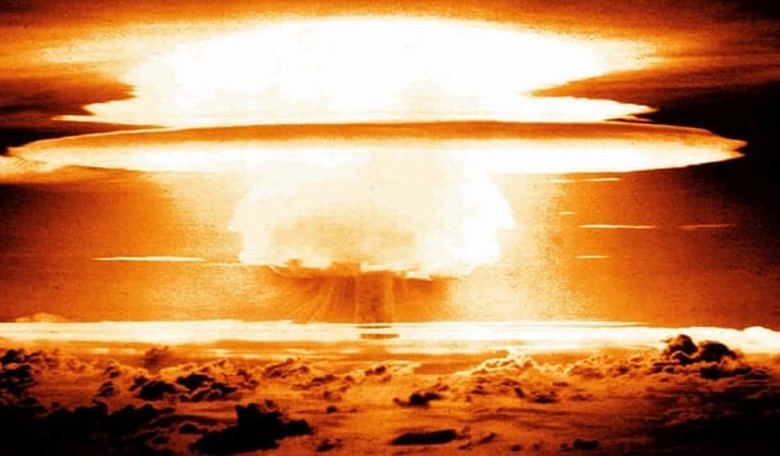
September 23rd, 1949, was a key day in history. The Cold War was just getting started in earnest, the Soviet Union was building aircraft and tanks, the former Allies were broken apart, the Iron Curtain was coming down in Europe.
On the 9th of September in 1949, Director of Central Intelligence Admiral Roscoe Hillenkoetter asked to see President Harry Truman. When he was ushered in, Hillenkoetter handed the president a memorandum describing an "abnormal radioactive contamination" in the north Pacific. The cause was thought to be a nuclear explosion in Asia. That was confounding, because up to that point the United States was the only nuclear power on the planet; that was the case no longer. The Soviet Union was now a nuclear-armed state.
Moscow’s success in building a nuclear bomb was a monumental development made all the more alarming for U.S. strategists by the fact that it occurred one-to-four years sooner than analysts had expected. The White House chose to preempt possible Kremlin triumphalism by announcing the finding to the world on 23 September 1949, a move that evidently came as a shock to the Soviets who had no idea the U.S. had the capability to isolate and identify the signs of a nuclear blast.
The United States dubbed the Soviet nuke "Joe-1." And in heading off the Soviet's jeering announcement, President Truman gave the Soviets some idea of American capacities they didn't know we had.
The White House announcement on 23 September may have stunned Stalin and the Soviet Politburo; they did not know that the U.S. had a surveillance system geared to detect the tell-tale signs of nuclear activities and they wanted to avoid giving Washington an incentive to accelerate its own nuclear weapons activities. The Soviet test was also a jolt to U.S. intelligence analysts who had estimated that Moscow was unlikely to have the bomb before mid-1953, although they had deemed mid-1950 as a possibility. A few weeks after the test, CIA Director Roscoe Hillenkoetter argued that "I don't think we were taken by surprise" because of an error of only a "few months," but not all of his Congressional overseers accepted that.
We all know what followed; any of you readers who are, like me, a Boomer, we remember all too well what followed. For decades, as both the United States and the Soviet Union built warheads and delivery systems with abandon, the threat of a nuclear war hang over our heads like Damocles' sword. We practiced "duck and cover" drills. Every town, even small, Iowa farm towns, had a civil defense siren that they tested monthly; those were, of course, used to warn of impending tornadoes as well as nukes, but the tests sent chills down our backs nonetheless. After Joe-1, the nuclear arms race was under way, and the Cold War was kicked into high gear. During my own Army service over 30 years later, as the drill sergeants made plain, we were still training with the primary objective of countering a thousand Soviet tanks storming through the Fulda Gap into Western Europe.
Fortunately, that never happened. But it very easily could have. The Soviet Union, in time, collapsed under the weight of its own lunatic economic system, and the United States pretty much sealed that deal when a great American president, Ronald Reagan, realized that we could have beans and bullets both, but the Soviets couldn't; he played that card against them and drove them into bankruptcy. So, the Cold War ended, with no nuclear holocaust.
But it could have all ended very differently. We got our first look at that possible calamity on September 23rd, 1949, when President Harry Truman upstaged the Soviets with an announcement of their new nuclear capability.