
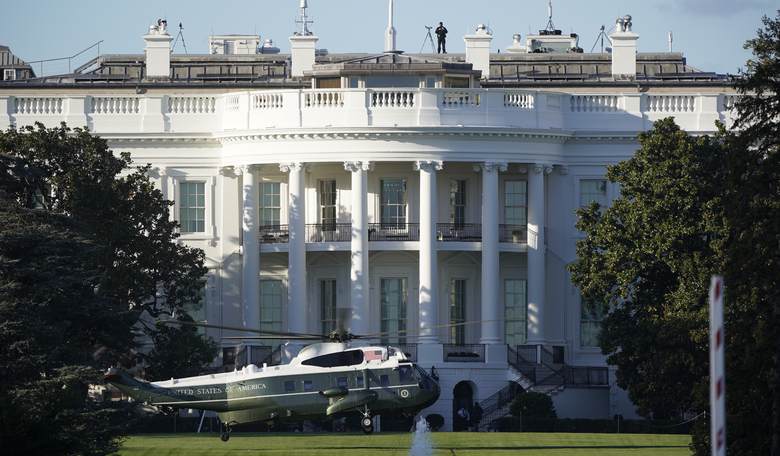
President Trump’s decision to build a granite helipad with the seal of the United States President on it on the South Lawn is a straightforward upgrade that addresses basic operational reality. Yet much of the coverage has focused less on the physical change itself and more on the White House’s concurrent decision to restrict access for certain legacy news outlets.
The logistical case for the project is hard to dismiss. For years, the presidential transport unit faced a glaring hardware mismatch: the newer, heavier VH-92A Patriot fleet — which replaced aging Vietnam-era choppers — exerts immense downward engine heat.
We have liftoff from the South Lawn 🚁 President Trump cuts the ribbon, officially opening the new helipad at the White House. https://t.co/XBMwqXxUGU
— The White House (@WhiteHouse) September 21, 2026
Landing these advanced aircraft on soft grass routinely tore up the lawn and scorched the turf, forcing pilots to rely on alternative landing setups or distant drop-offs.
The new carved-granite landing zone provides a permanent solution. Beyond protecting the physical grounds, it allows Marine One to set down closer to the residence, shortening the president’s ground transfer and reducing exposure during arrivals and departures. In a high-threat environment, reducing time spent on an open lawn is a standard security protocol, not a luxury.
.@POTUS participates in a ribbon cutting to unveil the new White House helipad 🇺🇸 https://t.co/kJHuYPQGMR
— Margo Martin (@MargoMartin47) September 21, 2026
Furthermore, eliminating the need for extended ground motorcades cuts down on urban gridlock and operational friction. Presidents of both parties have routinely altered the White House footprint to overcome and adapt to shifting technological and security needs; this upgrade fits squarely into that tradition.
Predictably, however, the press corps preferred to make themselves the story. When the administration restricted pool credentials for outlets like CNN, Politico, and MS NOW, the media response was immediate panic. The excluded outlets promptly filed a joint lawsuit, framing the credential enforcement as a systemic threat to democratic norms.
The day has finally come! The Sikorsky VH-92 Patriot which first flew almost 10 years ago is departing the new White House helipad with POTUS onboard for the first time! 😎🇺🇸💪 Welcome to the 21st-century everyone! 🥳 https://t.co/HNX3Z588Nw
— Thenewarea51 (@thenewarea51) September 21, 2026
Access disputes are nothing new. Executive administrations have always exercised discretion over credentialing, pool rotation, and physical proximity to the president. While journalists naturally push back on restrictions, treating routine credentialing policy as an unprecedented crisis reveals a distinct lack of perspective.
The imbalance in coverage highlights a familiar media blind spot. A concrete infrastructure fix — funded privately through defense contractor contributions to solve an engineering flaw — gets treated as a footnote. Meanwhile, disputes over press privileges generate endless commentary. The media’s instinct to center itself in every story obscures the functional necessity of the project.
A grounded view of the presidency starts with the reality of the office. Executing the duties of the executive branch requires secure, reliable movement. Replacing a tear-prone lawn with durable granite to safely land modern aircraft is plain common sense. It does not require dramatic outrage or media hand-wringing.
The White House is not a press gallery; it is the seat of the executive branch. The helipad will make the short trip between aircraft and residence faster, safer, and more controlled. The surrounding noise about which networks hold pool credentials is real, but secondary. Practical improvements to presidential security and infrastructure deserve to be judged on their merits, not used as props in the media's running grievance campaign over its own access. The fight over press passes will come and go, but the granite pad remains a sensible, long-overdue fix for the job.