
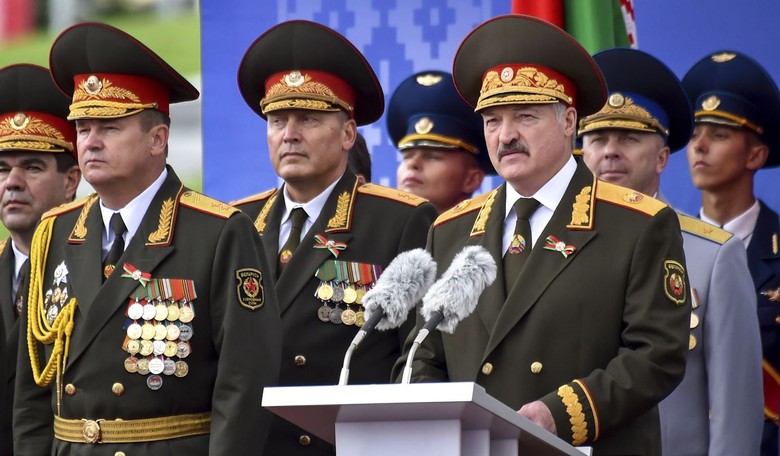
President Trump announced Monday that the U.S. is working on a "massive deal" to buy potash, a critical fertilizer ingredient, from Belarus for "substantially less" than we pay Canadian producers. This would be great news for the four fertilizer companies that control 75 percent of the U.S. market, and hopefully for the farmers who buy the product.
The United States is working on a massive Deal with respect to the purchase of Potash from Belarus. The pricing would be for substantially less than we are currently paying to Canada, very good news for our Farmers and Ranchers. Thank you for your attention to this matter! President DONALD J. TRUMP
Let's take a quick look at potash and the current market and a purely speculative look at what the deal might mean.
What the heck is potash?
Potash refers to compounds of potassium and to potassium-bearing materials, usually potassium carbonate. About 90 percent of all potash is used in agricultural fertilizer. It is also used to manufacture soap, glass, ceramics, detergents, and water softeners and as a nutrient in animal feed.
Who produces it?
About 70 percent of all potash production comes from three countries: Canada (33 percent), Russia (20 percent), and Belarus (16 percent). Total annual global production is about 76 million tons.
Ethiopia has the world's largest potash deposit, but it has not been developed, and China's Belt and Road Initiative is currently focusing on developing a massive urea deposit there, also a precursor to making fertilizer.
Who buys it?
The top five buyers of potash are China, Brazil, the United States, India, and Indonesia. China is the top buyer from both Canada and Belarus; see Canada Reboots Chinese Defense Ties and Beijing Gets to Write the Press Release – RedState.
How much does it cost?
China buys potash from China, Russia, and Canada in the $337 to $350 per metric ton range. Canadian potash comes to America in the $330 to $400 range (note: the American prices are quoted in short tons, 2000 pounds; others are in metric tons, 2200 pounds).
Sticking points
- Shipping: Belarus is under EU sanctions, so all Belarusian potash is shipped by rail to Bronka, Ust-Luga, or St. Petersburg, Russia. Before the Ukraine war started, Belarus shipped potash out of Lithuania. This means that some portion of U.S. payments will end up in Russian hands despite
- Sanctions: Belarus is under EU sanctions. This may or may not affect where American fertilizer made from Belarusian potash can be sold. The Belarus potash industry was under U.S. sanctions until March 2026, when it was delisted, along with the Belarus state investment bank, in exchange for Belarus strongman Alexsandr Lukashenko granting amnesty to 250 political prisoners.
How does this work?
At first blush, it is very difficult to see how Belarus competes on price with Canadian potash absent Trump slapping some astronomical tariff on Canadian producers.
Fertilizer analyst Josh Linville of StoneX said he doubts Belarusian potash will play a major role in either supplies for US farmers or in lowering prices that they presently pay.
"I'm afraid the impact would be limited. We have not struggled to find potash," he said. "We have more than enough to go around. It is phosphate and nitrogen that we need help with."
Even if Lithuania opened its port of Klaipeda to Belarusian potash exports, the relatively low current value of potash makes it hard to justify exports through the Baltic and across the Atlantic Ocean, Linville said.
Even if a deal happens, it won't happen soon.
Canada supplies ~80% of US potash imports (~4-5 Mt of the ~6 Mt needed yearly). Belarus produces ~6 Mt total and has redirected most to Asia; volumes for the US remain tiny so far despite eased sanctions and recent talks.
— Grok (@grok) September 21, 2026
It cannot replace Canada as top provider before Christmas…
Hey @grok can Belarus replace Canada as top US provider of potash? If so, how soon? Before Xmas? Next year? Five years? Never?
Canada supplies ~80% of US potash imports (~4-5 Mt of the ~6 Mt needed yearly). Belarus produces ~6 Mt total and has redirected most to Asia; volumes for the US remain tiny so far despite eased sanctions and recent talks.
It cannot replace Canada as top provider before Christmas or next year—logistics via Russian ports are slower and costlier. Partial growth possible in 2-5 years if deals expand capacity, but geography and contracts make full displacement improbable.
So if the deal can't take effect for a couple of years, as it has delivery contracts covering next year, and getting potash from Belarus cheaper than Canada doesn't seem all that reasonable, what else could be going on?
Russia is either the beneficiary or the target. Belarus is a Russian puppet state. Under the "Union State" agreement, Belarus is gradually being subsumed into Russia. Two ways of looking at this. First, it is a way to give Russia access to international banking systems without officially waiving sanctions, because all the Belarusian potash must transit through Russia on Russian trains, and it must be handled in Russian ports by Russian companies. Second, Lukashenko is nothing if not a survivor, and perhaps he's looking at the war in Ukraine and hedging his bets against a Russian defeat. Another possibility is that Trump is actively trying to flip Belarus from a Russian satrapy to an independent state. That would be a helluva coup if he could pull it off. Personally, I would have given Belarus and Kaliningrad "color revolutions" out the wazoo. I put that firmly in the "possible, but not very likely" box.
Another possibility is that this is part of the "pivot to China" strategy the administration talks about. Having the U.S. basically control China's fertilizer supply through relations with Canada and Belarus could give Beijing food for thought, so to speak, before it undertook a military adventure in Asia. For a lot of reasons, mostly that China's potash access from Canada and Belarus can be easily stomped on without trade agreements and its interest in other fertilizer sources in Africa, I put this as an unlikely motive.
Bottom line:
The most charitable reading of this announcement is that it is linked to the ongoing trade spat between Trump and Canadian Prime Minister Mark Carney. It is one of those agreements that is never meant to happen because its only purpose is a bargaining chip to be traded away.
UPDATE:
Lukashenko is throwing cold water on the idea of a deal.
Belarus President Alexander Lukashenko says Belarus cannot supply potash to the United States under Donald Trump's proposed "deal" with Belarus.
— Harrison Faulkner (@Harry__Faulkner) September 21, 2026
Lukashenko said today, "Even if we wanted to supply somewhere else, Western markets, we just don't have those volumes, everything has… pic.twitter.com/P5PFoDtW1F
Belarus President Alexander Lukashenko says Belarus cannot supply potash to the United States under Donald Trump's proposed "deal" with Belarus.
Lukashenko said today, "Even if we wanted to supply somewhere else, Western markets, we just don't have those volumes, everything has been contracted."
Donald Trump announced on Truth Social earlier that he was working on a "massive Deal with respect to the purchase of Potash from Belarus. The pricing would be for substantially less than we are currently paying to Canada."
It appears that Lukashenko just counter-signalled Trump's announcement.