
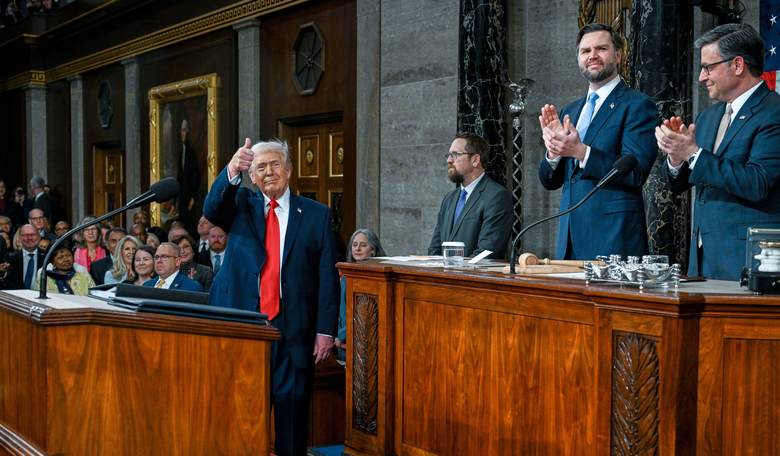
President Donald Trump just scored something increasingly rare in Washington: a bipartisan win.
The House voted 352–72 Wednesday to pass the National Fraud Enforcement Division Act of 2026, legislation that would put the Trump administration's new DOJ fraud division into federal law.
Then lawmakers prepared to get out of Dodge. House Speaker Mike Johnson canceled votes scheduled for Thursday, meaning House members are heading home for more than six weeks and aren't expected back in Washington until after the November midterm elections.
But before leaving town, an overwhelming majority of the House agreed on at least one thing: The federal government should have a dedicated operation going after fraudsters ripping off taxpayers.
The bill, H.R. 9576, was introduced by Rep. Brad Finstad (R-MN) and would formally establish the National Fraud Enforcement Division within the Department of Justice.
The Trump administration created the division earlier this year as part of its broader effort to combat fraud involving federal programs and taxpayer dollars.
DOJ says the division investigates and prosecutes fraud affecting the federal government, federally funded programs and private citizens, while coordinating investigations across agencies and jurisdictions.
The legislation would establish the division under the attorney general and put it under an assistant attorney general nominated by the president and confirmed by the Senate. It would also authorize the division to oversee multi-agency and multi-district fraud investigations, establish national enforcement priorities, assist U.S. attorneys and recommend legislative or regulatory changes aimed at closing vulnerabilities exploited by fraudsters.
In other words, this isn't just another congressional resolution praising the idea of fighting fraud. It would codify the DOJ operation Trump created.
The division is currently headed by Assistant Attorney General Colin McDonald, who was sworn in April 1 as its first leader. The administration has already put the new organization to work.
In June, McDonald announced charges against 455 defendants involving more than $6.5 billion in alleged healthcare fraud schemes during a two-week nationwide enforcement push. The division has also targeted Medicaid, COVID-relief, tax and other federal-program fraud.
DOJ says the stakes are enormous. A Government Accountability Office estimate cited by the department puts annual federal losses from fraud somewhere between $233 billion and $521 billion. That's quite a target-rich environment.
And apparently enough Democrats agreed that making the fraud division permanent was worth doing. The lopsided 352–72 vote came just before Johnson pulled the plug on the rest of the House's week.
"The House has done its work," Johnson told reporters Wednesday. "It's time for our members to go home to their districts and make their case to the American people."
Not everybody was thrilled with that decision. Rep. Ralph Norman (R-SC) blasted the early departure as "unacceptable," arguing that House members shouldn't be leaving Washington to campaign while unfinished business remains.
"The Founders did not envision taking this much time off and still getting paid," Norman said.
Among the matters being pushed off is Rep. Thomas Massie's effort to impeach Defense Secretary Pete Hegseth over the Iran war. Johnson dismissed that effort as a "publicity stunt" and said it would eventually be tabled.
Democrats, meanwhile, had called for the House to remain in Washington to address concerns surrounding artificial intelligence. Congress also has yet to renew Section 702 of the Foreign Intelligence Surveillance Act, which expired in June.
The Senate, at least for now, is scheduled to remain in session through the end of September. And that's where Trump's fraud bill is headed next.
Whether the Senate moves as decisively as the House remains to be seen. But a 352–72 vote in this Congress is difficult to ignore.
For one afternoon, at least, Washington found something almost everybody could agree on: Going after people stealing taxpayer money.