
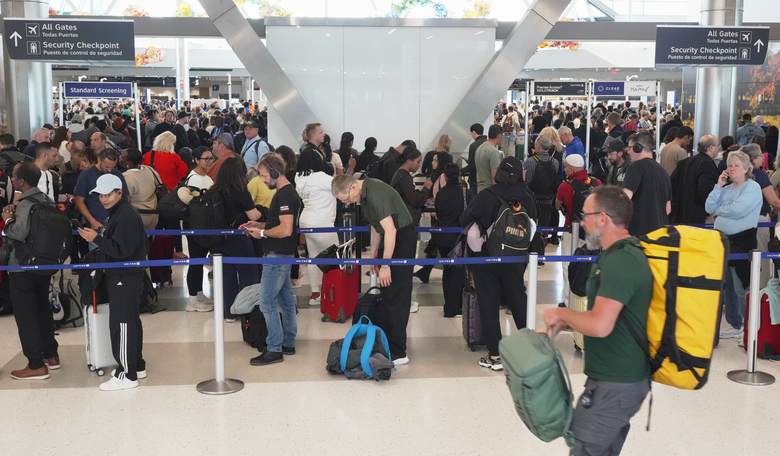
Time was when you took a loved one to the airport to catch a flight, or when you had a loved one arriving on a flight, you could walk through security and escort them to or meet them at the gate. In the post-9/11 world, that practice was greatly restricted; now you can get a pass through the Transportation Security Administration (TSA) checkpoints to meet small children or elderly/disabled relatives at the gate, but as far as the old practices, those were gone.
Now, the Department of Homeland Security may be renewing this practice, at least in part. Department of Homeland Security (DHS) Secretary Markwayne Mullin appeared recently on Fox News' Fox and Friends to describe the changes.
.@SecMullinDHS on TSA's new program allowing non-passengers to meet loved ones at the gate: "We came up with a program that doesn't compromise security at all - it's just a part of the known passenger process. We hope that it will help the passenger experience." pic.twitter.com/y2NKn4v90w
— Rapid Response 47 (@RapidResponse47) September 8, 2026
Secretary Mullin says:
What we're really trying to do is look at the most forward-facing government agency in the country, and that's TSA. TSA obviously was created to keep our skies safe, and our passengers safe as they are traveling. We have 2.4 million passengers every single day that go through TSA. And, we have loved ones... I mean, I have kids, that, when they were younger, they would fly, and my wife and I would have to get special permission to be able to walk them to the gate, and to let them go. And while it's not just kids, it's also adults, its our wives, it's our parents, elderly parents, or our grandparents that we want to pick up at the gate. And so, we're trying to look at, how can we do this better and still keep everybody safe. Well, so, we started going through the same thing as known passengers, or global entry, if we can do it with that, we can also do it with passengers that may need special assistance or just a little extra attention. What about veterans that are coming back, that their loved ones want to meet them at the gate? So, we came up with a program that doesn't compromise security at all. It's just part of the known passenger process. And we hope that it will help the passenger experience. Because TSA sometimes kind of gets a bad name. And, we're going to improve that.
The new program is being called Gateside.
The program, called Gateside by TSA PreCheck, allows eligible TSA PreCheck members to enter the secure area of participating airports to meet or see off friends and family at their gate, meet someone during a layover, or visit airport restaurants and shops.
Gateside is currently available at 13 airports across the United States, including Los Angeles International Airport, Dallas Fort Worth International Airport, Harry Reid International Airport in Las Vegas, and San Diego International Airport.
The other participating airports are Phoenix-Mesa Gateway Airport, John Glenn Columbus International Airport, Detroit Metropolitan Wayne County Airport, Wichita Dwight D. Eisenhower National Airport, Indianapolis International Airport, Bill and Hillary Clinton National Airport, Will Rogers International Airport, Eppley Airfield and Salt Lake City International Airport.
Those of us who traveled in the pre-9/11 world remember that in most places, anyone could go through security at any time, travelers or not, and I remember regularly being accosted by cult members selling flowers and books, and seeing just the general confusion that resulted from people who didn't really have any business in the terminals and the concourses just kind of wandering around. Now, today, with the growing homelessness problem in a lot of the cities where the airports named above are located we can well imagine what might ensue. But the new TSA Gateside program seems a happy medium; if you have a relative, friend, or loved one departing or arriving at Gate X on Flight Y, you should be able to pass through TSA and meet them at the gate/deliver them to the gate.
It would have been nice to have had this practice looked at 20 years ago, but government all too often works at the pace of a spavined snail.