
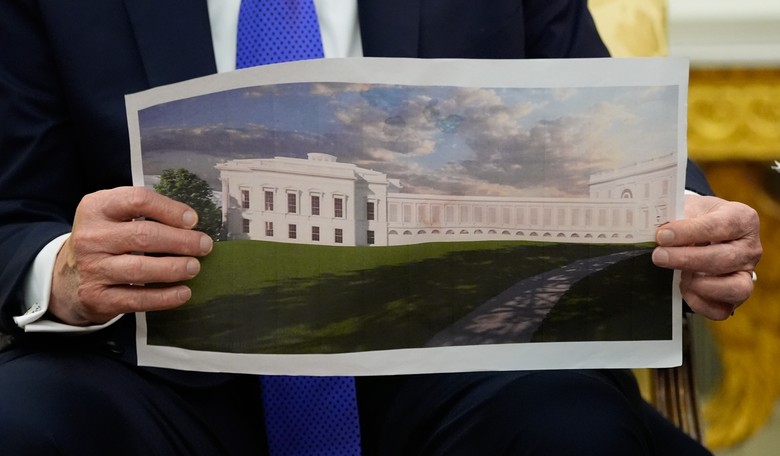
On Monday, the Supreme Court cleared the way for construction on the White House ballroom to proceed. The High Court granted the Trump administration's request to stay the injunction blocking above-ground construction of the new White House East Wing/ballroom project.
What this means is that construction can continue while the administration seeks Supreme Court review of the case. But the 5-4 ruling comes with a significant wrinkle: Chief Justice John Roberts joined the three liberal justices in dissent and declared that the construction itself is “likely unlawful.”
In other words, SCOTUS isn't saying Trump can legally build the ballroom; it's saying that the group challenging it probably doesn't have standing to stop him.
The whole kerfuffle began when the National Trust for Historic Preservation sued over the East Wing project. D.C. District Court Judge Richard Leon granted a preliminary injunction on March 31 that, as clarified, allowed work on the underground military facility but largely stopped above-ground construction. The D.C. Circuit Court of Appeals initially stayed Leon's order, allowing the work to continue, but then it ultimately upheld the injunction on August 7.
Chief Justice Roberts then issued an administrative stay while SCOTUS considered the administration's emergency application. Today's ruling replaces that temporary administrative measure with a stay from the full Court pending the government's forthcoming petition for writ of certiorari and (if granted) the ultimate resolution of the case.
As indicated, standing was the basis for today's provisional win for the administration: National Trust relied on member Alison Hoagland, a D.C. resident and historic-preservation expert who regularly visits the White House area to establish that standing. Hoagland argues that the ballroom's “scale,” “height,” and “massing” would harm her aesthetic, cultural, and historical interests.
But the SCOTUS majority, in its per curiam decision, says that's not enough — mere “offense, disagreement, or distaste” over government action isn't a concrete, particularized injury allowing someone to sue. Nor does Hoagland's particular expertise give her a special standing exception, as the Court notes that Article III standing “is not measured by the intensity of the litigant's interest.” Ruling otherwise, the majority posits, could effectively allow anyone offended by a government project to sue over it.
To bolster its case, the administration emphasized both national security concerns and the balance of the equities. The administration submitted declarations from senior national-security officials arguing the underground facility and ballroom constitute one integrated construction project. The Army Secretary says the ballroom's height and mass are important to protecting the underground military facility. Additional concerns include Secret Service operations, foreign intelligence gathering during prolonged construction, and structural/construction problems from stopping work midway. Ultimately, the majority finds that those concerns substantially outweigh Hoagland's claimed aesthetic harm.
Again, though, the Court emphasizes that, “Today, we do not pass upon the legality of the government's East Wing project.” In fact, in Roberts' dissent, joined by the Court's liberal contingent, he states that, "That construction is likely unlawful." Roberts contends that Congress has prohibited construction of buildings on federal public grounds in D.C. without its “express authority” and that President's Park qualifies. Here, Congress hasn't expressly authorized the project. And, Roberts contends, a roughly $2.5 million appropriation for White House maintenance/improvements isn't authorization to use hundreds of millions in private donations to demolish the East Wing and replace it with a ballroom. Nor does the National Park Service's general authority to manage President's Park provide the necessary congressional authorization.
So, what does today's ruling mean from a practical standpoint? Well, for now, the ballroom construction continues. The government now must file its petition for cert, and if SCOTUS declines to hear the case, today's stay automatically dissolves; if SCOTUS takes it, the stay lasts until the Court issues its judgment.
Meanwhile, the underlying question — does the president actually have legal authority to build this thing without express congressional authorization? — remains unresolved. Either way, though, for now, Trump has the five votes he needs to keep building the ballroom. And with the Supreme Court's stay remaining in place through its consideration of the case, there's another practical question looming over the litigation: How much — or all — of the ballroom will be built before the courts ever definitively decide whether the administration had the legal authority to build it in the first place?