
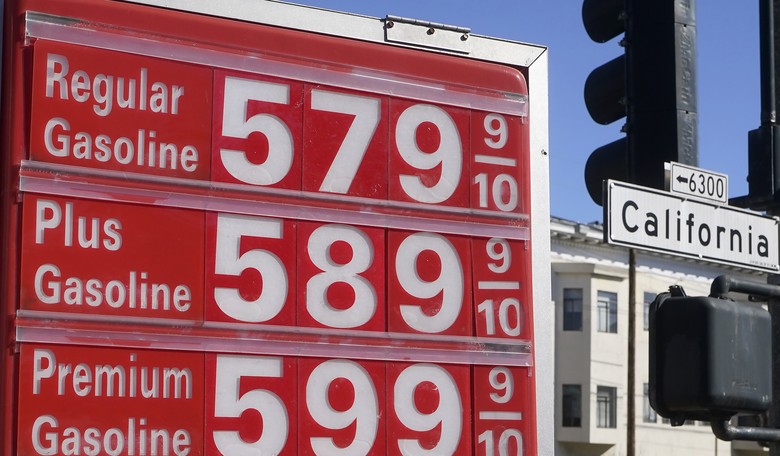
Most people are keenly aware of gasoline prices. We see them go up and down every day in our daily travels. Prices for gasoline and diesel fuel are emblazoned on the landscape in huge, illuminated signs at every gasoline station, every convenience store, every place where you can stop and fuel up your benzene-burner. Energy costs are at the heart of every aspect of our economy, folded into every economic decision we make, every price we pay; but nowhere are we so deluged with that information as we are with gasoline prices.
Now, they are uncomfortably high, and it may well cost the Trump administration and Congressional Republicans in November.
Gas at the pump costs 40% more than it did before the Iran war began in February, according to the Energy Information Administration. And whether you’re a die-hard Democrat or red-blooded Republican or somewhere in between, everyone pays directly or indirectly for that hike.
Historically, this would be awful news for the White House occupant. Political scientists seem to agree that, unlike some trends that preoccupy pundits, gas prices really do move the needle on presidential approval.
That's understandable; it's highly visible. In any crisis, prices, as the saying goes, go up like a rocket but come down like a feather. Everyone knows whether gas prices are rising or falling; they usually have a pretty good reason why, and most people understand that government, especially the federal government, can have at least some influence over those prices. The president's power to affect gas prices isn't as great as many people seem to think, but that's immaterial; the president, any president, is the guy whose name is on the blame line.
Gasoline is a substantial part of the typical family’s budget, of course, but its real influence may lie in its simplicity. As Northwestern University’s Laurel Harbridge-Yong said on Matt Grossmann’s “The Science of Politics” podcast, you drive by gas stations with enormous price signs all the time. If you have a gas-powered car, you fill up regularly, so you have a common point of comparison. And, unlike with groceries where the long receipt obfuscates individual changes, you watch your wallet empty as your car fills up.
Average nationwide gasoline prices right now, as of this writing, are at about $4.08 a gallon. When President Trump took office in January of 2025, they were at about $3.08 a gallon. One year later, shortly before the Iranian conflict started, they were at about $2.80 a gallon.
There are other factors, ones that Washington can affect to some degree; as prices rise and fall, the Renewable Fuel Standard (RFS) tax does likewise; this is the program that is pushing things like biofuels. This RFS cost is a considerable addition to fuel prices, and it's increasing rapidly.
Under EPA’s final renewable volume obligations for compliance years 2026 and 2027, the agency elected to reallocate 70% of previously exempt volumes—above the range advocated by petroleum interests and below the level sought by biofuel interests. Following the late March 2026 announcement, RIN prices, already elevated, rose between 6% and 9%.
What it all adds up to is this: Gasoline prices are too darn high, and anything that can be done to bring them down before November will help Republicans in what is increasingly looking like an uphill battle to hold the Senate and the House of Representatives. Now, President Trump has just concluded a deal with Venezuela, which nation has by far the largest petroleum reserves in the world, and we already have Gulf Coast refineries set up to process Venezuelan crude into gasoline, diesel, and other products. The question is, how fast can that happen? How soon can we start seeing an increase in supply that should be enough to bring prices down? And what action can either Congress or the president take on the ridiculous, climate scold-appeasing RFS?
These are two more major questions that the Republicans in Congress and the White House need to be looking at right the heck now. Clock's a-ticking.