
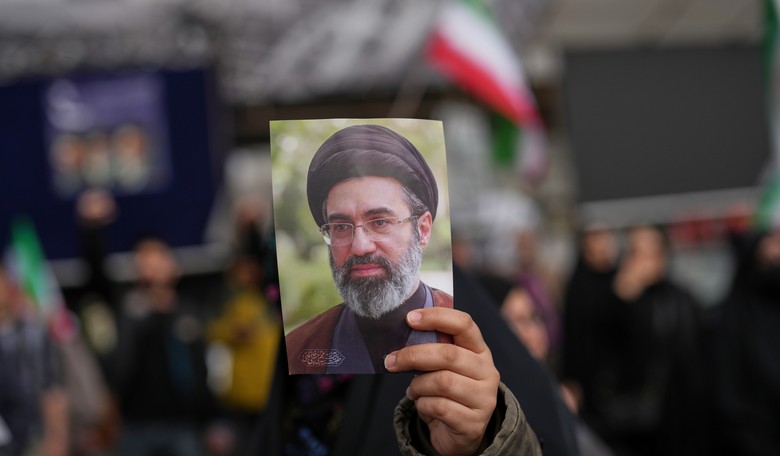
Iran is nothing if not inconsistent. Right now, they seem to have a bad case of the right hand not knowing what the left is doing. Nobody really seems to understand who's calling the shots, either in Iran or elsewhere. Supposedly, the Supreme Leader, Mojtaba Khamenei, is still issuing statements, but there have been no public sightings of him since the American air strike that reduced his father, the previous Supreme Leader, to ambient temperature. Mojtaba Khamenei was reported to have been injured in that strike, but we haven't seen him since.
He does seem to be still issuing statements, or at least, someone is issuing them in his name. Now he's bemoaning Iran's collapsing economy, and indicating that Iran may be willing to come back to the bargaining table. Trouble is, we've heard that kind of thing from Iran before.
Iran’s Supreme Leader Mojtaba Khamenei said "there is the need to seriously address the chain of economic and livelihood challenges, such as inflation, unemployment, management of prices and the market for goods and services," according to Reuters, as the U.S. economic campaign against Tehran is mounting.
The Treasury Department launched Operation Economic Outcast against Iran on Monday, and on Friday, revealed it is taking action against a United Arab Emirates bank in a bid to “cut off a key financial lifeline and sanctions evasion vehicle for the Iranian regime.”
Iranian President Masoud Pezeshkian said to state media that Iranian exports have dropped nearly 35% due to ongoing sanctions against Iran and a U.S. military blockade of Iranian ports, Reuters added.
Good. Let's squeeze those exports down to zero. Now, the Iranian president we do know to be alive, so his statement counts for, perhaps, a little more. But this bit is also interesting:
Iranian ambassador to Germany Majid Nili said Tehran is ready to prepared in dialogue again with the U.S., a report said.
"Despite the existing political atmosphere and pressures, the path of dialogue and engagement based on mutual respect is still being pursued," Nili told Iran’s IRNA News Agency, according to the Middle East Eye.
The comment comes after Iranian Foreign Minister Seyed Abbas Araghchi said Friday that “putting diplomacy back on track isn't impossible” between the U.S. and Iran.
“It hinges on U.S. understanding of one simple fact: pressure doesn't work,” Araghchi wrote on X. “The U.S. should build trust, speak respectfully, acknowledge our rights, and uphold commitments.”
That's frankly a pretty tepid statement, the likes of which we've heard before. And right now, with no military operations against Iran currently underway and with oil prices still higher than we'd like to see, Iran's suddenly making statements like this reveals one thing: The economic pressure is working. Iran is feeling the heat. Even the Supreme Leader, assuming that he actually is not looking at whatever passes for daisies in Iran from the wrong side, is making noises about how bad things are for the Iranian people. That's a good indicator, especially since the Islamic Revolutionary Guard Corps (IRGC), which is in de facto command of what's left of Iran's military, isn't saying much at the moment.
Right now, the shoe is on the other foot. Iran's president Masoud Pezeshkian is describing the sanctions by the U.S. as "asphyxiating." Time, at least in the short term, is working for the United States for once. The Iranian leadership, what there is of it, is feeling the squeeze. Now it's time to keep up the pressure. Let them stew in the juices of their failing economy for a while. Let the rank and file Iranian people become more and more restive. Let the civil leaders sweat, and let the IRGC watch as their troops grow aggravated as their paychecks dwindle due to Weimar Republic-style inflation and their families suffer. Let the mullahs sweat as they check the balances in their Swiss bank accounts and send out feelers for the possibility of asylum in Moscow.
To Treasury Secretary Scott Bessent, the message is clear: It's working. Stay the course.