
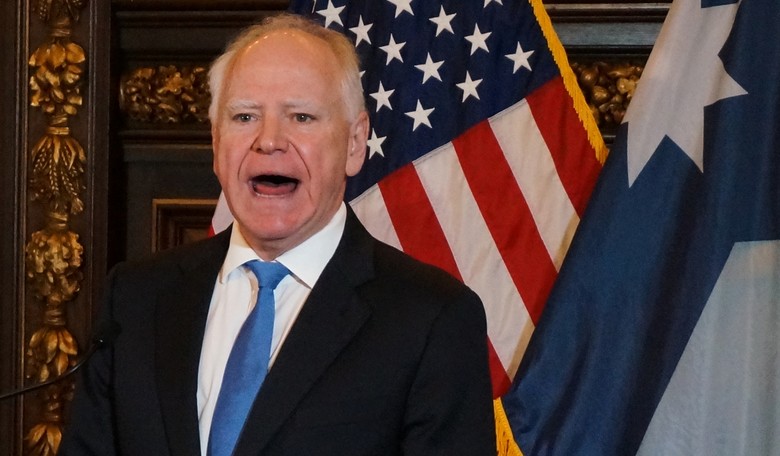
Minnesota Gov. Tim Walz (D) has suffered yet another setback in his crusade to make Immigration and Customs Enforcement (ICE) officers appear like lawless savages roaming the land and striking terror into innocent “undocumented” immigrants.
U.S. District Judge Fernando Rodriguez Jr. on Wednesday denied Minnesota’s request for a temporary restraining order (TRO) that would have forced Texas Gov. Greg Abbott (R) to sign an extradition warrant for ICE agent Christian Castro. Alternatively, the TRO would have required Cameron County authorities to keep Castro locked up until Abbott acted.
The ruling is a major setback for Walz and his ethically challenged Democrat attorney general, Keith Ellison, in a politically charged case stemming from the fallout from Operation Metro Surge.
Castro, an ICE agent, was charged in Minnesota after a January 14 enforcement operation ended with him firing a shot through the front door of a home and injuring a man in the leg.
Hennepin County authorities later charged Castro with four felony counts of second-degree assault and one misdemeanor count of falsely reporting a crime.
By then, Castro was back in Texas. The Justice Department confirmed that ICE leadership had ordered him to return there on January 15, the day after the shooting.
Texas authorities arrested him in Cameron County on May 29 on the Minnesota warrant, and he has remained in custody while the extradition request played out.
Walz formally requested Castro’s extradition on June 2. Minnesota later grew frustrated that Abbott had not signed a rendition warrant and sued Texas on August 18, claiming the governor had effectively refused to comply with federal extradition law. That was the theory Rodriguez rejected.
The judge found that Minnesota’s lawsuit was premature because Abbott had not actually denied the request.
“The record before the Court, however, reveals that Governor Abbott has not denied the request for a rendition warrant,” Rodriguez wrote.
Instead, Abbott had directed the Texas Secretary of State to investigate whether Castro qualified as a “fugitive” under the extradition laws — a step the judge noted is expressly permitted under the Uniform Criminal Extradition Act.
That distinction sank Minnesota’s request. Rodriguez ruled that Walz could not ask a federal court to intervene based on what Abbott might do later.
“Minnesota cannot premise its causes of action on the allegation that Governor Abbott may violate those authorities in the future; it must prove that a violation has already occurred,” he wrote.
And the court found no statute or constitutional provision imposing a deadline on Abbott to make up his mind.
“Minnesota identifies no statutory or constitutional provision requiring Governor Abbott to complete his investigation and decide whether to sign the rendition warrant within a particular time period,” Rodriguez wrote.
Whoops. A slight problem for Minnesota there.
That matters because Castro is approaching the end of the 90-day detention period allowed under Texas law for someone being held pending extradition. Under the Uniform Criminal Extradition Act, a fugitive not arrested on a governor’s warrant before that period expires “shall be discharged.”
At Tuesday’s hearing, Cameron County officials told the court that absent a new order or an extradition warrant from Abbott, Castro would be released on August 27.
Minnesota argued that was an emergency because Castro might flee to Mexico. Now, that is quite ironic.
The judge agreed that Castro fleeing to Mexico “would impose a hardship on Minnesota’s prosecutorial efforts,” but ruled that the possibility of future injury did not create a case the federal court could decide now.
The state submitted evidence showing that Castro had been speaking regularly with a romantic partner in Progreso, Mexico, and had discussed buying property and moving there.
The ruling does contain one interesting wrinkle for Abbott. Rodriguez expressed doubts about Texas’ legal theory that Castro might not qualify as a fugitive because he did not voluntarily leave Minnesota.
The judge cited Supreme Court precedent suggesting that someone can still be treated as a fugitive simply because he committed an alleged crime in one state and was later found in another — regardless of why he left.
But that question was not enough to save Walz’s TRO. The judge ultimately ruled the entire dispute was not yet ripe for federal intervention and concluded Minnesota had failed to show a substantial likelihood of success on the merits.
And Rodriguez went even further in a footnote: Even if the case were ripe, he said Minnesota still had not shown Abbott violated the Extradition Clause, the Extradition Act, or the UCEA simply by taking roughly three months to consider the request.
Rodriguez did leave open the possibility that a sufficiently prolonged delay could eventually amount to a constructive denial of Minnesota's extradition request, but said the case hasn't reached that point.
That gives Abbott a fairly strong ruling to wave around while Minnesota fumes.
Ellison responded by accusing the Texas governor of “playing with constitutional fire” and vowed to keep fighting.
Abbott’s office, meanwhile, said the court got it right and argued Texas is entitled to investigate whether Castro legally qualifies as a fugitive before the governor signs anything.
Walz has spent years arguing that Minnesota should not be compelled to turn local law enforcement into an arm of federal immigration enforcement. He has repeatedly blasted ICE operations, called Trump-era enforcement abusive, and pushed back against federal efforts to expand immigration enforcement inside the state.
Now he is asking a federal court to compel another governor to move faster against an ICE agent.
And Texas, for the moment, is the state telling Minnesota that the law does not move simply because Tim Walz wants it to.
Gov. Abbott essentially told Tim Walz to “Come and Take It.” And Walz decided promptly to “mess with Texas.”
And, as far as round one goes, Walz lost.