
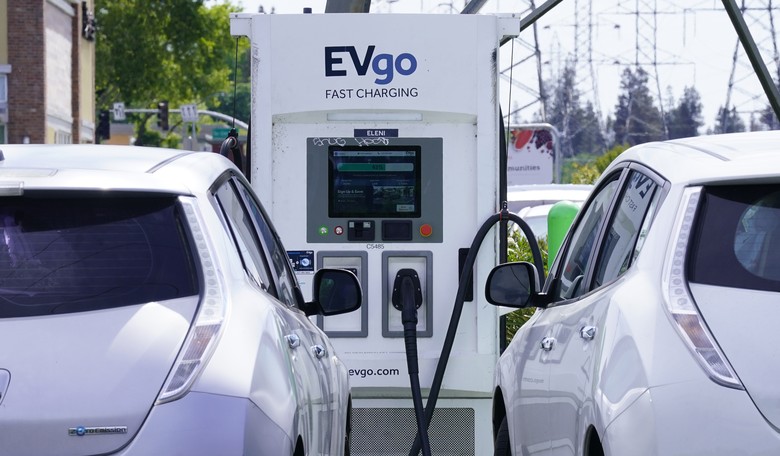
Despite years of heavy subsidies, mandates, and nonstop green promises, a new study shows that owning an electric vehicle is still a major headache in many of the country’s most progressive states.
New Jersey ranks as the least convenient place in America to drive an EV, with 74 electric cars competing for every charging station. 74! Can you even imagine that many vehicles competing per gas pump?
To be fair, the Garden State, with its ridiculous rules forbidding people from pumping their own gas, is the worst state in the country to drive, period. The family and I often plan gas stops in specific locations simply to ensure we can drive right through Jersey.
California, meanwhile, despite having the largest EV fleet in the nation, also lands near the top of the inconvenience list compiled by Law Bear.
High electricity rates, extra registration fees, and long waits at chargers are a common theme — a daily reality for drivers — even after billions of dollars in federal and state spending meant to fix these very problems.
As usual, the concept behind the Green New Deal seems little more than a blue-state, money-generating scam.
All five of the top five least convenient states for EV ownership are blue or blue-leaning. New Jersey, as we already mentioned, leads the nation with a crushing 74 electric vehicles per charging station and a $260 annual registration fee on top of it. A gas-powered passenger vehicle in the state, by comparison, will set you back between $46.50 and $84, depending on the car’s weight and age.
You're being financially punished for switching to the supposedly environmentally friendly electric option.
Hawaii, where drivers face both scarce chargers and electricity prices near 50 cents per kilowatt-hour (kWh) — high enough to wipe out much of the supposed savings — follows closely behind on the list.
California, home to more than a million EVs, still has 62 cars competing for every station and offers no state purchase tax credit. Allow me to repeat that: You do not get a tax credit for purchasing an electric vehicle in the most progressive state in the nation.
Washington and Nevada round out the top five, neither of which offers tax credits.
Elon Musk himself has pointed this out:
The article is totally false btw. You can add up every government incentive my companies have ever received and they amount to less than 2% of the value of SpaceX and Tesla!
— Elon Musk (@elonmusk) June 14, 2026
And many of these incentives actually helped our competitors disproportionately to Tesla or SpaceX.
For…
Embedded tweet continues:
... example, when President Trump removed the $7500 tax credit for electric vehicles, Tesla sales actually INCREASED, because more buyers shifted from other EV makers to Tesla.
"We often hear that EVs help you save money, but the reality is more complicated," a spokesman from the firm that compiled the study tells RedState. "The average electric vehicle costs over $40K, and in some states, electricity rates are so high that charging expenses can add up fast. EVs depreciate faster than gas cars, too, meaning you lose more money when it's time to sell."
"Electric vehicles are the future, sure, and they promise better safety. But whether getting one now makes financial sense is still up for debate."
Not much of a debate unless you have the means to toss money out your moonroof. The numbers do not lie, even from an overall national perspective. The data consistently shows overcrowded chargers, high electricity rates, extra registration fees, and a still-massive national charging deficit across the board.
This is government-driven technology forced on the public during the Biden era before the infrastructure, not to mention the economic feasibility, for many states was even in place. It was an irresponsible push for a dream that worked only in the imagination of progressives running the previous administration.
None of this is a knock on the better-engineered EVs themselves. Tesla, in particular, has proven the technology can be excellent when the private sector leads instead.
Tesla Supercharger energy delivered is growing exponentially https://t.co/6hEQ4FKDyN
— Elon Musk (@elonmusk) April 1, 2026
The study comes as California Governor Gavin Newsom (D) just announced another $95 million in taxpayer money for more EV chargers and hydrogen stations. Because wantonly throwing cash at the problem is ever an effective solution.
This is the same state that already ranks near the top of the EV inconvenience list, struggles to keep the lights on during times of peak demand, and charges residents some of the highest electricity rates in the nation. Pouring tens of millions more into charging infrastructure while the grid is this blatantly unreliable shows how divorced left-leaning politicians are from the everyday reality on the ground.