
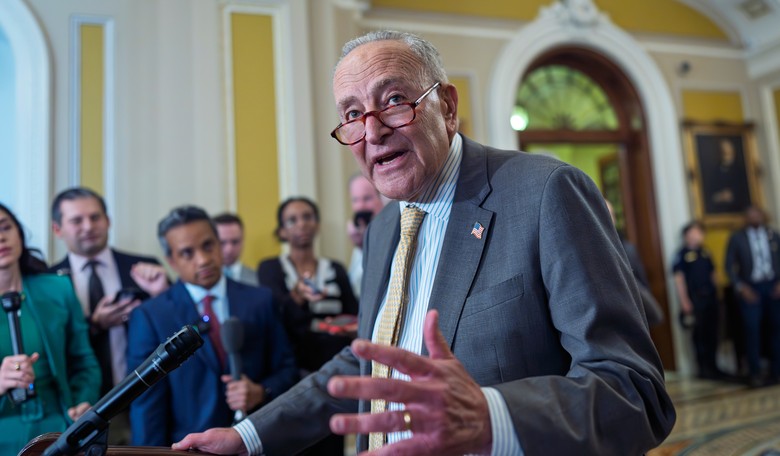
Chuck Schumer may not be partying as hard as his fellow Democrat Senate colleagues, despite massive developments for the future of their party.
The scale of the Republican Party's defeat in the 2026 midterm elections is becoming clear, with Democrats securing 55 Senate seats and closing in on a possible 56th as the final votes are counted in Alaska. The results represent a crushing reversal from the 53-47 Republican majority that existed before Election Day, leaving the GOP facing a difficult road back to power.
Former Democratic Rep. Mary Peltola has expanded her lead over Republican Sen. Dan Sullivan in Alaska, putting Democrats within reach of a nine-seat gain. According to Alaska Public Media, Peltola led by more than 10,000 votes after Friday's count, with approximately 96 percent of ballots counted. The Associated Press had not called the race as of Saturday morning, and the state's ranked-choice tabulation is scheduled for November 18.
Even without Alaska, the Democratic victory is considerably larger than many political observers expected. The party has already flipped eight Republican-held seats, including several in states where Republicans entered the election with substantial advantages.
As RedState's Adam Turner noted in his final Senate polling analysis, Democrats faced a punishing electoral map. The party needed to capture four Republican seats to win the majority, including contests in states Donald Trump carried comfortably in 2024.
Instead, Democrats blew past that threshold. The losses began in North Carolina, where former Democrat Gov. Roy Cooper defeated Republican Michael Whatley by nearly 20 percent. In Maine, Democrat Troy Jackson unseated longtime Republican Sen. Susan Collins, ending her nearly three-decade Senate career.
Texas delivered one of the night's biggest surprises, with Democrat James Talarico defeating Republican Ken Paxton by approximately 12 points. The victory ended decades of Republican control of the state's U.S. Senate seats and accompanied a broader Democratic breakthrough in Texas politics.
Ohio saw former Democratic Sen. Sherrod Brown reclaim a seat by defeating Republican incumbent Jon Husted. In Iowa, Democrat Josh Turek defeated Republican Ashley Hinson, while Kansas delivered another major upset when Democrat Adam Hamilton unseated Sen. Roger Marshall.
The Democratic victories extended even deeper into Republican territory. In South Carolina, Democrat Annie Andrews won a Republican-held seat, while Mississippi delivered a particularly narrow upset when Democrat Scott Colom defeated Sen. Cindy Hyde-Smith.
Those eight victories alone transformed the Senate map. Democrats also successfully defended their seats in Michigan, where Abdul El-Sayed defeated Republican Mike Rogers, and Georgia, where Sen. Jon Ossoff won reelection against Republican Mike Collins.
Taken together, the results amounted to a political bloodbath for Republicans, with the party losing seats across the Midwest, South and Northeast. Several races that once appeared securely Republican ended in Democratic victories, suggesting the national political environment overwhelmed longstanding partisan advantages.
The consequences extend well beyond the next Congress. If Peltola prevails in Alaska, Republicans will enter the 2028 election cycle holding just 44 Senate seats. Even a successful presidential campaign would leave the GOP needing six net Senate pickups merely to produce a 50-50 chamber in which a Republican vice president could break ties.
That would require a strong Republican election cycle, including victories in competitive states such as Ohio, Georgia, Pennsylvania, Arizona and Nevada, along with a breakthrough in a Democratic-held seat such as New Hampshire or another opportunity elsewhere.
Republicans would also have to defend their existing seats, including contests in Wisconsin, North Carolina, Alaska and other states that could become competitive. A single unexpected loss could complicate the path further.
Meanwhile, Democrats are already fighting over who should lead their expanded Senate majority. Sen. Chris Van Hollen of Maryland has launched a challenge against longtime Democrat leader Chuck Schumer, arguing that the party needs new leadership to meet the demands of voters who delivered its decisive victory.
Van Hollen has attracted support from Sen. Bernie Sanders and incoming senators Abdul El-Sayed and Peggy Flanagan, along with other Democrats seeking a more confrontational approach toward the Trump administration. His support stands at five senators and growing, as Axios reported.
Schumer, however, insists he already has the votes to retain his leadership position. Several established Democrat senators have publicly backed him, arguing that replacing the leader who presided over such a substantial electoral victory would make little sense.
The fight exposes divisions within the Democratic Party even as it prepares to take control of the Senate. Progressives want a more aggressive agenda, while other members favor retaining experienced leadership and maintaining a broader political coalition.
For Republicans, however, the immediate problem is more fundamental. The party must determine how it suffered such extensive losses in states that appeared reliably Republican only two years earlier. Candidate selection, voter dissatisfaction, campaign organization and the national political environment all deserve examination.
The results also raise difficult questions about whether Republicans have adequately addressed the economic and political concerns of voters who supported Trump in 2024 but declined to support the party's Senate candidates in 2026.
Even a strong Republican presidential performance in 2028 would face the obstacle of an unfavorable Senate map, potentially limiting the next administration's legislative agenda and judicial appointments.
The 2026 midterms have reshaped the balance of power in Washington. Democrats have won a commanding Senate majority, and Republicans face the prospect of spending several election cycles rebuilding their position.
Alaska may still determine whether the final Democratic total reaches 56 seats, but the larger result is already settled. Republicans have suffered a sweeping Senate defeat, and recovering from it may not just take the next election, but the subsequent election after that.