
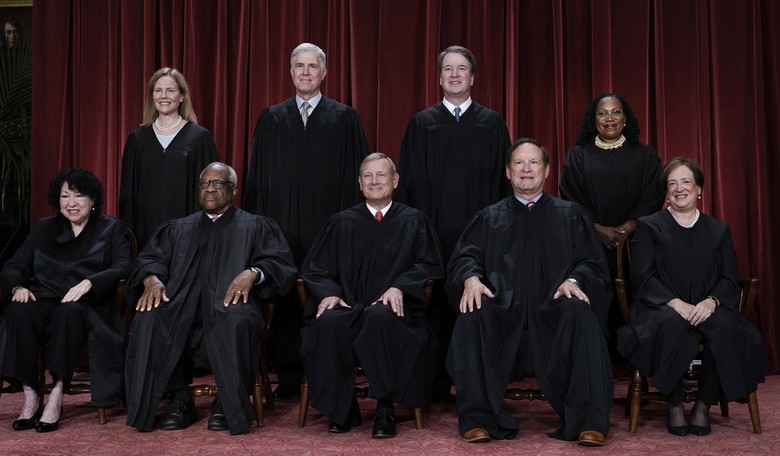
Supreme Court Justices Neil Gorsuch and Sonia Sotomayor don't exactly have a reputation for marching in lockstep.
Appointed by Republican and Democratic presidents, respectively, the two frequently approach constitutional questions from opposing perspectives.
But every so often, a case comes along that makes the ideological differences look almost irrelevant.
That's what happened Tuesday when Sotomayor, joined by Gorsuch, sharply criticized the government's prosecution of a Mexican national for illegal reentry, warning that the circumstances raised "serious constitutional problems."
The case involved Jesus Herrera-Salazar, who was convicted of illegally reentering the United States after being discovered in Texas in 2020.
Following his first conviction, Herrera-Salazar remained in the country under supervised release, as required by federal authorities. He was subsequently discovered in Oklahoma and prosecuted again for illegal reentry.
There was just one problem: He had never left the United States between the two prosecutions — in fact, as Sotomayor notes in her statement, Herrera-Salazar "was expressly instructed not to leave the Eastern District of Oklahoma" during his supervised release.
Sotomayor, Gorsuch blast illegal immigrant's prosecution as 'constitutional absurdity' https://t.co/Di90VJBibY https://t.co/8A24hllPDE
— New York Post (@nypost) October 14, 2026
Herrera-Salazar argued that punishing him twice for what amounted to one continuous offense violated the Fifth Amendment's Double Jeopardy Clause.
The 10th Circuit disagreed, treating the convictions as separate offenses. Sotomayor and Gorsuch weren't buying it.
"When a defendant is convicted of a crime that involves continuous, uninterrupted conduct, our precedents and the logic of the Double Jeopardy Clause strongly suggest that the Government is barred from charging that defendant with the same continuous crime for a second time simply by focusing on a different time marker," Sotomayor wrote, joined by Gorsuch.
"That makes sense."
The two justices agreed that the Supreme Court should decline to hear the appeal because Herrera-Salazar had already served both sentences and was deported in 2024.
But they made clear that lower courts should not repeat what happened.
"Should circumstances like these arise again, I encourage courts to avoid the constitutional absurdity that occurred here and give the Double Jeopardy Clause its full weight and meaning," Sotomayor wrote.
The ruling underscores a basic constitutional principle: The government's authority to enforce immigration law does not include permission to prosecute someone twice for the same offense.
The rare episode comes amid a busy Supreme Court term involving immigration enforcement and the Trump administration. And the Supreme Court has handed the administration a number of wins.
As RedState's Susie Moore reported earlier this month, the justices recently vacated a 9th Circuit ruling against the administration in its dispute over Temporary Protected Status for Venezuelan nationals.
That decision sent the case back for reconsideration under an earlier Supreme Court ruling limiting judicial review of certain TPS decisions.
It has been a busy time for Supreme Court rulings. And when justices can put aside ideological differences and side with the Constitution, it is a good day for the court.