
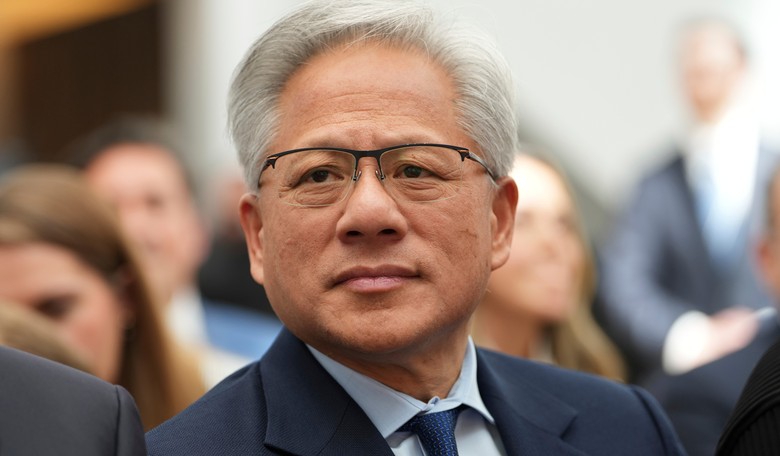
Immediately after National Economic Council Director Kevin Hassett spoke with Jake Tapper about all things Nvidia, Rep. Jim Himes, the ranking member on the House Permanent Select Committee on Intelligence, joined Tapper to discuss the same issue, leading off by calling Hassett's remarks "absolute nonsense."
Of course a Democrat is going to be calling remarks from a Trump administration official absolute nonsense, but Himes at least had a decent reason for his claims on this occasion.
Related to the Nvidia board of directors' decision to reinstate its founder, Jensen Huang, Hassett told Tapper that "[W]hat the president did is that he got everybody together and he made sure that the board of Nvidia had all the correct information they needed to make a judgment on this matter... making sure they had all the correct information, rather than leaks and spurious press attacks."
Just what was that information? Hassett said that a lot of the intel related to "what was going on" is "highly classified," so that wasn't shared with the board, but he's "sure that they were very, very careful to give the people the information they needed without violating classified information."
Again, what information? Hassett said, "It's like all of that stuff needed to be clarified for the board so that they could make a rational decision."
According to Rep. Himes, there's a lot our government doesn't know yet, or at least a lot that the Gang of Eight hasn't been told. He said (emphasis mine):
I mean, we know two things, right, both of which are important. Number one, the board, in firing Jensen Huang, they didn't know what the relationship was like with Alice Huang. By the way, we still don't know what the relationship was like with Alice Huang.
. . ."I'm a member of the Gang of Eight, right? I get briefed on this stuff. We have no idea to date -- and I have had conversations as recently as yesterday. We have no idea precisely what the relationship was between Alice Huang and the Chinese Ministry of State Security.
"We don't even know if there was a counterintelligence investigation undertaken by the FBI of Alice Huang. So, what Donald Trump could have said to the board that, as Kevin Hassett was trying to tell you was putting all the facts on the table - we do not have all the facts.
"So, in addition to everything else, the board of directors has opened themselves to the risk that it may turn out that there's more garbage in this relationship between Jensen and Alice. And how are they going to feel when that -- if and when that eventuality plays out?"
Over the next two weeks several people central to these events — Commerce Secretary Howard Lutnick, Jensen Huang, Nvidia general counsel Tim Teter, and Commerce Under Secretary Jeff Kessler — will give private and public testimony in Congress, so we'll know a lot more. But the unknowns mentioned by Himes are pretty big unknowns, especially for an issue that's been going on for two years. How is it that we (meaning, the government) don't yet know precisely what Huang's relationship with the Chinese Ministry of State Security (MSS).
Still, Himes said the Intelligence Committee has some questions for Jensen Huang in an effort to assess what damage might have been done to national security as a result of his affair with Alice Huang (no relation), because Alice Huang will likely not be available for questioning for the foreseeable future (she is reportedly in Beijing).
"Now, what we can ask Jensen Huang next week is, what information did you give her, right, because that will help us develop a sense for how much of a risk he really was. And, of course, the question is, what influence went in the other direction? Did Alice Huang pressure you or, God only knows what, to do certain things, maybe simply sell chips to companies that are handing them on to the Chinese?
"So the question really is for Jensen Huang, what information went from you to Alice Huang and what influence came in the other direction?"
According to a Bloomberg investigation published over the holiday weekend, some of Nvidia's Blackwell chips, which are not among the chips that can be legally sold to Chinese entities, made their way to a data center in Shanghai tied to Alice Huang. Himes believes that there are additional chips being used in China to train their AI, and thinks there will ultimately be a Megaspeed tie-in. He told Tapper:
There is no question in my mind that, inside China, some of the most advanced chips are training their AI today. And we will get to the bottom of why that is, because, despite what Kevin Hassett said, Howard Lutnick in the Department of Commerce was working with Nvidia and encouraged by the president.
And that's where Alice Huang's company is so interesting, because I bet we're going to find that that company was providing training capacity on Nvidia's most advanced chips, but doing it from Singapore.
Regardless of one's belief on the effectiveness of export controls on AI chips or whether it helps or harms U.S. national security to have unfettered business ties with China, at this moment in time we do have controls on the sale and use of those chips, and if those laws were broken, possibly with wink-and-nod approval from the Commerce Secretary, we need to know that, and there should be accountability.