
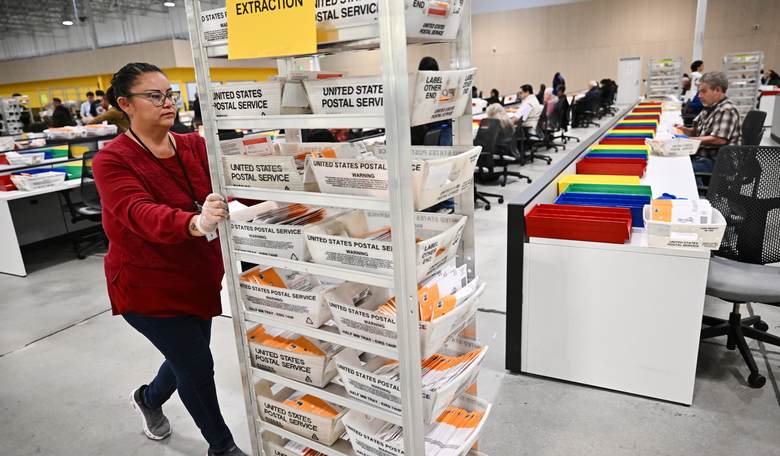
The last 24 hours have been a whirlwind of activity related to California elections and the handling of mail ballots from likely noncitizens on a list of 20,000 California voters generated by the Department of Homeland Security, and alleged threats from federal law enforcement officers aimed at election workers in the state. In the latest twist, the Biden-appointed activist judge in the Northern District of California who issued a temporary restraining order against the DOJ has been slapped down by the 9th Circuit Court of Appeals.
District Judge Trina Thompson issued the TRO, requested by the SEIU on behalf of election workers, Friday evening. Under that order, the DOJ and DHS were told they "shall not threaten, intimidate or coerce state or local elections officials or workers to demand that they halt processing the ballots of any registered voter solely on the basis that the ballot belongs to an individual alleged by Defendants to be ineligible to vote," demand that any election official segregate ballots from specific "registered voters" on the basis that the voter was on the DOJ list of likely noncitizens, or "threaten state or local election officials and workers with criminal prosecution for processing or counting ballots in the 2026 election." She also ordered DOJ to inform her of "any pending search warrant applications, grand jury subpoenas, or other demands to access election materials or ballots pertaining to any list of individuals alleged by Defendants to be ineligible to vote, or compel testimony related thereto."
As I wrote at the time, even though I'm not an attorney, I'm skeptical that she has the authority to issue such an order. Our friend Bill Shipley, a/k/a Shipwrecked Crew, went a bit further, saying, "There is black letter authority that a federal law enforcement officer can ADVISE anyone of the law and the possible consequences of violating the law. This judge is an idiot."
Judging by the happenings since that time, he might have a point. At 7:45 PM PT on Monday night the 9th Circuit Court of Appeals granted the DOJ's motion to stay the TRO pending appeal, saying that one reason they were able to review it at all was that Thompson ordered the TRO to be in effect for 17 days, which is longer than the default TRO period of 14 days.
A TRO has the effect of a preliminary injunction (and is therefore reviewable by the court of appeals) when it lasts longer than the default TRO period of fourteen days, when it requires mandatory action, or when, absent review, the appellant “would be effectively foreclosed from pursuing further interlocutory relief."
The TRO here has all three features. It lasts an initial period of seventeen days, it requires mandatory action by the Government (notifying every recipient of the letters and disclosing pending subpoenas and warrant applications), and it bars the Government from demanding ballot sequestration until and beyond Election Day, which renders later interlocutory relief meaningless for the Government’s purposes.
Whoops.
But it gets better. Thompson apparently realized her mistake sometime Monday and attempted to amend the order to only last 14 days, but the DOJ had already appealed, so she no longer had jurisdiction.
For the legal nerds, a few other nuggets from the 9th Circuit opinion:
Plaintiffs’ VRA claim faces an immediate problem: Section 11(b) does not contain an express private cause of action. See 52 U.S.C. § 10307(b). Instead, the VRA’s text vests enforcement authority in the Attorney General.
The more fundamental problem is that Plaintiffs’ claim would require us to recognize an implied private cause of action against the Executive.
This separation-of-powers concern has particular weight in this case. Consider the conduct at issue here: the Government delivered letters to state and local officials that requested that the states implement the Executive’s preferred policy, warned those states of the strictures of federal law, and instigated investigations into suspected violations of that law. These are core Executive functions. Congress cannot be lightly presumed to have imposed new liability for that conduct. See Trump v. United States, 603 U.S. 593, 609 (2024)
We therefore decline Plaintiffs’ invitation to read the VRA as rendering the Executive’s exercise of those functions as unlawfully intimidating, threatening, or coercive.
Just as legal watchers were digesting the opinion, everything changed. The dissenting opinion in the Monday night ruling was from Chief Judge Mary Murguia, who requested an en banc hearing. So the 9th Circuit requested pretty immediate briefing from the parties, and then at 10:23 PM PT issued an order that the case be reheard en banc and vacating the three-judge panel order.
Which brings us to the current action, for which there's some cause for cautious celebration. Around noon PT Tuesday, the en banc panel issued an order stating:
A majority of the en banc court has voted to reinstate the three-judge panel’s order filed on November 2, 2026. Pending further order of the court, the three judge panel order filed on November 2, 2026, and previously vacated, is reinstated.
What will happen next? Who knows. There's a possibility that they could hear the case as a "super en banc" since this panel was comprised of 11 judges and not all 29 on the 9th Circuit. Given the hour, that's not likely to happen today. But never say never.