
Lots of us are readers, and that's an unalloyed good thing. Some of us started reading at a very early age; for me, it was somewhere around four. When I went to kindergarten, I remember having to go see the principal and read to her, because the teacher wasn't sure how to deal with a kindergartner who already knew how to read, that being the first major hurdle in most of my peers' formal education. I thought I was in trouble. But it all worked out, and while my classmates were learning the ABCs I already knew how to piece together, the teacher, as instructed by the school principal, just let me read.
And back in that long-lost time, one of my favorite things to read was the adventures of a certain British bear of very little brain, his home and friends in the Hundred Acre Wood, and the boy Christopher Robin who was at the center of everything.
Now, that silly old bear Winnie the Pooh has turned 100 years old.
“Pooh, promise you won’t forget about me, ever. Not even when I’m a hundred,” Christopher Robin implores his bear in the final chapter of AA Milne’s The House at Pooh Corner. This week Winnie-the-Pooh himself turned 100, and he certainly hasn’t been forgotten. Birthday celebrations have included a week of special programmes, introduced by the queen, on Radio 4; a collection of Royal Mail stamps; and a Google doodle.
Not bad for “a bear of very little brain” who appeared in four slim books. Winnie-the-Pooh, illustrated by EH Shepard, was published on 14 October 1926 and had sold 150,000 copies in the US by the end of the year.
Pooh and his friends may have been the Harry Potter of his time. Even when I was little, in the mid to late 1960s, most of my friends knew of Pooh and could name his many friends, including Owl, Kanga and Roo, Rabbit, Eeyore the donkey, Piglet, and of course the bouncy Tigger. Long before Disney animated the characters, most of us little Boomers knew of Pooh's stories; if we hadn't read them, we had them read to us.
It's interesting that the Guardian piece linked here compares Pooh to another famous British bruin.
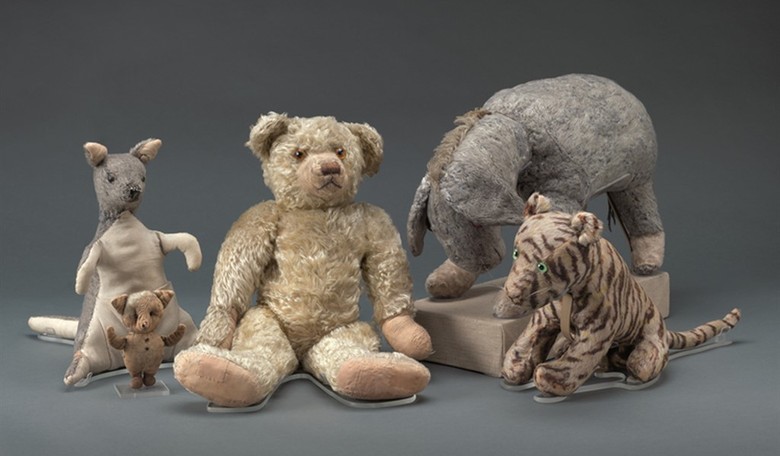
Both stories were created in the aftermath of war: Winnie-the-Pooh was Milne’s escape from the horrors of the Somme; Paddington was inspired by evacuees in the second world war. Pooh was based on a toy from Harrods, Paddington on a solitary teddy that Bond found in a toyshop on Christmas Eve. The Hundred Acre Wood is a sheltered rural idyll; Paddington arrives at a bustling postwar London station. Both are beloved at Buckingham Palace, but it was the bear from Peru who was invited to tea for the platinum jublee of Queen Elizabeth II.
Whatever the sources, it's Pooh that will always be my preference, even now. When my kids were little, I read them the Pooh stories. When my grandchildren were little, I read them Pooh's stories. And, in the next few years, when I have great-grandchildren, I still have Pooh's stories at hand.
Pooh's story hasn't ended yet. In 2018, out came the movie Christopher Robin, with Ewan McGregor in the title role of an adult Christopher Robin who is once more visited by his old friends; in that film, Pooh was still his old self; a self-professed bear of very little brain, who nevertheless managed some nuggets of typical Pooh wisdom, like "I always get to where I'm going by walking away from where I've been." That's more profound than one might think at first.
I like this film in large part because the characters weren't the Disneyfied versions, but more like the originals, the illustrations in the books — and, I liked the wave of nostalgia it provoked, hearkening back to a time when I was very young.
Happy birthday, Pooh. May your tales amuse many generations to come.