
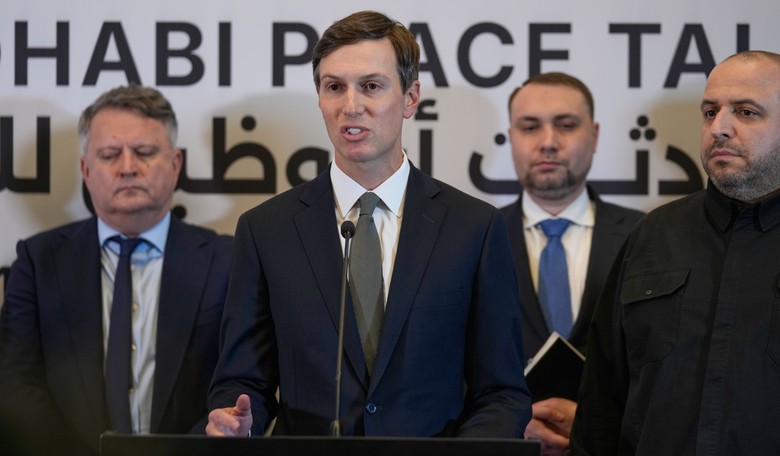
U.S.-mediated trilateral talks between Russia and Ukraine concluded in Abu Dhabi on Wednesday, after two days of negotiations. This was the first direct engagement between the parties since February and the fourth such meeting since the trilateral negotiations began on January 23, also in Abu Dhabi. The sessions produced a concrete humanitarian agreement on a large-scale prisoner exchange but otherwise ended with a whimper, not a bang; see Trump Scores Major Win As Russia, Ukraine Agree to Largest Prisoner Swap of the War – RedState.
The only tangible outcome was an agreement in principle on the largest release of prisoners of war to date. The exact number wasn’t fixed, but both sides acknowledged that more than 1,000 PWs, possibly as many as 1,500, will be involved. Prisoner exchanges, it should be noted, have happened periodically over the 57 months the war has persisted. Those exchanges were usually between 50 and 100; see Putin's War, Week 118. Ukraine Gets a Green Light From Biden and France Nearly Has 'Boots on the Ground' – RedState and Putin's War, Week 50. The Calm Before the Storm – RedState, among others. Prisoner exchanges remain the only publicly visible area where the Ukrainians and Russians seem to be able to find agreement.
Despite the sides being no closer to an agreement today than they were on February 24, 2022, everyone tried to act like something had been accomplished. Jared Kushner, who along with Steve Witkoff leads U.S. negotiations to end the war, described the discussions as “pretty tough”, yet productive, with “significant progress” on security guarantees for Ukraine and “openings and opportunities.” He noted territory remains the hardest unresolved issue.Ukrainian chief negotiator Rustem Umerov reported “huge progress” on security and prosperity issues, while stressing that ending the war and securing reliable post-war guarantees for Ukraine remain the first steps. David Arakhamia, parliamentary leader of Zelensky’s party, called the round one of the toughest because the Russian side arrived with “very strict instructions” that left little room for bargaining.
Russian chief negotiator Vladimir Medinsky offered a more mixed view. He said the sides found mutual understanding on some issues but not others. In an interesting twist, he seemed intent on bootstrapping these negotiations with a larger mission of changing the current European security system. Ominously, he said that “every inch of Russian land will be returned to Russia, one way or another.” As Russia already occupies more than 100 percent of the territory to which it is entitled, if Russia was only interested in the return of Russian land, there would be no reason to negotiate anything.
As this was happening, the read out of a call between Finnish President Alexander Stubb gave and Norwegian Prime Minister Jonas Gahr Støre was circulating in Europe.
Stubb described his phone conversation with Putin as “a good, direct conversation.” The Russian president is “very perceptive, very analytical, very well prepared and very calm in the way he conducts a conversation,” he said. “And Putin certainly knows how to listen,” the Finnish president added.
Stubb acknowledged that Russia’s position had not changed: Putin continues to deny Ukraine’s independence, sovereignty and territorial integrity. At the same time, he said, at least now there is a return to the negotiating table in Abu Dhabi.
EU representatives were present, but Medinsky refused to engage with them and questioned why they were there.
Taking a step back, there was a clear contrast between the sides. Ukraine and the U.S. emphasized incremental progress on security architecture and humanitarian steps while keeping European involvement on the table. Russia was intransigent on meaningful steps to end the war, it wanted to expand the scope of the talks to include all of Europe, and it was negative about EU involvement despite the very large role it is playing. It declared that European security since, wait for it, Yalta, must be reconsidered. According to Medinsky, a “new, modern, updated security system” was needed that didn't "disadvantage" Russia and the war in Ukraine was merely a symptom of the failure of the current system.
As Winston Churchill is alleged to have said (If you ignore Tucker Carlson and the "Britain started World War 2" crowd), "To jaw-jaw is always better than to war-war." Anyone who thinks that negotiations aimed at ending this war have any chance of success absent some force majeure event also thought Trump was going to end the war within 24-hours of his inauguration.
Kushner and Witkoff are scheduled to meet Russian President Vladimir Putin in Moscow on November 12. They then plan to travel to Dublin to brief Zelensky.