
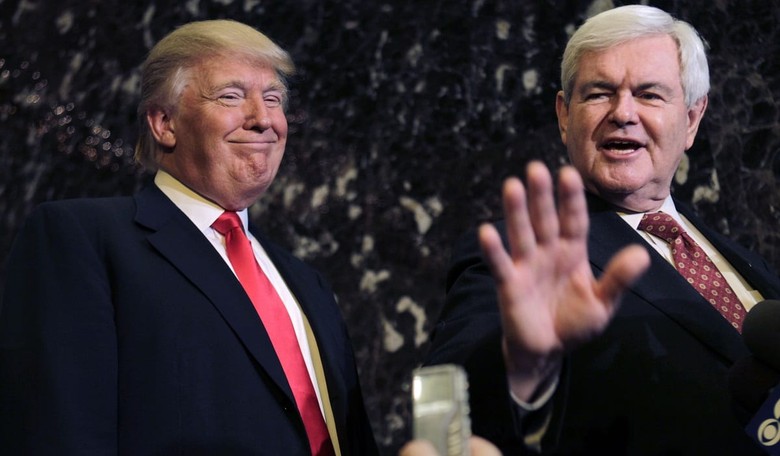

Hillary Clinton’s campaign launched a hard-hitting ad against Donald Trump on Monday, using comments by Senate Majority Leader Mitch McConnell, House Speaker Paul Ryan, Senate Foreign Relations Committee Chairman Bob Corker, former House Speaker Newt Gingrich and Ana Navarro chiding Trump for his comments about Judge Gonzalo Curiel.
The ad, too cleverly titled, “GOP disunity: Donald Trump’s comments about Judge Gonzalo Curiel,” begins with a clip of Trump’s interview with CNN’s Jake Tapper last Friday during which The Donald denies that his criticism of Curiel on the basis of his Mexican heritage is “the definition of racism”:
TAPPER: If you are saying he can’t do his job because of his race, is that not the definition of racism?
TRUMP: No, I don’t think so at all. We’re building a wall. He’s a Mexican.
Then to transition to the Republican criticism of Trump’s comments “even other Republicans are offended” appears on the screen followed by clips of:
- Video of Ana Navarro, a CNN contributor and former Jeb Bush surrogate saying, “How dare he question a judges responsibility, a judge’s adherence to the Constitution because he is of Mexican descent?
- Video of McConnell on NBC’s “Meet the Press” on Sunday. CHUCK TODD: Is it a racist statement? SEN. MCCONNELL: “I couldn’t disagree more with a statement like that.”
- Video of former House Speaker Newt Gingrich’s on “Fox News Sunday.” WALLACE: “Are you comfortable with a potential president attacking a federal judge for his heritage?’ GINGRICH: “No. This is one of the worst mistakes Trump has made and I think it’s inexcusable.”
- Video of Sen. Bob Corker on ABC’s “This Week With George Stephanopoulos.” STEPHANOPOULOS: “He says that when he questions whether the judge can be fair because of his Mexican heritage, that is not racist. Do you agree? CORKER: Look, I don’t condone the comments.
- Audio of House Speaker Paul Ryan saying, “I completely disagree with the thinking behind that.”
- Video of Navarro saying, “He is just as American as Donald Trump.”
You can watch the ad below:
There was a way for Trump to legitimately criticize Judge Gonzalo Curiel. As former Attorney General Alberto R. Gonzales points out, the test is whether there is an “appearance of impropriety” under the facts as they reasonably appear to a litigant in Trump’s position, but Curiel’s Mexican heritage alone would not be enough to raise a question of bias. But there might be legitimate concerns for Judge Curiel to address:
Curiel is, reportedly, a member of a group called La Raza Lawyers of San Diego. Trump’s aides, meanwhile, have indicated that they believe Curiel is a member of the National Council of La Raza, a vocal advocacy organization that has vigorously condemned Trump and his views on immigration. The two groups are unaffiliated, and Curiel is not a member of NCLR. But Trump may be concerned that the lawyers’ association or its members represent or support the other advocacy organization. Coupled with that question is the fact that in 2014, when he certified the class-action lawsuit against Trump, Curiel appointed the Robbins Geller law firm to represent plaintiffs. Robbins Geller has paid $675,000 in speaking fees since 2009 to Trump’s likely opponent, Hillary Clinton, and to her husband, former president Bill Clinton. Curiel appointed the firm in the case before Trump entered the presidential race, but again, it might not be unreasonable for a defendant in Trump’s position to wonder who Curiel favors in the presidential election. These circumstances, while not necessarily conclusive, at least raise a legitimate question to be considered. Regardless of the way Trump has gone about raising his concerns over whether he’s getting a fair trial, none of us should dismiss those concerns out of hand without carefully examining how a defendant in his position might perceive them — and we certainly should not dismiss them for partisan political reasons.
Trump should have checked with his great lawyers about judicial recusal before attacking the judge because of his heritage.