
According to a Seeking Alpha post on 12 April, the Federal Reserve is no longer reporting M1 and M2 numbers. This may be true because the latest M1 numbers from the Federal Reserve Economic Data (FRED) from the St. Louis Fed that were posted were for the end of February:
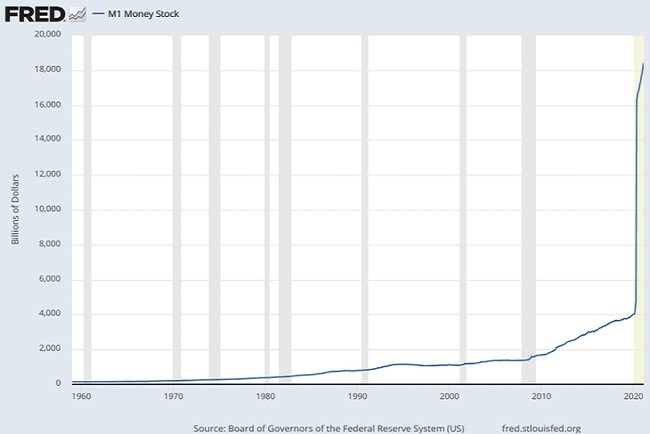
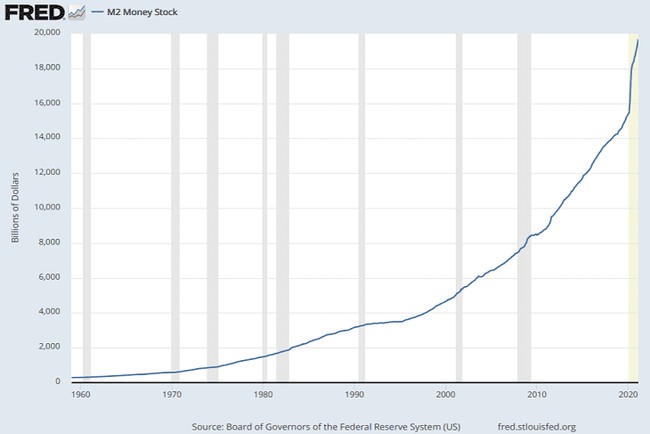
That’s $18.4 trillion, which is up a shocking 450% over the last year, while the less liquid/less volatile M2 money supply is up 30%, as shown in the below figure:
A couple of definitions are in order. From FRED/St. Louis:
M1: Beginning May 2020, M1 consists of (1) currency outside the U.S. Treasury, Federal Reserve Banks, and the vaults of depository institutions; (2) demand deposits at commercial banks (excluding those amounts held by depository institutions, the U.S. government, and foreign banks and official institutions) less cash items in the process of collection and Federal Reserve float; and (3) other liquid deposits, consisting of other checkable deposits (OCDs) and savings deposits (including money market deposit accounts). Seasonally adjusted M1 is constructed by summing currency, demand deposits, and OCDs (before May 2020) or other liquid deposits (beginning May 2020), each seasonally adjusted separately.
M2: Beginning May 2020, M2 consists of M1 plus (1) small-denomination time deposits (time deposits in amounts of less than $100,000) less IRA and Keogh balances at depository institutions; and (2) balances in retail money market funds (MMFs) less IRA and Keogh balances at MMFs. Seasonally adjusted M2 is constructed by summing savings deposits (before May 2020), small-denomination time deposits, and retail MMFs, each seasonally adjusted separately, and adding this result to seasonally adjusted M1.
FDR took the US dollar off the gold standard in 1933 during the Great Depression, but it wasn’t until Nixon’s decision in 1971 that the US dollar became a fiat currency by announcing that the US would not pay convert dollars at the heretofore stable (if not fixed) rate of $35 per ounce. And thus began the inflationary cycle that has devalued the US dollar to this very day. Just think about it: gold traded on 13 April at $1746.50 per ounce! Millennials can’t conceive of the fact that we oldsters used to buy a bottle of Coke for one thin dime back in the day.
An old saying pertains: too many dollars chasing too few goods is the very definition of inflation. And the US Federal Reserve has been pumping up the money supply by printing dollars for decades. To understand more about inflation, you may wish to read this short tutorial.
Getting back to the Fed not reporting the M1 and M2 numbers. The upward spikes in those February numbers virtually guarantee inflation – if not hyperinflation – in our immediate future. Way too many dollars chasing way too few goods and services. Can that non-reporting just be a “glitch in the machine,” or is there an ulterior motive involved? Keeping with another old saying that “there are no such things as coincidences,” consider the Hologram’s ridiculous federal spending spree, including what has already been passed into law and what is in the queue:
- The Orwellian-named “American Rescue Plan,” which at $1.9 trillion was billed as a “COVID relief plan” although only a fraction of the money is earmarked for individuals and distressed businesses. Over $350 billion of that gargantuan amount is earmarked to bail out Blue states and cities that have piled up massive debts over the years. (As an aside, there was around $1 trillion unallocated from last year’s $4 trillion virus relief bills.)
- An “infrastructure” bill is being widely discussed by the Hologram and congressional Democrats – probably modeled after the Democrats’ Moving Forward Act proposed last year with a LOT more thrown in to get to the proposed $2.2 trillion price tag. Over $1 trillion of that huge number is NOT for infrastructure as normal Americans would define it, but of course, the Democrats define terms to suit the political needs of the moment. Here is just some of what else is included:
- Biden wants $400 billion for the care economy, which targets caretakers and access to care for seniors and adults with disabilities.
- Then there’s $580 billion for research and development, manufacturing, and training. The research and development portion concentrates on climate change.
- We also have $100 billion to develop the workforce in low-income communities.
- A jobs bill that is a Democrat spending priority. Originally, it was to have been bundled with the infrastructure bill, but their plan is now to ram it through separately later this year. The price tag? Another estimated $2 trillion, and who knows what leftwing boondoggles and earmarks will be included?
That’s a total of $6 trillion in pork-barrel spending in a single year, over and above the existing budget of the federal government! The average American cannot even conceive how big a number that really is. Printing money (and/or taxing Americans into oblivion) is the only way to pay for that spending profligacy. It’s a good thing that the Fed pumps up the money supply electronically these days, as there aren’t enough government printing presses in the US to do it the old-fashioned way.
Conclusion. No wonder the Fed stopped announcing the monthly M1 and M2 numbers in February. M1 and M2 will shoot up through the roof with all that Democrat-initiated spending, with massive inflation sure to follow. Commodities prices were already surging upward, and consumer prices have made the biggest month-on-month jump since 2009 even before the passage of the Democrat spending bills. The Biden regime and Democrats in general don’t want any discussion about the hyper-inflationary aspects of their proposed spending because that would potentially derail their once-in-a-generation opportunity to change the US economy forever.
As for me, I’m buying silver…
The end.
[Hat tip: Mike C]