
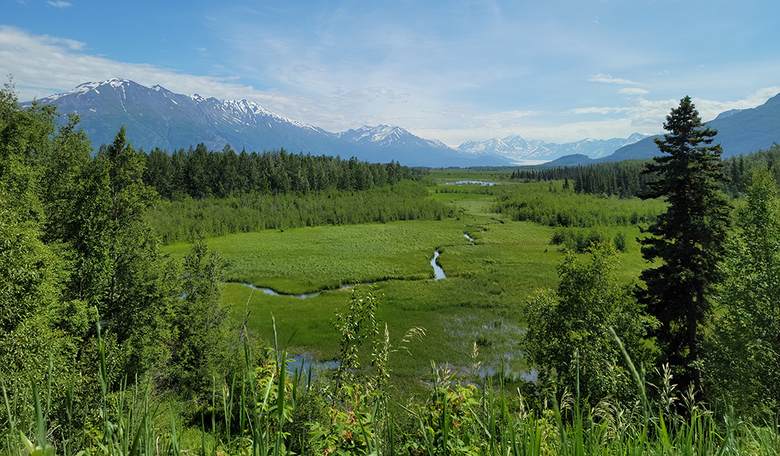
Alaska is a state with a lot of empty places. A major north-south route here in the Great Land is the George Parks Highway (Alaska Route 3), which runs from the Matanuska-Susitna town of Palmer north to Fairbanks. In fact, it's not just a major north-south route in this part of the state, it's the only north-south route in his part of the state, aside from a few side roads. The Parks Highway is also parallel to the Susitna Valley's electrical grid, which is basically a single line, also carrying electricity from the Anchorage area to Fairbanks.
As you might suspect, that's a rather concerning liability. I live along this route, and I can tell you, we lose power several times a year, sometimes for an hour, sometimes for a day, occasionally for longer.
The Department of Energy, under Energy Secretary Chris Wright, is kicking in to fix that.
Following August meetings with energy, military, mining, and other industrial leaders in Alaska, U.S. Secretary of Energy Chris Wright has unveiled plans for the federal government to contribute up to $150 million in Defense Production Act funding toward a second high-voltage connection between Southcentral and Interior Alaska.
"Supporting improvements to Alaska's transmission infrastructure with Defense Production Act funds reflects the Trump administration's commitment to strengthening national security, improving grid reliability, and lowering electricity costs," Wright said.
The approximately $418 million Beluga-Healy Transmission Project would involve the installation of roughly 223 miles of new 230-kilovolt transmission line between Beluga and Healy, providing a parallel pathway to move electricity along Alaska's Railbelt.
The Railbelt describes the rail line from Anchorage to Fairbanks, which runs more or less parallel to the Parks Highway.
The proposed line would run from the Beluga substation through West Susitna, where a new substation would be built, toward Willow and north to existing transmission infrastructure at Healy.
The project would also integrate with the Alaska Energy Authority's Cook Inlet PowerLink project being developed to improve transmission between the Kenai Peninsula and Anchorage.
Together, the upgrades are aimed at increasing the capacity, reliability, and redundancy of a largely linear Railbelt electrical system that serves roughly 75% of Alaska's population and five major military installations.
Note that last bit; there is actually a national security issue at hand here. From Joint Base Elmendorf-Richardson in Anchorage to Fort Wainwright in Fairbanks, Alaska's unique strategic position at the top of the Pacific makes it a place where there are and always will be a serious military presence, and those people and facilities depend on reliable electricity. Yes, the armed services have backups for when the grid goes down, as do many Alaskan residents, but it's preferable to have some redundancy in a system that doesn't resemble a grid so much as a thread.
During an Alaska mining and energy roundtable convened by (Energy Secretary) Wright, former International Tower Hill Mines CEO Karl Hanneman told the energy secretary that Alaska does not have an electrical grid so much as an "extension cord."
Unlike the highly interconnected and redundant grids serving much of the Lower 48, Alaska's Railbelt electrical system largely follows a single corridor between population centers, with limited pathways for moving power around disruptions or delivering electricity to major new loads.
"We have four military installations on the extension cord – that's a problem," Hanneman told Wright.
Alaska isn't like most other places; it's certainly not like the other 49 states. The very size of the Great Land makes projects like this daunting, but this strikes one as something that needs to be done, not only for national security reasons, but for the well-being of the residents of the state. And here's another thing: Since the federal government still owns about 60 percent of Alaska, then it stands to reason that it should kick in some to improve Alaskan infrastructure.
And, if the result is the power only going out once a year instead of three or four times, most Alaskans will count that as a win.