
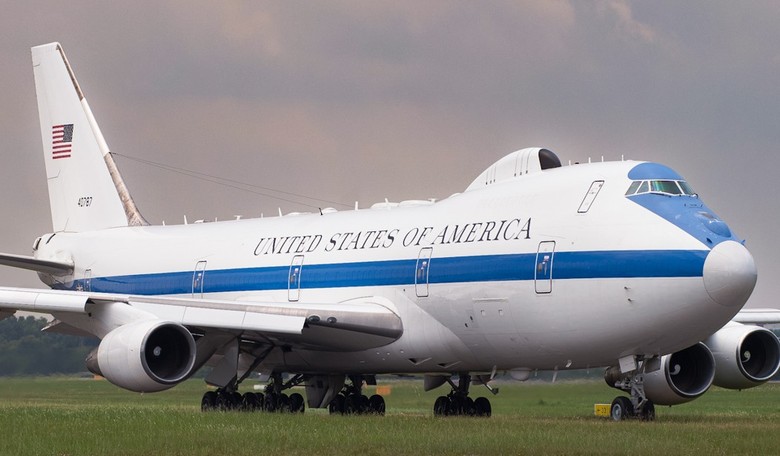
The unusual aircraft seen in Tulsa this week was not Air Force One, though it is understandable that many people made the connection. The E-4B Nightwatch is a modified Boeing 747, one of only four in the U.S. Air Force fleet. It exists for a grim but necessary purpose: keeping America’s national command structure functioning if a catastrophe takes out command centers on the ground.
That is a sobering mission for any airplane. It is also a reminder that serious national defense is not an abstraction. It depends on preparation, hardware, training, and people willing to plan for circumstances the rest of us hope never occur.
The E-4B serves as the National Airborne Operations Center. In a national emergency, the aircraft can provide the president, defense secretary, and Joint Chiefs of Staff with a secure, survivable location from which to communicate, direct U.S. forces, and coordinate with civilian authorities. It can refuel in flight, carries extensive communications equipment, and is maintained so that at least one aircraft can be ready around the clock.
A USAF E-4B and a US Navy E-6 Mercury are up and visible over continental USA this morning. Both are called “doomsday planes,” but both are also regularly seen in routine flights over the USA. Seeing them up is no cause for alarm, although some accounts will try to convince you it is. Just fyi: There is always a Navy E-6 up. 24/7/365. But, it is not always visible on radar.
— ꧁ C a r o l i n a ꧂ (@CarolinaOuest) September 28, 2026
There is nothing glamorous about why such a capability is needed. The E-4B is often called a "doomsday plane," a label that gets attention but can obscure the more important point. Its real value is not in drama. It is in continuity.
A responsible government does not wait until every phone line is dead, every computer network is damaged, and every building is inaccessible before asking how the country will be led. It builds redundancy beforehand. It prepares for the worst precisely so that panic, confusion, and opportunism do not control the response when the worst arrives.
The E-4B "Nightwatch" was seen in a training exercise at Tulsa International Airport Monday morning. Nightwatch, or the "Doomsday Plane," is the National Airborne Operations Center for the President in the event of a national emergency. Courtesy: Tulsa International Airport https://t.co/AJmj4mOKyz
— KOKH FOX 25 (@OKCFOX) September 28, 2026
That principle should not be controversial. A family keeps insurance without hoping for a fire. A city maintains emergency services without expecting disaster every morning. The federal government, entrusted with the defense of a nation of more than 300 million people, must do the same on a much larger scale.
The Nightwatch fleet is particularly notable because it is so small. The Air Force operates only four E-4Bs, all assigned to Offutt Air Force Base in Nebraska. One is kept on alert 24 hours a day, seven days a week, with a global watch team able to support its mission. This is not an excess of government duplication. It is a limited, specialized capability that reflects the reality that command and communication cannot be allowed to fail at the moment they matter most.
Navy ‘Doomsday Plane’ Fleet To Almost Double In Size With New E-130Js A much bigger fleet of smaller turboprop E-130Js is set to replace the smaller fleet of larger E-6B jets, but the Navy has also acknowledged risks. https://t.co/ooPfpJF4NH
— TWZ (@thewarzonewire) August 10, 2026
Seeing one of these aircraft in Tulsa also offers a quiet point of pride for the Midwest. Our part of America has long understood the importance of military readiness. From Tinker Air Force Base to the many Midwesterners who have served in uniform, defense is not merely a budget category here. It is a practical responsibility.
The E-4B is an aging aircraft, and the Air Force is preparing a successor known as the Survivable Airborne Operations Center. That modernization is warranted, but it requires predictable funding rather than the political games and delayed defense budgets that too often stall critical acquisitions in Washington. A credible deterrent requires more than good intentions and speeches; it demands dependable systems maintained and modernized on schedule.
The Nightwatch’s visit did not signal that a crisis was underway. It simply reminded Tulsa that preparedness is always underway. America is safer when its leaders can govern through a crisis, its military can receive lawful orders, and its adversaries understand that no single attack can leave the nation blind or leaderless.
That is not alarmism. It is the basic discipline of national security.