
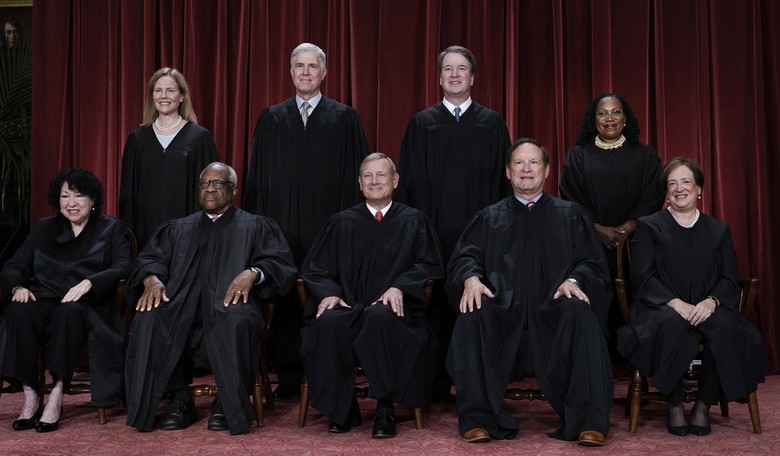
On Monday evening, the U.S. Supreme Court denied the Trump administration's emergency request to allow the U.S. Postal Service's (USPS) new ballot-mail rule to take effect for the 2026 elections.
The ruling leaves U.S. District Court Judge Indira Talwani's preliminary injunction in place and effectively means the rule will not govern the November midterms.
Ultimately, the Court found that the government is unlikely to succeed in challenging the injunction and that the equities don't support a stay.
In March, President Trump issued an executive order on election integrity that instructed the USPS to develop new safeguards for federal ballot mail. The USPS issued its final rule on the matter in late August.
The requirements of that rule include:
- special election-mail logo/scannable envelopes;
- a unique barcode for each voter;
- states must upload basic voter information to a USPS portal;
- USPS verifies compliance before mailing ballots to voters.
Additionally, the rule provides that noncompliant outgoing ballot mail would be rejected/returned to election officials for correction. Talwani preliminarily blocked implementation of that rule nationwide. (That doesn't necessarily run afoul of SCOTUS' CASA ruling, for those who might be wondering: CASA barred universal relief that extends beyond what's necessary to protect the plaintiffs, and Talwani concluded that nationwide relief was necessary to fully protect the plaintiff states and organizations here.)
The Court's denial of the application for stay was per curiam (the ruling was issued by the Court as a whole rather than attributed to a particular justice), but Justice Brett Kavanaugh authored a concurrence, agreeing with the denial of the stay, but it should be noted that he did not conclude that the USPS lacks authority to issue the rule. In fact, he says there's “at least a fair prospect” the rule falls within the USPS's statutory authority.
Kavanaugh's problem with the rule is timing: Implementing it for the 2026 elections would, in his view, be arbitrary and capricious under the Administrative Procedure Act (APA) because state/local election officials haven't been given sufficient time to implement the requirements reasonably. In other words, for Kavanaugh, this is effectively “not now,” rather than necessarily “not ever.”
Justice Samuel Alito penned a dissent in which Justice Clarence Thomas joined. Alito would have granted the application for stay because, in his view, the challengers face an especially difficult merits hurdle as the USPS generally isn't subject to APA review and their ultra vires theory is the kind of claim SCOTUS has called a “Hail Mary pass” that “rarely succeeds.”
Alito observes that the USPS has broad statutory authority to regulate collection, handling, and delivery of mail. And he takes the timing concern seriously but says the challengers and the courts helped create the problem through months of premature litigation and injunctions over the earlier presidential directive.
Whatever ultimately happens to the USPS' authority to impose the new requirements, one question is now effectively settled: They won't be in place for the 2026 midterms. The larger legal fight over whether the USPS may impose them with adequate lead time, however, isn't necessarily over.