
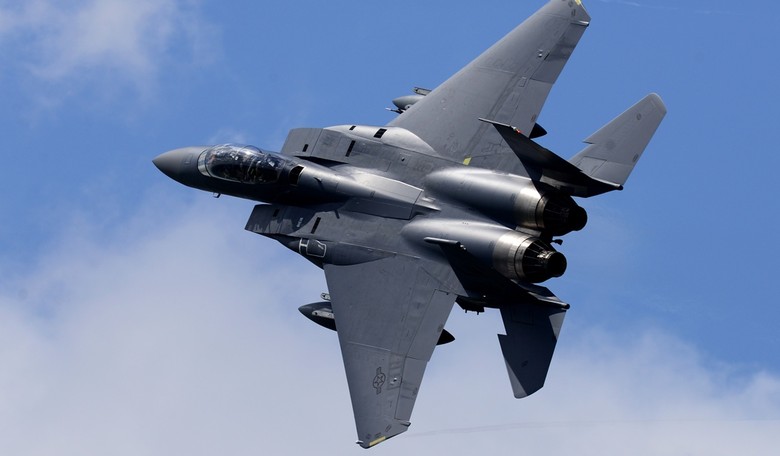
We're finally hearing from "Bravo," one of the two service members who were shot down over Iran during fighting in April.
Admiral Brad Cooper, the commander of U.S. Central Command, leading U.S. forces in the Middle East, told "60 Minutes" that the U.S. had flown "broadly 13,000 missions" by that point, and they had air superiority, but "we weren't flying over Kansas."
Then they spoke with "Bravo," the weapons systems operator, who shared with them his harrowing tale. He said their plane getting hit was "like getting hit by a freight train."
For the first time publicly, the U.S. Air Force officer who was shot down over Iran and stranded behind enemy lines for two days tells his story, only on 60 Minutes. pic.twitter.com/r1uiksAZvl
— 60 Minutes (@60Minutes) September 13, 2026
The pilot "Alpha" landed safely, but Bravo was lucky to be alive. His parachute had been damaged, and he ended up "free-falling."
After his parachute was damaged in an Iranian attack and didn’t fully open, the U.S. Air Force officer who was ejected from his fighter jet said “free-falling was a good way” to describe his descent. Military debriefers estimated he hit the ground at between 70 and 100 mph. pic.twitter.com/pNnR1LNDeL
— 60 Minutes (@60Minutes) September 13, 2026
"At one point when I looked up and saw no parachute, that was the most terrifying thing I've ever seen," Bravo said. "So I paused, right then, and I prayed, 'Lord, your will be done. But if I'm getting through this, I need help.'"
He said they estimated he hit between 70-100 mph; he called his survival "a modern-day miracle." "It's a testament to God's provision in my life to bring me through that moment in a way that didn't prevent injuries, but prevented any catastrophic injuries that would have affected my ability to survive," he believed.
He broke his back, an arm, and a shoulder. He also sprained an ankle and was bleeding from cuts and scrapes. But still, he moved as quickly as he could away from his landing spot, so as not to be caught by the Iranians.
After ejecting from a fighter jet shot down over Iran, U.S. Air Force officer Bravo broke his back, arm and shoulder upon impact with the ground. Badly injured and stranded in a valley surrounded by cliffs, he mustered the strength to climb a 7,000-foot ridgeline in order to… pic.twitter.com/Dn9NgUl47s
— 60 Minutes (@60Minutes) September 14, 2026
Alpha was rescued within six hours. But it took longer to find Bravo.
Bravo decided his best bet was going up, so, despite the injuries, he climbed up a 7,000-foot ridgeline. When asked how he did it, he replied with a great line: "Never let a lack of motivation put you on Iranian TV." He managed to avoid the Iranian searchers looking for him for two days.
The Iranian forces got within a few hundred meters of Bravo.
According to U.S. military sources, Iranians got within a few hundred meters of the U.S. Air Force officer, who was shot down and stranded in Iran earlier this year. https://t.co/7KfRc1L0jO pic.twitter.com/NhYpk3LEUg
— 60 Minutes (@60Minutes) September 14, 2026
Bravo communicated with U.S. forces, letting them know he was hurt but alive. "God is good," he messaged them.
Bravo, the U.S. Air Force weapon systems officer who was stranded behind enemy lines in Iran for two days, tells 60 Minutes about the first message he was able to send to the U.S.: “God is good.” https://t.co/xqTEaggw2A pic.twitter.com/z7cBfqCksI
— 60 Minutes (@60Minutes) September 14, 2026
The Central Intelligence Agency (CIA) was involved, helping throw Iran off with some deception and using technology to help pinpoint Bravo's location.
U.S. forces hit some of the Iranian Revolutionary Guard Corps (IRGC) who were nearby and then went in to get him, deploying about 92 people on the ground in the process, plus other supporting people in the air and on the operation. They were the first American boots on the ground in Iran in 46 years.
Newly declassified footage shows the events leading up to the rescue of Bravo, the U.S. Air Force officer who was shot down and survived behind enemy lines in Iran for two days. https://t.co/YUIzeTBpKt pic.twitter.com/0x2zDndgmC
— 60 Minutes (@60Minutes) September 14, 2026
The moment Bravo saw the elite forces coming to save him was "one of the greatest moments of my life."
“The moment a PJ showed up to me on that ridgeline was one of the greatest moments of my life,” says Bravo, the U.S. Air Force officer who was shot down and stranded behind enemy lines in Iran, referring to the pararescue specialists who picked him up. https://t.co/5ZAghyd0wG pic.twitter.com/53PeuvtgkV
— 60 Minutes (@60Minutes) September 14, 2026
Bravo thanked them for all that they did.
They still had to get out. The planes had trouble, with the landing gear getting stuck. So they had another clandestine unit come to get all the people out, and then they bombed the stuck aircraft so no technology would fall into Iranian hands.
Bravo was finally able to call his wife.
After two days behind enemy lines in Iran, Bravo, the rescued U.S. Air Force officer, was finally able to call his wife back home in the U.S. https://t.co/tp4MKk3pyo pic.twitter.com/XO67vaxyMK
— 60 Minutes (@60Minutes) September 14, 2026
Bravo explained what he wanted people to take away from all this.
"It's a story of the teamwork, the training, of the faith, of the decisions and the leadership to do something that will live in history as an example of what America's willing to do, in order to uphold our promise and leave no man behind."