
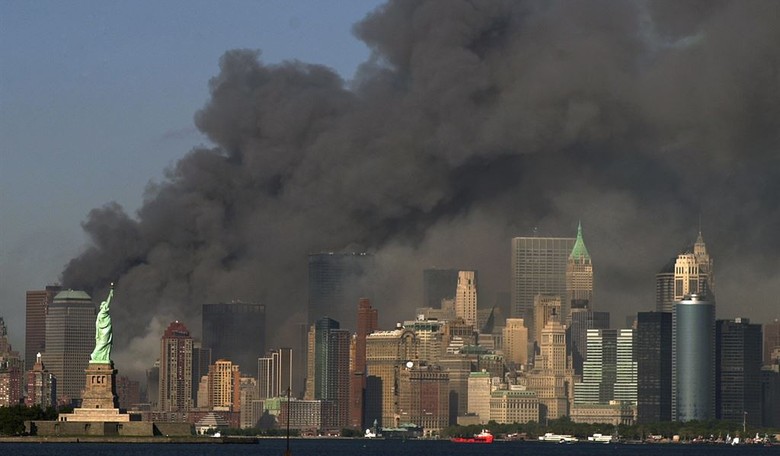
Like so many of us, I remember exactly where I was when the Twin Towers came down.
A few years earlier, when I was in my 20s, I was writing but needed to make a living. I discovered something more lucrative than waiting tables: temping. I would put on a suit and go to whatever job needed me, and it was fascinating — I worked for architects, insurance giants, accounting firms, and more.
The most prominent experience was when I worked for a time for a credit card company — high up in one of the Towers. I don’t remember which one or what floor we were on, but I took great pride in arriving each day at such an iconic place, taking one of the mind-blowingly fast elevators to the office, and thinking, “I work here.”
Watching those skyscrapers fall on TV is seared forever into my memory, just as it is for so many Americans.
In the following awful days and years, we’ve heard more about the heroic first responders and how bravely they acted in an unimaginable situation. I knew there had been a huge boatlift, but I admit to not fully remembering just how massive an operation it was until I came across this tweet the other day. It’s courtesy of Barnaby Breaks History, who bills himself as “Engineer by day, chasing history by night," and I’ve checked his facts.
They're not only correct, but they are also terrible and awe-inspiring at the same time:
🇺🇸 The Boatlift That Was Bigger Than Dunkirk
— Barnaby Breaks History 🇺🇸 (@BarnabyHistory) September 7, 2026
At 10:45 a.m. on September 11, 2001, a Coast Guard lieutenant named Mike Day keyed a radio in New York Harbor and said the only sentence that mattered.
“All available boats. This is the United States Coast Guard. Anyone wanting to… pic.twitter.com/u6UnWOtfWN
The Boatlift That Was Bigger Than Dunkirk
At 10:45 a.m. on September 11, 2001, a Coast Guard lieutenant named Mike Day keyed a radio in New York Harbor and said the only sentence that mattered.
“All available boats. This is the United States Coast Guard. Anyone wanting to help with the evacuation of Lower Manhattan, report to Governors Island.”
The boats were already coming.
Imagine: not only were people in Lower Manhattan dealing with a mass terror event with chaos and smoke all around them, but they had nowhere to go. The bridges and tunnels were closed, and the subways were dead. No one knew if more attacks were coming, and there were rumors of bombs in the subways.
So American heroes showed the spirit of the nation:
On 9/11, roughly 800 mariners on about 150 vessels moved as many as 500,000 civilians off Manhattan in about nine hours. Ferries. Tugs. Dinner boats. Pilot boats. Yachts. A retired fireboat. Rubber dinghies that held two people. The largest water evacuation in history.
U.S. Coast Guard Lieutenant Mike Day commences the waterborne evacuation from Manhattan aboard any available craft.
— 2001 Live (@25YearsAgoLive) September 11, 2026
It’s an immense operation, and its scale will eclipse Dunkirk - but it has to be done. pic.twitter.com/2JMXBkOlXG
One of the best-known sea evacuations in history was pulled off in 1940 during WWII when Allied soldiers saved hundreds of thousands of soldiers from the oncoming Nazis by extracting them from the French port of Dunkirk by boat. The legendary operation rescued over 330,000 soldiers, took nine days to pull off, and was a major turning point in the war.
The 9/11 escape was larger and was accomplished in about nine hours.
Read the full story of how they pulled it off here, courtesy of Barnaby Breaks History. Thank you for highlighting such a powerful moment, Barnaby.
Evil made its appearance that day — in the form of radical Islamic terrorism; let’s not ever forget that — but the good outweighed it all. We saw astonishing acts of heroism from NYFD firefighters and NYPD officers, selfless passengers aboard United Airlines Flight 93, and regular people just trying to help each other through the living nightmare.
And boat captains. Barnaby sums it up beautifully:
In raw numbers it was bigger than Dunkirk. No boat went down. By nightfall the southern tip of Manhattan had been emptied by people who were not on anyone’s list of heroes when the morning started.
They were tug captains. Ferry deckhands. Pilots. A lieutenant with a microphone. Ordinary boats answering one sentence.
All available boats.
True heroes.