
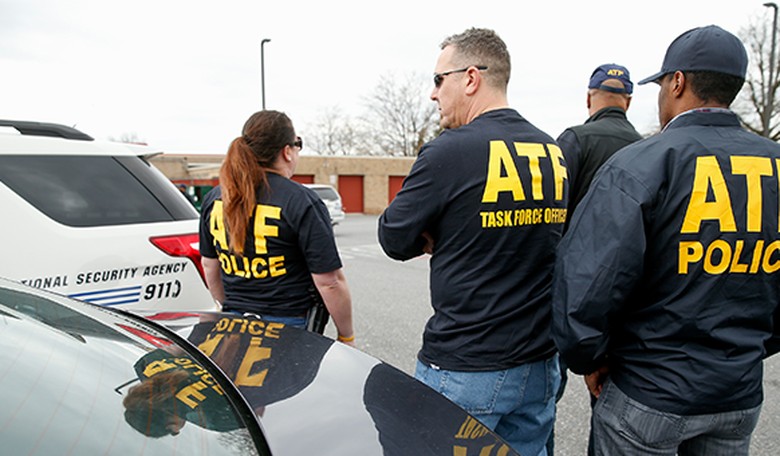
President Trump acted on Friday to remedy a series of wrongs committed by a weaponized Bureau of Alcohol, Tobacco, Firearms and Explosives (ATF) employed by the lawless Biden administration to send a message that if you disagreed with ATF's bureaucratic interpretation of rules allegedly enforcing federal law, you faced a long-term in prison.
President Trump's pardon to former Navy sailor Patrick “Tate” Adamiak wiped away a 20-year sentence resulting from what gun-rights groups labeled an ATF show trial over inert replicas. Also included in the pardon were three other National Firearms Act defendants: George Peterson of Louisiana and Shane Cox and Jeremy Kettler of Kansas.
The most egregious case was that of 31-year-old Adamiak. Adamiak was an active-duty E-6 serving in a master-at-arms billet, that is, the Navy equivalent of a military policeman, when he was arrested. The entire trial was a crap show of lies and bad faith on the part of the government.
Using evidence from an informant who was trying to avoid substantial jail time, federal agents raided Adamiak's home in Virginia Beach, Virginia.
Agents found cut-up and demilled parts kits, including PPSh-41-style kits sold to the informant; inert and DEWAT RPG-7 launchers and M79/M203-related items; a Denix non-firing STEN replica; pre-ban open-bolt semi-auto MAC-style pistols and carbines; two IMI Uzi carbines with display barrels; and several unfinished MAC “flats,” which are sheet-metal pieces.
Adamiak was charged with five counts, including receiving or possessing an unregistered firearm and transferring a machine gun tied to the PPSh-41 parts, plus three counts of receiving or possessing unregistered destructive devices involving an M79, an M203, and two RPGs. The jury convicted him on all five.
Sentencing stacked 10 years consecutive on the two machine-gun counts and ran the destructive-device counts concurrently, producing 20 years plus three years of supervised release. Prosecutors originally sought enhancements that would have pushed the range toward 30 years or life by treating hundreds of MAC flats as machine guns.
There were no operational firearms found. All of the parts he bought were legal to buy. In the hands of a rogue ATF, the replica arms were all treated as functional weapons. Adamiak was charged with multiple charges of machine gun possession after his parts were fitted to other parts he did not have, to form a working gun. The fraud perpetrated upon the United States to hang a conviction on an innocent man beggars the imagination.
[Jeffrey R. Bodell, an ATF Firearms Enforcement Officer] inserted a real STEN action and a real STEN barrel into Adamiak’s toy submachinegun and got it to fire one round, even though the toy’s receiver wouldn’t accept a real STEN magazine. Bodell actually classified the toy, which are [sic] very popular, as a machinegun.
“I examined the large black item in the photograph there. It’s marketed as a replica submachine gun, specifically a Sten Mk II, which was a World War II British submachine gun. My examination of that, I found it to be both a firearm under the Gun Control Act and a machine gun,” Bodell told the jury.
Bodell fired five of Adamiak’s very expensive and extremely collectible legal semi-auto handguns, which fire from an open bolt. All the ATF technician could achieve was semi-auto fire, but he still classified all five highly sought after firearms as machineguns.
“They did not shoot automatically, and they weren’t converted to shoot automatically, but they are machine guns because they’re designed to shoot automatically,” Bodell told the jury.
Bodell ruled that several receivers that had been cut in half were actually machineguns. The same parts are still legally sold online and do not require an FFL or any paperwork.
The worst thing Bodell told the court were his misconceptions about two inert RPGs, which Adamiak bought years earlier at an outdoor fair in California.
Bodell took the inert rocket launchers to the ATF’s lab and added missing fire-control components including a firing pin from a functional RPG from the ATF’s collection. Bodell also added a sub-caliber training device that resembles a warhead, which can fire 7.62x39mm rounds on its own without even loading it into an RPG.
When the subcaliber components fired a live round, Bodell classified the RPGs as rocket launchers.
The ATF still employs Bodell.
Adamiak has served over three years in prison on totally fabricated charges. In a just society, everyone who touched the prosecution side of this case, including the judge, would be serving out the remaining 17 years of that sentence.
Three other men were also pardoned.
George Peterson, a Louisiana federal firearms license holder, was convicted in a suppressor-registration case that his lawyers treated as a Bruen challenge to the NFA tax-and-paperwork scheme. On Jan. 9, 2024, he was sentenced to 24 months in prison and 3 years of supervised release. It was painful, but in the long run his legal case prevailed. Congress removed the tax on silencers in the One Big Beautiful Bill and, thanks to the Silencer Shop Foundation v. ATF (N.D. Tex. No. 6:25-cv-056, consolidated with Jensen v. ATF), federal registration of silencers was made illegal in most of the country. Since then, the Fifth Circuit has stomped the ATF rule that makes a suppressor a firearm; see The 5th Circuit Just Lit the Fuse on the Next Big Second Amendment Fight – RedState. In August, the ATF let the window for opposing the injunction close without filing an appeal; see 'No Feds Allowed': DOJ Let the Clock Run Out – Then Gun Owners Made 2A History at 12:01 AM – RedState.
Shane Cox and Jeremy Kettler were convicted in 2016 after relying on Kansas’s 2013 Second Amendment Protection Act, which purported to put in-state-made firearms and accessories beyond federal reach. Cox was found guilty on eight counts of illegally making and marketing firearms; Kettler on one count of possessing an unregistered silencer. Both received probation. Federal courts held the Supremacy Clause trumped the state statute and that an older Kansas suppressor ban had not been cleaned up when SAPA passed. The Kansas Senate later urged a presidential pardon, arguing the men followed a law the Legislature itself had written.
There has been a lot of criticism of President Trump's use of the pardon power.
President Trump issued 30 clemency grants on Thursday, including to a drug dealer-turned-business executive, a longtime Philadelphia union boss convicted of bribery and a former Navy sailor imprisoned for firearms offenses.
The clemency grants were confirmed by White House officials and representatives for the recipients.
They went to an eclectic group, continuing Mr. Trump’s unpredictable and unorthodox use of pardons that wipe away most consequences of convictions and commutations, which cut short sentences.
While other presidents have drawn criticism for using clemency to reward supporters or protect allies, Mr. Trump has taken it to a new level. His use of clemency has spawned a cottage industry of lawyers and lobbyists offering to use their connections to bring cases to his attention in exchange for hefty fees.
Thursday’s beneficiaries included some prominent figures. But the pardons also encompassed lower-profile people who were facing long sentences and lacked obvious connections to the president or his allies.
The pardon power is how the brute force of justice is tempered and civilized. Saint Thomas Aquinas wrote, “Justice without mercy is cruelty; mercy without justice is dissolution.” The mercy extended by the nation's Chief Magistrate is remarkably different than weak and corrupt judges who release felons to go on to murder.
In this case, President Trump was able to bolster gun rights while clearing three men who should never have been indicted in the first place. In the case of Adamiak, he righted an evil conspiracy to rob a man of most of his life to curry favor with political bosses. I hope vengeance is coming for everyone involved in that grotesque miscarriage of justice.