
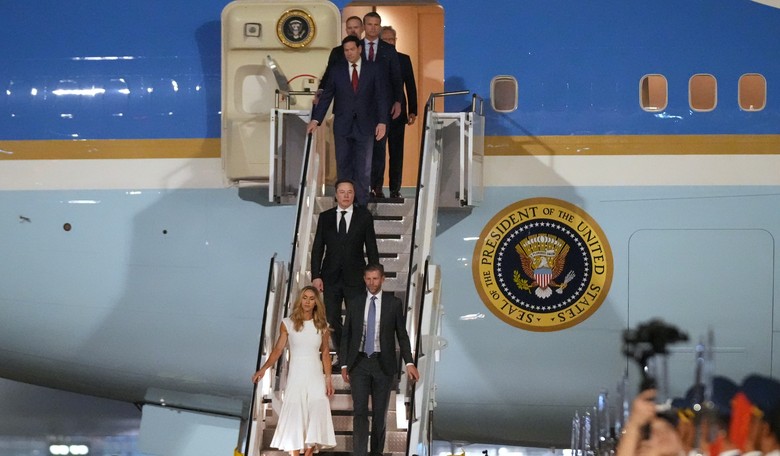
The news about Nvidia CEO Jensen Huang's relationship with tech executive Alice Huang, a Chinese national whose Singapore-based company, Megaspeed, is suspected of diverting embargoed Nvidia chips to Beijing, just keeps coming. The latest: "People with knowledge of the matter" tell the New York Times that President Donald Trump was "reminded" while "aboard Air Force One in May en route to China," just prior to a stop in Alaska at which Jensen Huang would be joining the group, "that the United States had obtained sensitive intelligence showing that Nvidia’s chief executive was in a relationship with a woman believed to be a Chinese spy," and, despite that alleged reminder, still allowed Mr. Huang to join him.
I was in the pool on that trip to China. Here are my pics from the refuel in Alaska where Jensen Huang boarded Air Force One. He flew via his private jet to Anchorage to join the trip https://t.co/z28zZuHrK7
— Emily Goodin (@Emilylgoodin) November 10, 2026
According to the Times, this contradicts Trump's claims that he didn't know about Mr. Huang's relationship with Alice Huang when he was headed to Beijing. What Trump said, though, was, “No, I didn’t hear about it then." When he was asked whether he'd received a briefing on the issue "last year," Trump said, "I’d certainly check with the intelligence people. They could have been mentioned. Certainly, it didn’t make much of an impact on me.”
Which is actually pretty close to what the "people with knowledge of the matter" reportedly said to the Times. It was reported late last week that Secretary of State Marco Rubio drafted a memo this spring, prior to the trip, and the Times reports that it "was circulated to a small number of top administration officials. It was not intended for Mr. Trump, according to one person with knowledge of the matter, and it was not shown to him aboard Air Force One."
Mr. Huang wasn't initially invited to be part of the group of tech leaders traveling to China with Trump, a fact that had caused a bit of a stir. So, the Times reports:
With little warning, Mr. Trump invited Mr. Huang to meet up with Air Force One during a refueling stop in Alaska. Mr. Rubio was among more than a dozen administration officials on Air Force One for the trip.
A U.S. government official, who spoke on the condition of anonymity because they were not authorized to discuss the matter publicly, confirmed that when Mr. Rubio learned that Mr. Huang would be joining the trip in Alaska, he “briefed the president on the issue.”
Mr. Trump was not particularly moved by what he heard from his national security adviser, and continued with the plan to pick up Mr. Huang, the people with knowledge of the events said.
Now, if Rubio's memo, drafted only a few weeks prior, was only circulated to a small number of administration officials and not intended for Trump, how could he have been "reminded" about the intelligence developed regarding the relationship between Mr. Huang and the Megaspeed executive, and that it was believed that Alice Huang was a Chinese asset?
Once aboard Air Force One, Mr. Huang saw Trump briefly, then "remained in the separate part of the plane for almost all of the trip,” the source told the Times. When the Times reports that their source said Trump "was not particularly moved by what he heard," what does that mean? What did he say? Or is that simply the source's interpretation of Trump's facial expression? What type of media firestorm would have been caused if Trump then suddenly changed gears and uninvited Mr. Huang, leaving him stranded on an Alaskan runway? We know that Mr. Huang wasn't given a defensive briefing the way former Rep. Eric Swalwell was when he got involved with Christine Fang; if Trump had decided after Secretary Rubio said whatever he said aboard Air Force One to leave Mr. Huang behind, would that have tipped off the Chinese? Or, if the reason Mr. Huang wasn't given a defensive briefing was because U.S. officials thought he might be part of the plot, would a sudden change-of-plans have tipped him off? Just a few things to consider.
While this most recent New York Times piece on the issue seems to be an attempt at constructing a narrative shifting blame to Trump, and really a nothingburger, overall, this is a massive story, and the extramarital affair only plays a role to the extent that it possibly kept Mr. Huang from having Nvidia look closely at what Megaspeed was doing with Nvidia chips and ensuring there were no diversions into China.
It might seem that the story was conveniently timed after the midterm election to help Democrats who might want to heavily regulate the industry (and data centers), but the Commerce Department investigation into Megaspeed started in 2024, continued once the Trump administration took over, then moved to the Justice Department late last year. It wasn't a secret, either. The New York Times published an expose in October 2025 reporting on Commerce's investigation into Megaspeed, the company's questionable origin story, and its links to China, and the Times, the Wall Street Journal, Bloomberg, and others have published multiple stories about the investigation and the problem of what appear to be shell companies receiving clearance to purchase Nvidia's advanced A.I. chips and possibly diverting them to China.
If that is happening, it's a major national security issue that needs to be fully investigated and resolved, regardless of any political fallout.
Megaspeed was founded on September 28, 2023, just weeks before the Commerce Department's Bureau of Industry and Security (BIS) issued updated semiconductor export controls designed to close several loopholes in the rules that went into effect a year prior. Based in Singapore, it spun off from China-based 7Road, a gaming company, and quickly set up a subsidiary in Malaysia "that quickly snapped up nearly $2 billion worth of Nvidia’s most advanced products." Ms. Huang, a former television news anchor for Chinese state-run media who had no experience in the tech industry, was a founding director. According to the Times expose:
It is not clear where Megaspeed’s billions of dollars came from to buy chips. But a few weeks after the gathering in Taipei last year, Megaspeed began receiving a steady supply of multimillion dollar shipments of some of Nvidia’s most advanced chips, according to Malaysian trade records.
Those purchases would have been illegal under U.S. law if Megaspeed were still a Chinese subsidiary. But Nvidia had determined that Megaspeed was a Singaporean company, said a person close to the company’s compliance division, and believed it was a newcomer to the cloud-computing industry that would compete for business against U.S. companies. Megaspeed, Nvidia officials said, did not raise any red flags.
It's also been reported that advanced Nvidia chips were sold to Chinese firms with empty offices and possible ties to the Chinese government, and that the Commerce Department had "approved those companies to handle Nvidia’s H200 chips, some of which have ties to firms under sanctions over national security," and that Commerce's investigation into Megaspeed was taken over by the Justice Department after Nvidia general counsel Tim Teter emailed agents at BIS asking about their investigation into Megaspeed and informing them that Under Secretary Jeff Kessler had given him the okay to reach out.