
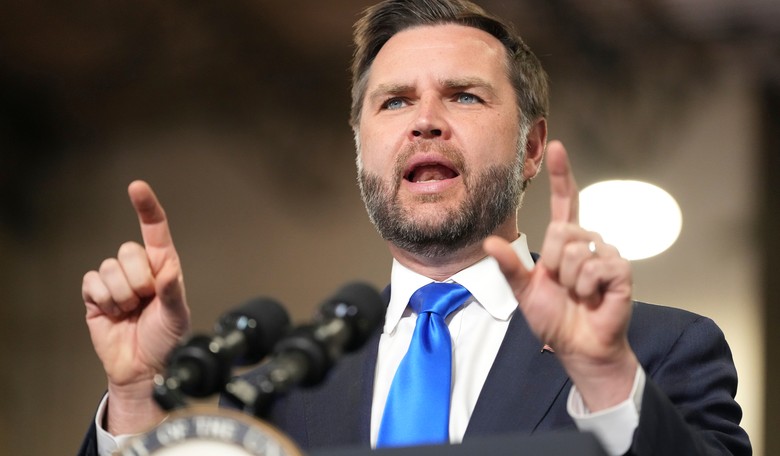
Immediately after the votes were counted, the great battle to blame the culprit for the 2026 Republican “thumping” began. Vice President JD Vance was the first out of the gate. Echoing Tucker Carlson, Vance claimed:
The top four answers (for why the disaster), accounting for nearly all of the responses were: 1) End the war 2) Focus on cost of living/inflation 3) Put America First 4) Change our relationship to Israel.
Vance’s dovish argument implicitly 1) blames Israel and its allies, many of whom are American Jews, for persuading/tricking/forcing President Donald Trump to attack Iran, which 2) spiked inflation and 3) caused the blue tsunami.
Full disclosure – as an American Jew who is pro-Israel and a hawk on Iran, I personally don’t care for this argument. But let’s evaluate it objectively and rationally. Are the three elements of this entire argument actually true?
Did Israel and its allies persuade/trick/force Donald Trump to go to war against Iran?
A huge problem with this contention is Donald Trump's known prejudice against the Iranian regime. Trump has a long history of despising them, beginning in 1979, when they seized U.S. Embassy personnel, an act of war. Since that year, the Iranian regime has killed and wounded thousands of Americans, directly or indirectly through its proxies. Also acts of war. They have targeted prominent Americans for assassination, including Trump. Also acts of war.
Sam Nunberg, who worked for Donald Trump for many years, has himself attested (to me) that Trump hates the Iranian regime with a passion.
The president is also well-known to be an emotional guy who can easily develop grudges. He rarely forgives unless the opponent tries to make amends. Iran plotting to kill him multiple times, including once before his second term, does not strike me as indicating that they were trying to make amends.
Another thing that undermines this claim is that not only Vance, but Donald Trump Jr., also strongly opposes the Iran war, and they have from the very beginning. These two are clearly valued by the president. Are we to believe that Israeli Prime Minister Benjamin Netanyahu, Secretary of State Marco Rubio, conservative commentator Mark Levin, Israeli-American philanthropist Miriam Adelson, former Bush speechwriter Marc Thiessen, or the late Sen. Lindsey Graham (R-SC) were more persuasive to President Trump than are his own son, his running mate, and their allies? Not likely. That is, unless we consider that Trump has his own strongly held view to the contrary of the doves.
Overall, this part of the vice president’s argument strikes me as patently false.
Did the Iran war cause the spike in inflation and gas prices?
Certainly, the Iran war is a cause of the spike in inflation and gas prices. It has restricted the amount of oil and trade to the rest of the world. But there are other factors that contribute or could even be the main cause.
Redstate’s own Shipwreckedcrew points to another conflict that is adding to the problem:
The "Iran War" simply became a vessel into which a lot of other complaints could be poured even though their connection to war was tenuous. Fertilizer and diesel prices are impacted more by the Ukraine War than Iran, and those two huge drivers if continuing high prices in stores.
The BBC finds that of the two conflicts, the Iran War is slightly predominant:
The figures suggest the conflict with Iran has had a greater impact on the global drop in diesel export volumes than the Ukraine war. Exports from Russia are down around 670,000 barrels a day compared with a fall of around 810,000 from the Middle East.
Then, there are the tariffs. President Trump is a throwback to the original Republican Party presidents, who favored a strong tariff to protect American industries. Tariffs can cause inflation. A paper from the New York Federal Reserve claims:
The cost of many everyday items would have declined last year and early this year without President Donald Trump’s tariffs… The cost of 67 categories of goods was 2.9 percentage points higher as of February thanks to tariffs... Without the levies, the team found that prices for the products they studied would have pulled back by almost 1%.
A rise in federal government spending can also boost inflation. As the Federal Reserve Bank of St. Louis writes, “An increase in government purchases might drive up the cost of production. In turn, this would drive up inflation.” In 2024, under the Biden administration, the U.S. federal government spent $6.8 trillion. In 2025, the government spent $7.04 trillion. In 2026, the government has spent $7.40 trillion.
Therefore, it is a vast simplification to say that the Iran war, by itself, was the cause of the rise in inflation. At best, the Iran war might be the largest single component of the rising inflation, but almost certainly not the majority. But at worst, it might be far less than the impact of the tariffs.
Was the Iran war the driving force behind the blue tsunami?
Vance does not name the pollster whom he cites. That pollster is reportedly Mark Mitchell, the biased former (and allegedly fired) head pollster of Rasmussen Reports. However, a more legitimate number cruncher in the dovish camp, conservative commentator Ryan Girdusky, also feels this way. He references a Democrat data guy named David Shor, who has been objective in the past. Washington Examiner chief political correspondent Byron York, summarizing Shor's argument, noted that the “war elevated a run-of-the-mill loss into a historic defeat.” Shor wrote:
And there was a giant structural shift in public opinion. His approval ratings on the cost of living plummeted. To put some numbers on this, the day before the Iran war, Donald Trump had a 49 percent approval rating on gas prices. Within a week, it was 33 percent.
But other polls contradict this. Atlas’ polls had the Democrats ahead by 16 percent in Dec 2025, before the war. The RCP average also does not support this inference. Further, a ranking of about 50 polls and surveys on the midterms, from national polling averages to state-level exit polls, showed Iran was not the leading issue - it followed government corruption, cost of living (granted, this may include the war’s effect on gas prices), and immigration. Also, the Fox exit poll showed that the Democrats were the voters most infuriated by the war.
Of course, the exit polls are only of the voters who showed up and don’t include the nonvoters who are part of the GOP coalition. But remember, the GOP had good turnout for a midterm election. They lost primarily because the Democrats had supercharged turnout, and independents swung against them. The vice president was simply wrong when he claimed that “Our voters showed up. And the above four reasons are why many of them voted for Democrats.”
Vance also ignores any political impact from the tariffs. The conservative pollster and media consultant I spoke to, Rick Shaftan, strongly felt that tariffs were the main problem. And National Review's Dan McLaughlin has written:
In 183 polls taken between “liberation day” 2025 and the start of the Iran war, Trump’s approval on the economy averaged 41.5 percent approval and 54.5 percent disapproval. And things were not recovering…Trump suffered a net 24.5 point decline on the economy between Election Day 2018 and the start of the Iran war.
This is most easily seen in a chart measuring Trump’s economic approval during the tariff implementation “Liberation Day” and during the Iran war, which has been circulating on the internet.
Here's a simpler, more truthful, and more accurate data-based explanation of what happened, Che D. https://t.co/jOI8EaE7WA
— Phil Magness (@PhilWMagness) November 4, 2026
Another chart breaks down the tariffs’ negative impact for each state.
This same poll (the AP 2026 Voter Poll) has granular data in 45 states. Every state polled had more voters say tariffs hurt their local economy than helped, by a minimum gap of 19 pts and a median gap of 46 pts. Swing states also had large gaps (TX+44, OH+47, MI+50, IA+47). https://t.co/wcLbLfeXUq
— Andrew Lautz (@andrew_lautz) November 5, 2026
I can also tell you, historically speaking, voters in the Midwest, the West, and the South have long had a dislike of tariffs. Tariffs by earlier Republicans sometimes led to huge voter revolts against the GOP, including in 1890, when William McKinley’s large tariff also cost him his own House seat.
This last part of the argument is the hardest to judge, as there are contradictory points of view from experts on both sides. Nonetheless, it still strikes me that this is another simplification to claim that the Iran war by itself was the main cause of the blue tsunami.
Conclusion: Jennifer Van Laar, RedState’s own Managing Editor, has said that the vice president’s argument is “simplistic.” I will go further – it is mostly wrong and biased. I also find it to be incredibly disloyal to his own president.
Part 3 on The Aftermath is Coming…