
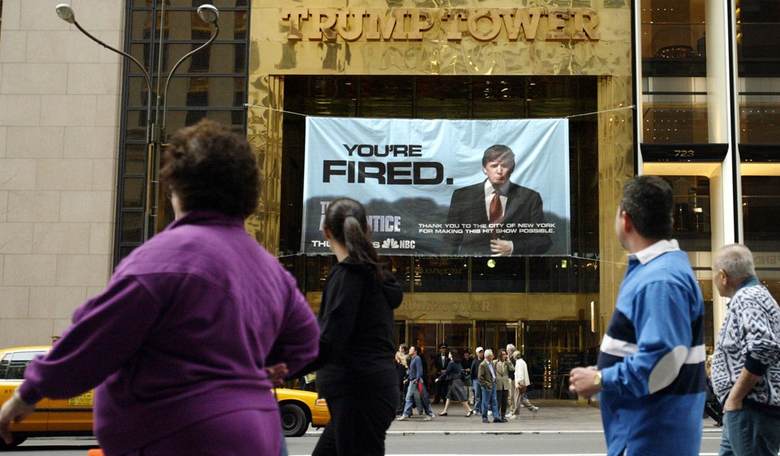
If anyone knows how to fire people, it's President Donald Trump. But the boardroom is a much different setting than the Oval Office, and thanks to a rather unusual statutory arrangement, his administration has discovered that getting rid of one particular federal official isn't nearly as straightforward as it might seem.
Especially when Trump has already fired most of the people whose approval he needs to do it.
That's essentially the predicament facing the Trump administration following a Tuesday ruling from the U.S. Court of Appeals for the D.C. Circuit involving Voice of America (VOA) Director Michael Abramowitz.
In Abramowitz v. Lake, a three-judge panel — Chief Judge Sri Srinivasan (Obama), Judge Cornelia Pillard (Obama), and Judge Florence Pan (Biden) — unanimously upheld a permanent injunction barring the administration from removing Abramowitz without approval from the International Broadcasting Advisory Board (IBAB).
And therein lies the rub.
You see, when President Donald Trump returned to office in January 2025, he dismissed six of the Board's seven members — and those seats remain vacant.
So why does that matter? Because Congress specifically gave that Board the final say over who gets hired and fired as head of VOA and five other federally funded international broadcasting networks overseen by the U.S. Agency for Global Media (USAGM).
That arrangement dates to reforms enacted in 2021, following controversy over the dismissal of several network leaders by then-USAGM chief Michael Pack. Lawmakers from both parties had raised concerns that those actions jeopardized the broadcasters' independence. Congress responded by strengthening the Board's oversight authority, including requiring its approval before network directors could be removed.
Fast-forward to summer 2025, when USAGM officials, including then-Senior Advisor Kari Lake, attempted to reassign Abramowitz to a management position in Greenville, North Carolina. He declined, and the agency informed him he'd been removed.
But there was one problem with that: no Board (IBAB) approval.
Abramowitz sued, and the district court blocked his removal. The administration appealed, arguing that the lawsuit belonged in the federal civil-service system and, more significantly, that Congress's removal restrictions violated the president's constitutional authority.
Judge Pillard, writing for the unanimous appellate panel, rejected both arguments.
First, the court explained that this wasn't an ordinary employment dispute. Congress designed the special removal procedures to safeguard VOA's journalistic independence, not simply protect an individual employee's job.
But then there's the more consequential constitutional question.
Under Article II, the president exercises authority over executive-branch officials. But Congress also has constitutional power to determine how certain lower-ranking federal officers are appointed — and, under the court's reasoning, removed.
The administration conceded that it hadn't followed the statute. Its argument was that the statute itself was unconstitutional. But the D.C. Circuit disagreed, reasoning that the president retains ultimate control because he can remove Board members, who in turn possess authority to remove network directors.
In other words, having presidential authority doesn't necessarily mean the president gets to bypass every step Congress has established.
The panel also addressed the Supreme Court's recent decision in Trump v. Slaughter, which reinforced broad presidential removal authority over principal officers. It concluded that the VOA arrangement preserves presidential oversight even under that framework.
Of course, the tricky part here is that exercising that authority may require appointing new Board members and obtaining Senate confirmation — hardly an instantaneous process, and hardly a given in the current political dynamic.
So that's where the administration's earlier decision to dismiss most of the Board becomes especially consequential, and we find ourselves with an administrative Catch-22.
Now, Tuesday's ruling doesn't make Abramowitz untouchable or resolve the broader/separate litigation over VOA's operations. It simply requires the administration to follow the statutory removal process — easier said than done at this point.
Whether SCOTUS ultimately agrees with the D.C. Circuit's understanding of presidential authority remains to be seen.
But the decision offers another intriguing peek at the ongoing separation-of-powers debate: Congress established the rules for removing VOA's leadership. The executive challenged those rules. And, unless/until there's a contrary ruling from the full circuit and/or SCOTUS, the courts are insisting they be followed.
So, it turns out that firing someone isn't always as simple as saying, "You're fired." Even when — or maybe especially because — you're the President.