
It's not every day that a federal appeals court hands down two decisions involving the same controversy, on the same day, with the same three judges reaching the same 2-1 split. But that's exactly what happened on Tuesday when the 9th Circuit delivered a pair of rulings concerning federal officers' use of tear gas and other crowd-control weapons during protests outside an Immigration and Customs Enforcement (ICE) facility in Portland, Oregon.
Both decisions favor the Trump administration. Both overturn preliminary injunctions issued by federal district judges. And both raise significant questions about the constitutional limits of government conduct — and judicial intervention.
But there's an interesting twist: One of the rulings relies heavily on the Supreme Court's landmark abortion decision in Dobbs v. Jackson Women's Health Organization. Yes, Dobbs. Bear with me here.
Two Lawsuits, Two Constitutional Questions
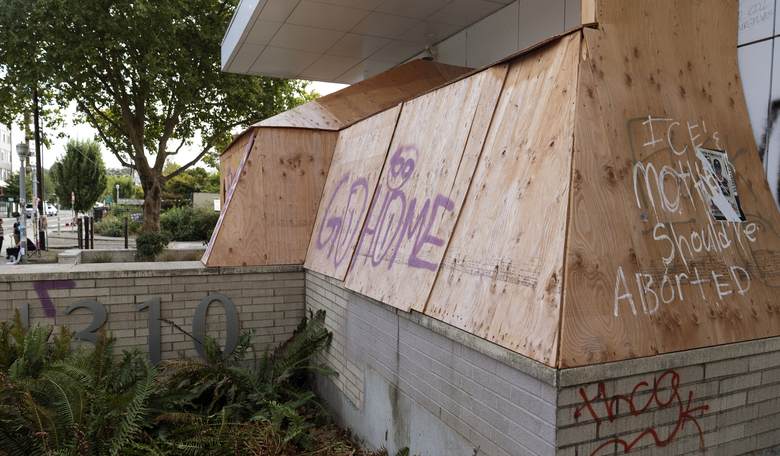
The litigation stems from months of demonstrations outside Portland's ICE facility, where protesters have gathered to oppose federal immigration enforcement. Some have protested peacefully. Others, according to the appellate opinions (and some of our own reporting here at RedState), have assaulted federal officers, vandalized property, blocked access to the facility, and thrown objects at law enforcement.
As one might expect, federal officers responded on numerous occasions with tear gas, pepper balls, and other chemical agents.
This, in turn, led to two separate lawsuits.
In Reach Community Development v. DHS, residents of Gray's Landing, an apartment complex across the street from the facility, alleged that chemical agents repeatedly drifted into their homes, affecting people who weren't necessarily participating in the demonstrations. A federal district judge (Amy Baggio) granted a preliminary injunction restricting the use of those agents.
Meanwhile, in Dickinson v. Trump, protesters and independent journalists alleged that officers were deliberately targeting them for exercising their First Amendment rights. A different district judge (Michael Simon) issued a separate injunction restricting federal officers' use of crowd-control weapons and even directing the parties to work out changes to identifying markings on their uniforms.
The 9th Circuit initially stayed both injunctions. On Tuesday, it vacated them altogether.
The Unexpected Dobbs Connection
In Reach, Judge Eric Tung (Trump), joined by Judge Kenneth Lee (Trump), concluded that the apartment residents hadn't established a likelihood of success on their Fifth Amendment substantive due process claim.
Momentary detour into the legal weeds: Substantive due process is one of those legal doctrines that sounds considerably more complicated than its basic premise, which is that certain fundamental liberties are constitutionally protected even when they aren't expressly spelled out in the document. But determining which liberties qualify is where things get tricky.
And in case you're wondering how a landmark abortion decision comes into play here, in Dobbs, the Supreme Court emphasized that recognizing an unwritten constitutional right generally requires examining whether that right is deeply rooted in American history and tradition. Tung applied that reasoning to the Portland residents' claim.
The plaintiffs argued that the government's conduct was so egregious it violated the constitutional standard prohibiting executive actions that "shock the conscience." But the majority held that wasn't enough. To prevail under their substantive due process theory, the residents needed to establish both that the government's conduct shocked the conscience and that it deprived them of a historically rooted constitutional liberty.
The majority concluded that no such right had been established against incidental exposure to chemical agents deployed during disruptive demonstrations.
One thing to note: The court didn't decide whether the officers' actions actually shocked the conscience. It found the constitutional claim deficient without reaching that question.
And Then There's the First Amendment
The second decision, Dickinson, involved a different constitutional protection: the right to protest and report on government activity without retaliation.
Writing for the same 2-1 majority, Judge Lee concluded that the plaintiffs hadn't sufficiently demonstrated that federal officers targeted them because of their protected expression, which is an important distinction — an officer's use of force may be excessive or unjustified without necessarily establishing that the officer acted in retaliation for someone's speech.
The panel also emphasized that law enforcement need not wait until someone poses an imminent threat of physical injury before dispersing a crowd. Serious disorder, criminal trespassing, and obstruction of law enforcement can also warrant intervention.
But the district court's injunction imposed broader restrictions, limiting the use of certain crowd-control weapons to situations involving imminent physical harm. The appellate panel rejected that approach.
It also found that the lower court had overstepped by extending relief too broadly, provisionally certifying a class of protesters and journalists without satisfying the requirements for class actions, and attempting to dictate how federal officers' uniforms should be marked.
Lee summed up that last point with a memorable observation:
Courts cannot be the couture of the executive branch.
In other words, judges may enforce constitutional limitations, but that doesn't give them unlimited authority to manage the day-to-day operations of federal law enforcement.
One Judge Was Not on Board
Judge Ana de Alba (Biden) dissented in both cases, although she agreed that parts of the Dickinson injunction were too broad.
In Reach, she disputed the majority's insistence on a historical-rights inquiry, arguing that claims challenging executive misconduct can be evaluated under the shocks-the-conscience standard without necessarily requiring that additional showing.
She also recounted troubling evidence concerning chemical agents allegedly deployed far from the facility, sometimes after crowds had dispersed, causing injuries to nearby residents. Her dissent raised allegations that some deployments may even have been intended to generate social media content, though the appellate majority did not adopt findings that officers deployed chemical agents for that purpose.
In Dickinson, de Alba argued that the record supported the district court's findings of retaliatory conduct. She would have preserved the prohibition against firing munitions at people's heads, necks, or torsos absent justification for deadly force, while agreeing that other restrictions went too far.
The Bigger Picture
Neither decision establishes that every use of tear gas or other force by federal officers was lawful. Nor do the rulings eliminate every potential constitutional claim arising from the Portland protests.
What they do establish is that these particular preliminary injunctions cannot stand. And together, they illustrate two important constitutional boundaries.
In Reach, the majority insisted that courts cannot recognize new substantive due process rights without the required historical foundation.
In Dickinson, the majority emphasized that even when courts are protecting established constitutional rights, their remedies must remain within the limits of judicial authority.
So, in a rather fascinating illustration, the same three judges confronted two different sets of plaintiffs, two different constitutional theories, and two different injunctions, and in both cases, the majority concluded that the district courts had gone too far.
Whether the plaintiffs seek further review remains to be seen. But the rulings add another layer to an increasingly consequential debate over the respective lanes of the executive and judicial branches.