
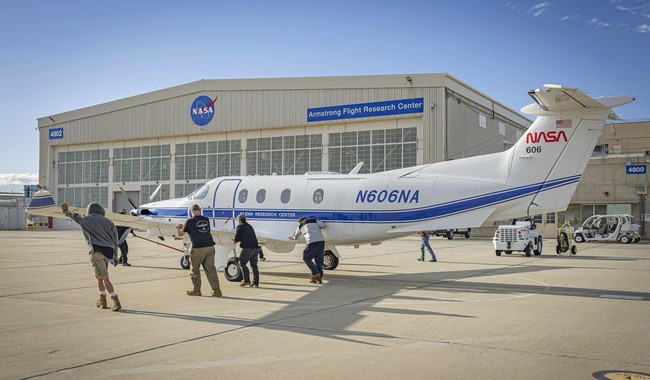
A NASA turboprop was in the air on October 21 when researchers caught individual particles of light. They sent photons over a quantum link between the plane and a ground station, which NASA describes as a first in the United States.
Glenn announced the result November 4 in a three-post thread. The agency sees aircraft eventually becoming part of quantum networks and says those networks could carry everything from quantum information to ordinary communications. The last post gives the result from the flight itself.
We’re taking quantum communications to new heights! ✈️ Late last month, @NASA researchers made history when they successfully sent tiny light particles, or photons, between an aircraft and a ground station over a quantum channel, the first time this has been achieved in the U.S. (1/3)
— NASA's Glenn Research Center (@NASAglenn) November 4, 2026
@NASA @NASAArmstrong @NASAAmes @NASAaero On Oct. 21, the team successfully locked onto a quantum signal and recorded data in flight, taking a major first step toward incorporating airborne systems in nationwide quantum networks. (3/3) https://t.co/xwto9qDePx
— NASA's Glenn Research Center (@NASAglenn) November 4, 2026
Did the team come away with an encryption key? Glenn’s announcement leaves that open.
A key has to stay secret. Quantum key distribution works like a tamper-evident seal, because trying to read the photons in transit can disturb them. The researchers can set aside some of their measurements and compare them for errors before using the rest. If the error rate is too high, they can start over.
The ground station near Munich was about 12 miles from the Dornier 228 when it received the light. The German researchers had mounted the transmitter on the aircraft, and they published the result in 2013.
For the Canadian test, the part meant for a satellite was the receiver. That went on the aircraft, which gave the researchers a way to see how fast they could get a ground signal to moving equipment. On some passes, it took less than 10 seconds after they sent the plane’s position. The connection lasted a few minutes. Their 2017 paper reports how many secure keys they made in that time.
“[W]e generated secure keys up to 868 kb in length.”
I ran into the same problem of keeping a beam on target in August, when I covered the Brookhaven experiment. The team sent light from a hospital rooftop at Stony Brook to a camera 13 miles away. The researchers had to correct for what the air did to the beam over those miles, using mirrors that could shift as the light moved. Stony Brook and Brookhaven could work with a fixed line between the rooftops. A plane keeps changing where the beam needs to go.
NASA had already used lasers to send ordinary data to and from aircraft. Glenn logged more than 50 hours with a live connection in those tests, using a Twin Otter as well as the PC-12. At 60 kilometers (about 37 miles), the equipment could still move data at gigabit-class speeds.
Glenn hasn’t said how far the October link reached or how long it lasted, but the direction is clear. President Trump said in his June 22 order that “America stands at the cusp of a quantum revolution,” and a quantum link to a moving plane is the kind of result that push is meant to produce.